





 France
 Japan
Japan Singapore
 United Arab Emirates
 United Kingdom























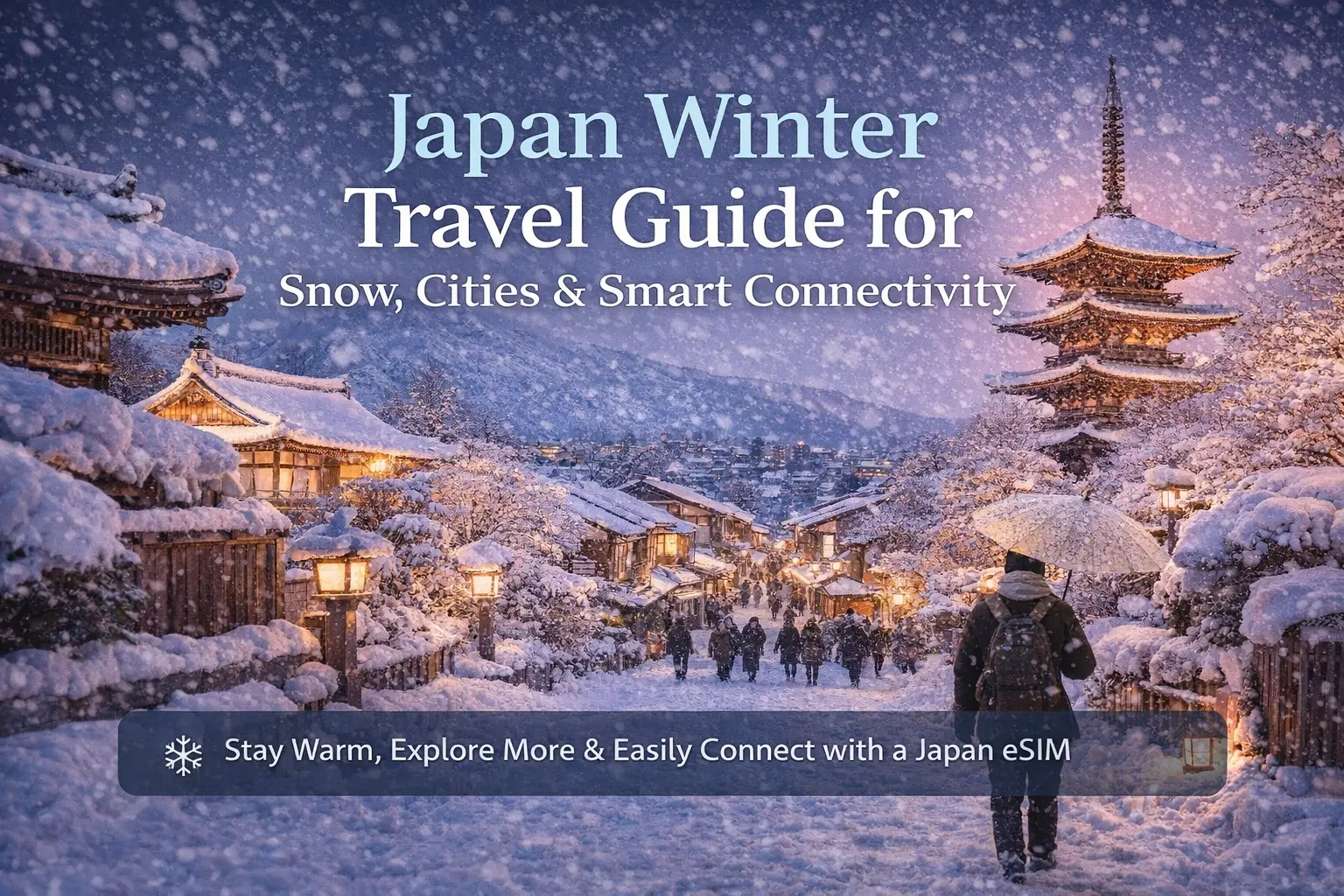
Japan Winter Travel Guide for Snow, Cities & Smart Connectivity
Planning a Winter Trip to Japan? Start Here.
Japan in winter is unforgettable—steaming onsens under falling snow, neon-lit city streets glowing against crisp night skies, and some of the best powder snow on Earth. But winter travel here also comes with real challenges: snow-delayed trains, sub-zero temperatures, shorter daylight hours, and a constant need for navigation and translation on the go.
This Japan winter travel guide shows you where to go, what winter is really like across different regions, and how to stay connected with a Japan eSIM, so your trip stays magical instead of stressful.
Quick tip: Winter travel in Japan means heavy reliance on maps, train apps, and translation tools.
Setting up aJapan eSIM before you arrive saves time, money, and stress—especially in snowy regions.
[View Japan eSIM plans] shows how similar planning principles apply in very different climates.
Understanding Japan’s Winter: When, Where, and What to Expect
Japan’s winter usually runs from early December to early March, but the experience varies dramatically depending on where you go. In Hokkaido, the snow season often starts in late November and can last into April, with Sapporo seeing average January highs around -1°C and lows near -7°C. By contrast, Tokyo’s winter is relatively mild, with daytime temperatures around 8–12°C in January and only occasional light snow that may not stick. This means your Japan winter travel guide needs to treat the country like several climates in one, especially if you’re combining snowy mountains with city breaks.
In my experience, first-time visitors often underestimate just how dry and windy it can be on the Sea of Japan side. Cities like Kanazawa and Niigata can feel much colder than the thermometer suggests because of humidity and wind chill, especially when you’re waiting on outdoor platforms for trains. Meanwhile, popular ski regions such as Hakuba in Nagano and Niseko in Hokkaido regularly receive several meters of snow per season, which is incredible for skiing but can complicate driving and local bus schedules. Understanding these regional differences helps you pack smarter and plan more realistic travel times between destinations.
Another nuance is daylight. In mid-winter, sunset in Tokyo is around 4:30–5:00 p.m., and in Sapporo it can feel dark even earlier because of cloud cover and snow. This affects how much you can comfortably fit into a day, particularly if you’re relying on public transport and walking. I often recommend travelers front-load outdoor activities—like temple visits in Kyoto or snowshoeing in Hokkaido—into the morning and early afternoon, then save museums, shopping, and onsen visits for after dark. With a solid handle on when and where winter hits hardest, you can start building a Japan winter itinerary that actually works on the ground.
Finally, winter also intersects with some of Japan’s busiest travel periods, especially New Year (around December 29 to January 3) when many locals travel to visit family. Trains sell out, some restaurants close, and certain attractions shorten hours. If your Japan winter cities travel plans fall over this period, booking shinkansen seats and key accommodations several weeks in advance is essential. It’s also a time when having reliable Japan mobile data for travel makes a big difference, because you’ll rely heavily on real-time train apps and translation tools when backup options are limited.
Best Japan Winter Cities: Urban Lights, Food, and Easy Day Trips
One of the joys of winter in Japan is seeing cities transform. Tokyo, Kyoto, Osaka, and Sapporo each take on a distinct cold-season personality, from light festivals to steaming street food stalls.
A smart Japan winter itinerary often anchors around two or three cities, with snow destinations added as side trips. This keeps logistics manageable while still delivering a true winter experience.
Tokyo
Winter in Tokyo is crisp and bright, with many clear blue-sky days. Neighborhoods like Shinjuku, Shibuya, Roppongi, and Marunouchi host winter illuminations from late November through early January. Cold weather also makes comfort food—ramen, oden, and hot pots—especially satisfying.
Navigating Tokyo’s massive stations is much easier with live maps and transit apps. Having a Japan eSIM for tourists active means you can find the right exit at places like Shinjuku Station without wandering the underground in freezing temperatures.
Kyoto & Osaka
Kyoto is quieter in winter than during peak autumn, which is a major advantage. A light dusting of snow on temples like Kinkakuji or Kiyomizudera feels almost surreal. Traditional accommodations can be drafty, so I always check reviews for heating before booking.
Osaka shines as a winter food base, with easy rail connections to Nara and Kobe. Dotonbori’s neon reflections on wet winter streets paired with takoyaki and kushikatsu make it a great stop for food-focused travelers.
Sapporo
Sapporo is the crown jewel of Japan winter cities travel. The Sapporo Snow Festival in early February fills Odori Park and Susukino with massive snow and ice sculptures. Temperatures often drop below -10°C at night, but the rewards—miso ramen, local beer, and nearby ski areas—are worth it.
Top Snow Destinations: Ski Resorts, Onsen Towns, and Scenic Routes
For many travelers, the whole point of a Japan winter trip is the snow. Japan is famous for its light, dry “Japow” powder, and regions like Hokkaido and Nagano deliver incredibly consistent snowfall. Niseko, on Hokkaido’s western side, regularly records over 10 meters of snow per season and has become a global ski hub, with English-friendly rentals, lessons, and après-ski. However, this popularity means higher prices and more crowds, especially around Christmas, New Year, and Chinese New Year. In my experience, visiting Niseko in late January or early February gives the best balance of deep snow and slightly thinner crowds, though you still need to book early.
If you prefer something a bit more low-key, consider Furano or Asahikawa in central Hokkaido. Furano’s ski area offers wide, scenic runs and a more local feel, while Asahikawa is a practical base for exploring several smaller resorts by bus. On Honshu, the main island, the Hakuba Valley in Nagano is another classic choice, with multiple interconnected resorts and frequent shuttle buses. You can reach Hakuba in about 3 hours from Tokyo by bullet train to Nagano Station and then a bus, making it ideal for a 3–4 day ski add-on to a city-focused itinerary. This is where having stable Japan mobile data for travel really matters, because bus timetables can change during heavy snow and English signage is limited outside main hubs.
Not every snow traveler wants to ski, though. Onsen towns like Nozawa Onsen (Nagano) and Zao Onsen (Yamagata) combine walkable streets, traditional ryokan, and steaming outdoor baths with snowy backdrops. In Nozawa, you can wander between free public baths called soto-yu, each with its own character, and watch locals steam vegetables in hot spring water in the central cooking area. Zao is famous for its “snow monsters”—trees coated in rime ice that look otherworldly at night when illuminated. Both towns are reachable by train plus bus, and both reward travelers who are comfortable using digital tools to navigate rural routes and check weather conditions.
One underrated snow experience is simply riding local trains along the Sea of Japan coast in winter. Routes around Niigata or between Kanazawa and Toyama can offer stunning views of waves crashing against snowy shores. However, heavy snow can cause delays or cancellations, especially on smaller lines. Having a Japan eSIM for tourists lets you monitor JR East and JR West apps for service updates, translate station announcements, and quickly rebook accommodations if needed. The combination of real-time information and a flexible mindset turns what could be a stressful disruption into just another story from your Japan winter travel guide.
Smart Connectivity in Winter: Japan eSIM, Coverage & Data Strategy
Connectivity is more than a convenience on a winter trip; it’s a safety net. When it’s -5°C, you really don’t want to be standing outside a closed café hunting for Wi‑Fi just to load a map. This is where choosing the best eSIM for Japan winter travel becomes a genuinely practical decision, not just a tech upgrade. With an eSIM, you can land, switch on data at the airport, and immediately see if your train is delayed by snow, message your accommodation, or pull up the platform map for Tokyo Station without queuing for a SIM card kiosk.
Most Japan eSIM plans for tourists, including those offered through EasyAlo, connect you to major networks like NTT Docomo, au (KDDI), or SoftBank, which have extensive coverage across cities, shinkansen lines, and major ski regions. In my own trips, I’ve found coverage surprisingly solid even in smaller onsen towns, though speeds can drop in very remote valleys or inside older ryokan with thick walls. That’s normal for any mobile network. The key is to choose a plan with enough data for your actual usage: for a 10-day winter trip using Google Maps, translation apps, social media, and some video calls, I typically budget 1–1.5 GB per day. That means a 15 GB plan is comfortable, while a heavy streamer might want 20–30 GB.
One smart move is to install your eSIM profile at home over Wi‑Fi before you fly, then activate it when you land by turning on data roaming for that eSIM only. This way you’re not trying to scan QR codes in a crowded airport with jet lag. If you’ve used EasyAlo for destinations like Italy or France before—maybe grabbing one of their France eSIM data plans for a European trip—the process will feel familiar: scan QR, add plan, set it as your data line, and keep your home SIM active only for calls or SMS. The same approach works seamlessly in Japan, and it’s particularly helpful when you need to show mobile QR tickets for shinkansen or ski passes while wearing gloves and juggling luggage.
Another connectivity tip that matters more in winter: always download key offline content as backup. Even with strong coverage, tunnels, mountain valleys, or temporary outages during storms can interrupt service. I always download offline maps for Tokyo, Kyoto, Sapporo, and any ski region I’m visiting in Google Maps, plus offline translations for Japanese in Google Translate. This way, if I’m walking through a blizzard in Niseko and my signal drops for a few minutes, I still have my blue dot on a cached map. Combining a robust Japan eSIM for tourists with sensible offline prep gives you resilience, not just speed.
Using eSIM in Japan During Winter: Practical, Step-by-Step Advice
Let’s get specific about how to use eSIM in Japan for tourists, especially in winter conditions. First, check that your phone is both eSIM-compatible and unlocked. Most recent iPhones (XS and newer), Google Pixel devices, and many Samsung Galaxy models support eSIM. You can usually confirm by going to your phone’s settings and looking for an option like “Add eSIM” or “Add mobile plan.” If you’ve previously used an eSIM in another country—say, when traveling with an Italy eSIM for local data—you’re almost certainly good to go for Japan as well.
Once you’ve purchased your Japan eSIM plan, you’ll receive installation instructions and usually a QR code. Install the eSIM profile while you have stable Wi‑Fi at home or at your departure airport. During setup, label it something clear like “Japan Data” so you can distinguish it from your home line. In your mobile settings, set the Japan eSIM as the default for mobile data, but keep your home SIM as the default for calls if you still need to receive SMS codes from your bank or airline. This dual-SIM setup is especially useful when you’re dealing with winter flight changes or train cancellations and need to verify things quickly.
When your plane lands in Japan, turn off data roaming on your home SIM to avoid accidental roaming charges, then enable data on your Japan eSIM. Within a minute or two, your phone should connect to a local network. I always test the connection by loading a simple website, then immediately check my train route from the airport into the city. In winter, this is when you might discover that heavy snow has disrupted certain lines; having data from the moment you land gives you time to adjust plans, contact your hotel, or rebook an airport bus before everyone else crowds the ticket counters.
During your trip, keep an eye on data usage in your phone settings. Many Japan eSIM plans for tourists are generous, but winter travelers often use more data than they expect because they’re checking weather radar, live train statuses, and translation apps more frequently. If you’re working remotely as a digital nomad, factor in video calls too. For those considering a longer stay, some of the tips from EasyAlo’s broader about eSIM overview—like managing multiple regional plans or topping up efficiently—can help you stretch your budget while keeping your connection reliable.
How to Use an eSIM in Japan (Winter-Friendly Setup)
-
Confirm your phone is eSIM-compatible and unlocked
-
Install the eSIM before flying, using home Wi-Fi
-
Label it clearly (e.g., “Japan Data”)
-
On arrival, turn off roaming on your home SIM and activate the Japan eSIM
I also recommend downloading offline maps and translations as backup for tunnels or remote valleys. Combined with an eSIM, this gives you both speed and resilience.
Japan Winter Itinerary Planning: Combining Snow, Cities, and Transit
Designing a Japan winter city break with snow destinations can feel overwhelming at first, but a few proven patterns make it much easier. A classic 10–12 day route looks like this: 3–4 nights in Tokyo, 3–4 nights in a snow destination (Hakuba, Nozawa, Niseko, or Zao), and 3–4 nights in Kyoto/Osaka. This structure gives you time to adjust to the time zone in Tokyo, dive into winter sports or onsen culture in the middle, and then slow down with temples and food in Kansai before flying home from Osaka or back through Tokyo. With the shinkansen, Tokyo to Nagano is about 90 minutes, and Tokyo to Kyoto is around 2 hours and 15 minutes, making these transitions very manageable if you plan ahead.
When building your Japan winter travel guide in practice, I recommend anchoring your fixed bookings around the snow segment, since ski accommodations and onsen ryokan often sell out first. Once you have those dates locked, fill in the city stays before and after. Pay close attention to transfer days: for example, getting from Niseko back to Tokyo typically involves a bus or train to Sapporo or New Chitose Airport, then a domestic flight, and finally a train into central Tokyo. In winter, each leg is vulnerable to weather delays, so avoid scheduling tight connections or non-refundable activities on the same day.
Rail passes can still be useful in winter, but not always. The nationwide Japan Rail Pass has become more expensive in recent years, so it’s worth comparing point-to-point fares using tools like HyperDia or Japan Travel by Navitime. Sometimes, regional passes—like the JR East Nagano Niigata Area Pass—offer better value if your Japan winter cities travel is focused on a specific region. Whatever you choose, having constant access to mobile data lets you check platform changes, reserve seats on the go, and react quickly if snow disrupts services. I’ve had trips where a sudden blizzard forced JR to suspend some lines, and being able to instantly see alternative routes and book a business hotel near a different station made the difference between a cold, stressful night and a manageable detour.
If you’re adding other countries to your winter escape, it’s also possible to chain multiple eSIMs together. For example, some travelers spend a week skiing in Japan, then fly down to Southeast Asia for warmth, using an EasyAlo Singapore eSIM plan as their base for city hopping. The same principles apply: install profiles in advance, activate on arrival, and keep your home SIM’s data switched off. Thinking about connectivity as part of your itinerary planning—not an afterthought—reduces friction and lets you focus on the actual experiences, like that perfect onsen soak while snow falls quietly outside.
Essential Winter Packing, Safety, and On-the-Ground Smart Tips
Winter packing for Japan is a balancing act between staying warm outside and not overheating indoors. Trains, department stores, and restaurants are often heated to 22–25°C, so wearing a heavy sweater under a thick coat can make you sweat the moment you step inside. I’ve found that a base layer (like Uniqlo Heattech), a mid-layer fleece or light sweater, and a good windproof outer shell works better than bulky parkas, especially in cities like Tokyo and Kyoto. For Hokkaido or ski resorts, you’ll want proper winter boots with good grip, waterproof gloves, a hat, and a neck gaiter or scarf; icy sidewalks around Sapporo in February are no joke.
One counterintuitive tip: bring a small microfiber towel and a lightweight pair of sandals or flip-flops. Many onsen and some traditional accommodations have wet floors in changing areas, and you’ll appreciate having your own quick-drying towel and indoor footwear, especially when it’s freezing outside. Hand warmers (kairo) are widely sold at convenience stores like 7‑Eleven and Lawson for about 50–100 yen each and can be lifesavers on long outdoor days. I usually throw a couple in my pockets before heading out to festivals or night illuminations. For electronics, consider a small dry bag or zippered pouch to protect your phone from slush and snow when you’re pulling it in and out for maps and photos.
Safety-wise, Japan is generally very safe, but winter introduces some specific risks. Slippery stairs at train stations, icy side streets, and deep ditches hidden under snow in rural areas can all cause falls. Walk slowly, especially in Hokkaido where locals often wear spikes or special soles in winter. If you’re driving, check whether your rental car is equipped with winter tires and chains, and avoid night driving in heavy snow unless you’re very confident. It’s also smart to keep copies of your key travel documents—passport, insurance, rail pass—in cloud storage or email, which is easy to access as long as your Japan eSIM for tourists is active and you have data.
Finally, think about how you’ll handle common winter annoyances like missed connections or sudden closures. If a snowstorm shuts down a ski lift or a train line, having the ability to quickly search for alternative bus routes, check hotel availability, or find an open restaurant nearby can turn a potential disaster into just a detour. Some of the mindset and planning tips in EasyAlo’s warm‑weather piece on Mexico winter sun travel actually apply here too: build in buffer time, stay flexible, and lean on your connectivity tools when plans shift unexpectedly.
Conclusion: Build a Winter Trip That Actually Works in Real Life
Japan in winter is one of those rare travel experiences that can feel both cinematic and deeply comfortable: snow falling on temple roofs, neon reflecting off wet city streets, and the shock of cold air when you step out of a steaming onsen. But the difference between a dream trip and a frustrating one often comes down to details—choosing the right mix of cities and snow destinations, understanding how weather affects transit, packing for multiple climates, and staying online when you need information the most. A thoughtful Japan winter travel guide doesn’t just list places; it helps you connect the dots in a way that matches your energy level, budget, and appetite for adventure.
If you remember nothing else, focus on three pillars: realistic itinerary planning, weather-appropriate gear, and reliable connectivity. Build your route around a few key hubs like Tokyo, Sapporo, and Kyoto with a snow base in between, check historical weather for your dates, and give yourself buffer time during transfers in case snow disrupts trains or flights. Then, set up a Japan eSIM for tourists before you fly so that maps, translations, and real-time updates are always in your pocket, even when you’re standing on a dark, snowy platform or trying to find your ryokan down a narrow lane.
In my experience, travelers who invest a little extra thought into these foundations enjoy their trips more and stress less when things inevitably go off script. Japan rewards curiosity and flexibility, especially in winter, when a sudden snowfall can turn an ordinary day into something special. With the right preparation—and a smart connectivity setup—you’ll be free to focus on the good stuff: that first glimpse of snow monsters in Zao, the quiet of a Kyoto temple garden after a flurry, or the taste of hot ramen after a long, cold walk. That’s the real heart of a Japan winter trip, and it’s absolutely worth planning for.