





 South Korea
 Thailand
 United Arab Emirates





























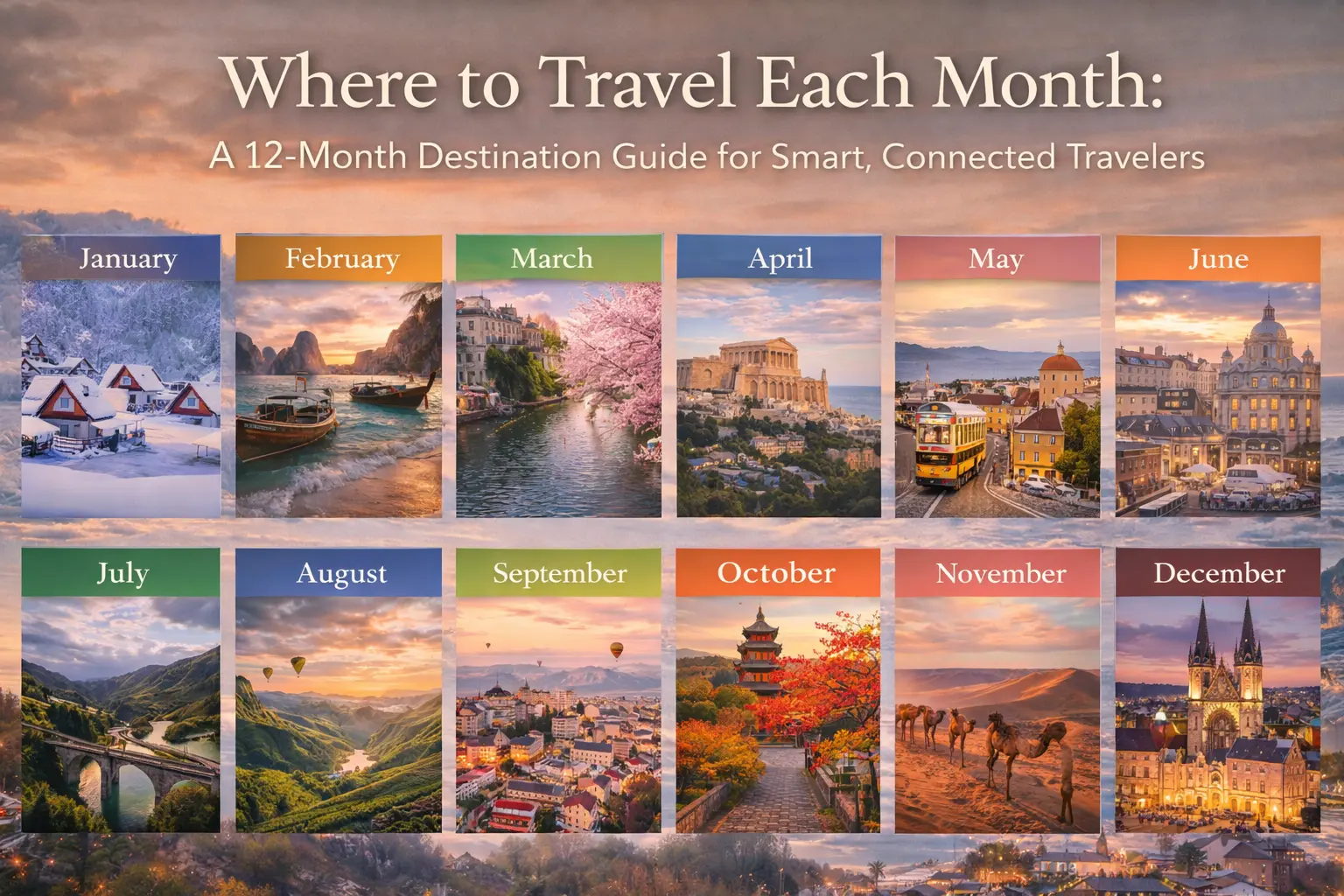
Where to Travel Each Month: A 12‑Month Destination Guide for Smart, Connected Travelers
If you’ve ever stared at your calendar wondering not just when you can travel, but where it actually makes sense to go, you’re not alone. The best places to visit each month change dramatically with weather, crowds, and flight prices, and getting that mix wrong can turn a dream trip into a slog of closed attractions and stormy skies. In this guide, we’ll walk through a full 12‑month plan so you can match destinations to seasons, find shoulder‑season sweet spots, and stay connected the whole way with reliable eSIM data. We’ll also point you to useful resources like EasyAlo’s about eSIM overview so you can understand exactly how to keep your phone online without paying painful roaming fees.
Instead of a random list of countries, you’ll get a practical framework: where to travel each month with reliable mobile data, how to think about summer vs winter travel planning, and how digital nomads can chain regions together for a smooth year on the road. Along the way, I’ll share real scenarios from my own trips—like landing late at night in a new city and needing maps immediately—plus specific connectivity tips for each season. Use this as your master roadmap, then later you can dive deeper into focused guides like “best places to visit in February” or “where to go in shoulder season” for more detail.
Why planning the best places to visit each month actually matters
Most people start by picking a destination and then squeezing it into their available vacation dates. In my experience, flipping that logic—choosing the best places to visit each month first, then matching your time off—saves money, avoids weather disasters, and makes connectivity planning much easier. For example, visiting Japan in August can mean brutal humidity and typhoons, while timing it for February or March lets you lean into winter festivals or early blossoms instead. EasyAlo even has dedicated resources like a Japan winter travel guide for snow and cities that only really make sense if you’re thinking seasonally.
Seasonal planning also affects how well your tools work on the ground. In peak summer in Europe, for instance, café Wi‑Fi is often overloaded and slow because everyone is streaming and uploading; in shoulder season, the same network can feel twice as fast. If you’re relying on cloud backups or video calls, that difference is huge. When you build a 12‑month travel route, you can prioritize destinations where mobile networks are strong during your travel window and where an eSIM gives you stable LTE or 5G even when the hotel Wi‑Fi is weak.
Another hidden benefit is cost. Airline pricing data consistently shows that flying into or out of major hubs like London, Istanbul, or Singapore can be 20–40% cheaper outside peak months. If you map your year so that you hit Europe in late spring and early autumn, Southeast Asia in the northern winter, and maybe South America when North Americans are back at work in September, you’re stacking the odds in your favor. You can then layer in regional eSIMs or country‑specific plans to keep data costs predictable instead of jumping between expensive short‑term roaming packages.
Finally, thinking month by month makes it easier to build a realistic packing and tech setup. When you know you’ll be in cold destinations for December and January and warm places from March onward, you can avoid lugging unnecessary gear and focus on a core kit. That includes your connectivity setup: one unlocked phone, a couple of backup offline map apps, and pre‑purchased eSIM QR codes stored safely in your email or password manager. This kind of intentional planning is what separates a chaotic year of travel from one that feels surprisingly smooth.
January–March: Winter sun, snow trips, and early‑year shoulder seasons
The first quarter of the year is where smart travelers can really shine. Instead of just escaping to the nearest beach, you can combine winter festivals, great skiing, and early‑season warmth in a way that makes the most of flight prices and data coverage. When people search for the best places to visit in January or the best places to visit in February, they’re often split between snow and sun, and the reality is that you can often do both with the right routing. For example, I’ve done a February loop that started with snow in Hokkaido and ended on a beach in Thailand without spending more than eight hours in transit between each leg.
In January, classic winter destinations like Hokkaido in Japan, the Alps in France and Italy, or Banff in Canada are at their prime. If you’re leaning into snow, look at cities with strong winter infrastructure and reliable networks. Sapporo, for instance, has excellent 4G and growing 5G coverage, which matters when temperatures drop below freezing and you don’t want to be wandering around trying to find your hotel. EasyAlo has deep dives like the Hokkaido powder snow travel guide with smart eSIM tips that show how connectivity planning fits into these trips, from downloading offline maps before a snowstorm to using translation apps at small ski lodges.
By February, many travelers are hungry for warmth, and this is where targeted guides to the best places to visit in February really pay off. Southeast Asia is in its dry season in places like Thailand and Sri Lanka, while Mexico’s Caribbean coast has ideal beach weather without full summer crowds. EasyAlo’s blog covers specific routes such as Thailand in February for beaches and smart connectivity and Sri Lanka in February, which are perfect examples of where to travel each month with reliable mobile data. When I tested eSIM coverage in southern Thailand, I was able to hotspot my laptop from a long‑tail boat in Krabi’s bay and still get emails out—something that’s basically impossible if you’re relying on a patchy hotel network.
March is one of the most underrated shoulder season travel months. In Europe, cities like Rome, Paris, and Barcelona start to wake up from winter without yet being overwhelmed by summer tourists. The weather is mild, accommodation prices are still reasonable, and eSIM coverage is excellent. If you’re planning a spring in Italy, for instance, pairing your route with an Italy eSIM for tourists means you can bounce between Florence, the Amalfi Coast, and smaller hill towns while staying online for navigation and restaurant searches. This is especially useful when train strikes or schedule changes pop up, which they often do in March; with live data, you can reroute on the fly instead of getting stuck at a rural station.
April–June: Classic shoulder season travel destinations
If you only adjust one part of your travel year, make it April to June. These months are the gold standard for shoulder season travel destinations, especially across Europe and parts of Asia. You get long days, blooming landscapes, and open attractions without the peak‑season chaos. In my experience, April in places like Istanbul, Athens, and southern Spain feels like cheating: you get mostly sunny days, café tables available without reservations, and flight prices that are often 30–50% lower than in July. From a connectivity angle, networks are less congested, so your eSIM data speeds are closer to what the carriers advertise.
April is fantastic for city‑heavy routes and cultural trips. Think cherry blossoms in South Korea, spring markets in Prague, or the tail end of sakura in northern Japan. It’s also a great time to explore big European hubs where you’ll want strong data for public transit apps and walking directions. For example, using an eSIM while exploring Paris or Lyon means you can rely on real‑time metro data instead of outdated paper maps. If you’re combining countries, regional guides like EasyAlo’s Europe eSIM setup guide for iPhone and Android help you understand how to manage a single plan across multiple borders without losing signal the moment you cross from France into Belgium.
May is arguably the sweet spot for Mediterranean trips. Greece, Turkey, and southern Italy offer warm but not scorching temperatures, and the sea is just starting to become swimmable. When I spent a May hopping between Athens, Santorini, and Naxos, I noticed something simple but important: ferries and small guesthouses often send last‑minute updates via WhatsApp rather than email. Having a local‑style data connection through an eSIM meant those messages arrived promptly, even out at sea. If Greece is on your list, pairing your island route with a dedicated Greece eSIM with island coverage ensures you’re not stuck offline when a ferry departure time changes by an hour.
By June, you’re at the upper edge of shoulder season in most of Europe, but there are still smart plays. Northern regions like Scotland, Scandinavia, and the Baltic states are just hitting their stride, with long daylight hours and moderate temperatures. This is also when digital nomads start flocking to cities with great co‑working scenes and outdoor life, such as Lisbon or Tallinn. If you’re working remotely, factor in not just Wi‑Fi but also mobile network reliability, since many co‑living spaces rely on 4G backup when their fiber drops. An eSIM with a stable LTE connection can save your workday when the café router decides to reboot in the middle of a client call.
July–September: Summer vs winter travel planning and smart reroutes
From July to September, the world splits into two camps: those leaning into classic northern‑hemisphere summer, and those deliberately escaping it. Summer vs winter travel planning becomes very real here, because the same month that’s perfect for hiking in the Alps can be miserable in some cities due to heatwaves and overcrowding. In my experience, the key is to embrace higher latitudes or higher altitudes, or to flip hemispheres entirely. You don’t have to avoid Europe in July and August, but you do need to be intentional about where you go and how you manage logistics online.
July is peak season in much of Europe, but it’s also the best time for certain experiences that simply don’t exist the rest of the year: midnight sun in Norway, alpine wildflowers in Switzerland, and lively festivals across the continent. If you’re planning a July route, consider mixing big cities with smaller towns and nature to avoid burnout. For instance, spend a few days in London or Edinburgh, then head into the Scottish Highlands where the air is cooler and the crowds thinner. A dedicated United Kingdom eSIM with nationwide coverage makes it easy to navigate remote roads, check bus schedules, and find last‑minute B&Bs even when you lose Wi‑Fi for hours.
August is when many Europeans themselves go on holiday, which means some cities empty out while beach towns overflow. This is one of those months where thinking like a contrarian pays off. Instead of the hottest Mediterranean islands, you might look at higher‑altitude regions like central Turkey’s Cappadocia or Georgia’s mountain towns. When I visited Cappadocia in late August, sunrise balloon flights were busy but still manageable, and daytime temperatures were hot yet bearable thanks to dry air. With a regional eSIM, I could book last‑minute sunrise flights and track pickup vans on a live map, which was crucial when one company changed their meeting point at 4:30 a.m. via text.
September is a gift for those who can delay their “summer” trip. In many parts of Europe and North America, the weather is still warm, the sea is at its best temperature, and families have gone home for the school year. This is prime time for wine regions like Tuscany, Provence, or Portugal’s Douro Valley. It’s also shoulder season in many Asian destinations that have just come out of their wettest months. For digital nomads, September is a great moment to settle for a few weeks in a well‑connected city, using a local or regional eSIM to keep costs down while you catch up on work after a more intense summer of movement.
October–December: Off‑peak gems, winter sun, and festive cities
The final quarter of the year is where this 12‑month approach really pays off, because so many people mentally “check out” of travel planning after summer. Yet some of the most rewarding trips I’ve taken have been in October, November, and December, when destinations are quieter, prices drop, and you can lean into either autumn colors or winter festivities. If you’ve been wondering, “Where should I travel each month of the year if I hate crowds?”, this is your season. You can also start to think about where you want to be for the holidays and how your connectivity setup will handle busy networks, especially in major cities hosting events.
October is perfect for fall foliage and food‑focused trips. Think Kyoto’s early autumn colors, New England road trips, or harvest festivals in France and Italy. In cities like Lyon or Bologna, having a reliable eSIM is surprisingly useful for spontaneous restaurant discoveries because many of the best local spots only take reservations via phone or WhatsApp, not slick online systems. I’ve often stood on a quiet Italian side street using my data connection to message three or four trattorias at once, then walking to whichever replied first. A dedicated France eSIM with strong city coverage or a similar plan for Italy makes these micro‑decisions easy instead of stressful.
November is classic “shoulder of shoulder season.” In Europe and North America, it’s cooler and darker, but that also means cheaper flights and hotels. This is a great time to head further south: Morocco, the Canary Islands, Mexico, or Southeast Asia just before the December rush. EasyAlo’s article on Morocco in winter with smart eSIM tips is a perfect example of how an off‑peak destination can still deliver warmth, culture, and strong connectivity. When I traveled through Marrakech and the Sahara, I used an eSIM to download offline maps before long desert drives and to coordinate with local guides who often rely on WhatsApp voice notes instead of email.
December brings holiday markets, ski trips, and winter sun escapes. Central European cities like Vienna, Prague, and Berlin light up with Christmas markets, while places like Dubai, the UAE desert, or southern Mexico offer warm days without summer humidity. If you’re chasing winter sun, guides such as EasyAlo’s Mexico winter sun beach guide with eSIM tips can help you choose between regions like the Riviera Maya and the Pacific coast while understanding where data coverage is strongest. In my experience, December is also when airport Wi‑Fi is most overloaded, so having a pre‑installed eSIM means you can ignore the “accept terms and conditions” screen and just tether your laptop from your phone while you wait out delays.
Building a 12‑month route: digital nomad travel guide mindset
If you’re not just taking one or two trips but planning a full year abroad, you need more than a list of the best places to visit each month. You need a strategy. This is where a monthly travel planning guide for digital nomads differs from a typical vacation article. Instead of thinking in isolated trips, you’re looking at clusters: three months in Southeast Asia, three in Europe, a couple in Latin America, and so on. The goal is to minimize long‑haul flights, avoid extreme weather swings, and keep your connectivity setup as simple and affordable as possible. In my own nomad years, the most sustainable routes were the ones that followed a logical seasonal curve rather than hopping randomly across hemispheres.
One practical approach is to choose three “anchor regions” for the year and assign them broad windows. For example, January to March in Southeast Asia, April to June in Europe, and September to November in Latin America, with July and August reserved for visiting family or exploring your home region. Within each window, you then use month‑specific guides—like the best places to visit in March or the best places to visit in February with eSIM coverage—to refine your exact stops. This layered planning keeps you flexible but still grounded in seasonal reality. It also lets you plan your connectivity in bigger chunks, using regional eSIMs where possible instead of constantly switching to short‑term tourist SIMs.
From a technical standpoint, digital nomads should think about connectivity on three levels: primary data line, backup options, and work‑critical tools. Your primary line will usually be an eSIM with a generous data allowance in your current region, installed on an unlocked phone that supports eSIM (most iPhones since XS and many high‑end Androids do). Backup options might include a secondary eSIM profile for the next country you’re visiting, plus downloaded offline maps on apps like Google Maps or Maps.me. Work‑critical tools include VPNs for secure connections, cloud backup settings tuned to avoid blowing through your data, and messaging apps configured so clients can always reach you even if your phone number changes.
It’s also worth being honest about your work patterns. If you know you have weekly video calls, you might avoid destinations where typical mobile speeds are under 10 Mbps or where power cuts are frequent. Conversely, if you mostly write or code asynchronously, you can take more risks on remote islands or mountain towns, relying on your eSIM to upload work in bursts when you pass through better‑connected hubs. The beauty of modern eSIM tech is that you can often switch plans within minutes if you arrive somewhere and discover the Wi‑Fi is worse than expected, instead of spending half a day hunting for a physical SIM shop that might be closed for lunch.
How to plan each month with eSIM and travel apps
So how do you actually put this into practice when you’re staring at a blank calendar? A simple workflow helps: pick your month, shortlist 3–5 destinations based on weather and interests, then sanity‑check them for connectivity and costs. For example, if you’re eyeing the best places to visit in March, you might be considering Lisbon, Tokyo, or Bali. A quick check of historical weather, flight prices from your home base, and local data coverage will usually reveal one or two clear winners. For connectivity, you can look up whether EasyAlo or similar providers offer strong local or regional eSIMs, and whether those plans connect you to major networks rather than obscure third‑tier carriers.
Next, map out your “essential apps” for that month. At a minimum, I recommend a maps app with offline areas downloaded, a translation app, a ride‑hailing or taxi app where available, and at least one messaging platform that locals commonly use (often WhatsApp, sometimes LINE or Telegram). Before you fly, install your eSIM profile while you’re still on home Wi‑Fi, but don’t activate it until you land; most plans only start counting days once they connect to a supported local network. This way you avoid that awkward moment of trying to scan a QR code at 2 a.m. in a dimly lit airport with patchy Wi‑Fi and a tired brain.
As you move through the year, keep a simple note or spreadsheet tracking which plans worked well in which countries and how much data you actually used. For instance, you might discover that a 5 GB plan was more than enough for a week in Singapore because Wi‑Fi was strong, but you burned through 10 GB in a week on a road trip across rural Mexico where you relied heavily on mobile data for navigation and streaming. Over time, this data will help you choose the right eSIM package size for each new month and avoid both overbuying and running out at the worst moment—like when you’re trying to pull up a QR code boarding pass at the gate.
Finally, remember that no plan survives first contact with reality unchanged. Flights get delayed, weather shifts, and sometimes a place just doesn’t feel right. The combination of flexible routing and on‑demand connectivity is what lets you adapt without panicking. If a typhoon threatens your beach week in September, you can use your eSIM data to quickly research alternative cities, book train tickets, and notify your accommodation—all from your phone. That’s the real power of pairing a month‑by‑month destination strategy with modern connectivity tools: you’re never truly stuck, just rerouting.
Connectivity pitfalls to avoid in your 12‑month plan
Even with a solid route and good eSIMs, there are a few common mistakes that can trip up smart travelers. The first is assuming that Wi‑Fi will always be good enough. In reality, hotel Wi‑Fi can be throttled, unsecured, or simply unreliable, especially in older buildings or remote areas. I’ve stayed in “business hotels” in major capitals where the Wi‑Fi dropped every 20 minutes, making video calls impossible. That’s why I treat Wi‑Fi as a bonus and my eSIM as the backbone of my connectivity. Before booking long stays, I’ll sometimes ask hosts for a screenshot of their speed test, but I still plan to rely on mobile data for anything important.
The second pitfall is ignoring compatibility and activation timing. Not every phone supports eSIM, and not every carrier unlocks phones by default. Before you commit to a year of travel, double‑check that your device is carrier‑unlocked and supports eSIM in the regions you’re visiting. On iPhones, you can usually see an “Add eSIM” or “Add mobile plan” option in settings; on Android, the wording varies but is similar. It’s also crucial to understand when your plan’s validity starts—most EasyAlo plans, for example, only begin counting days once you connect in the destination country, which means you can safely install the profile at home. Misunderstanding this can lead to people thinking their plan “expired early” when in fact it started before they arrived.
A third mistake is underestimating how data‑hungry some apps are. Navigation, social media, and cloud photo backups can chew through gigabytes surprisingly fast. Before a big trip, go into your phone’s settings and restrict background data for non‑essential apps, and configure photo backups to run on Wi‑Fi only. If you’re traveling as a couple or group, consider one person buying a slightly larger data plan and sharing it via hotspot, while others keep smaller plans as backups. This can be more cost‑effective in countries where data is relatively expensive, and it gives you redundancy in case one phone has hardware issues or gets lost.
Lastly, don’t forget about security. Public Wi‑Fi networks, especially in airports and cafés, are prime targets for snooping. Even though an eSIM gives you a more secure connection by default, you should still use a reputable VPN for sensitive activities like online banking or accessing work servers. Combine that with two‑factor authentication apps that work offline or via data (not just SMS), and you’ll be much better protected as you hop between countries. It’s not about being paranoid; it’s about making sure that a single compromised network doesn’t derail your entire year of travel.
Bringing it all together: your next step
Planning out the best places to visit each month isn’t about creating a rigid 12‑month itinerary that you can never change. It’s about understanding seasonal patterns, matching them to your own preferences, and then layering in smart connectivity so you can adapt in real time. When you know that February is ideal for Thailand or Sri Lanka, May is perfect for the Greek islands, and October shines in food‑loving European cities, you can make intentional choices instead of rolling the dice. Pair that with a reliable eSIM strategy and the right travel apps, and suddenly missed connections, confusing airport layouts, and last‑minute hotel changes become manageable annoyances instead of full‑blown crises.
Your practical next step is simple: pick the next three months on your calendar, choose one destination per month using the principles in this guide, and then check what eSIM options exist for each stop. Look for plans that connect you to major local networks, clearly state when validity starts, and offer enough data for your style of travel. Install the first eSIM before you leave home, test that your phone recognizes it, and set up your essential apps with offline backups. From there, you can refine your route, dive into more detailed monthly guides like the best places to visit in February with eSIM coverage, and start turning that abstract “year of travel” dream into something you can actually book—and enjoy.