





 Georgia
 Germany














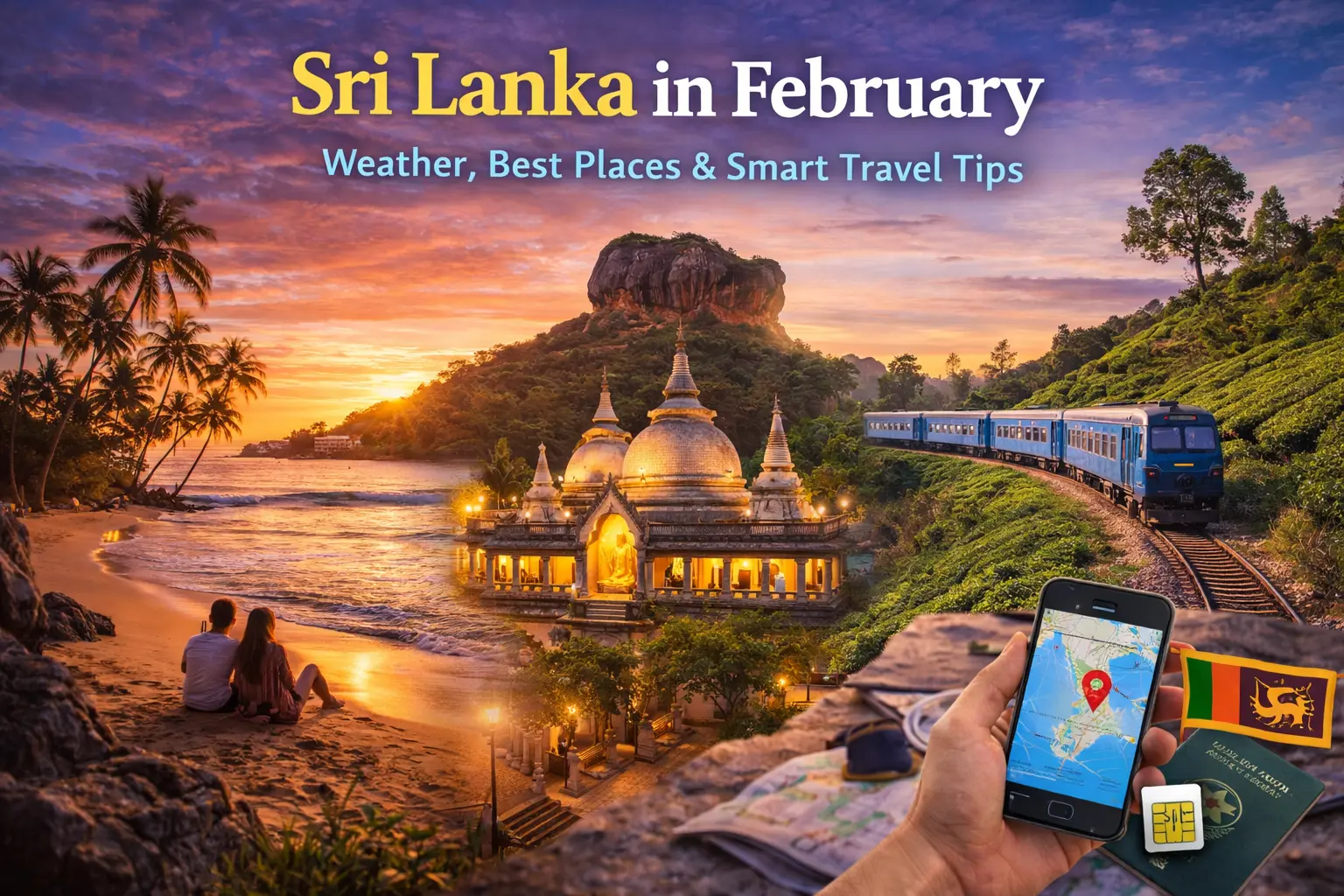
Sri Lanka in February: Weather, Best Places & Smart Travel Tips
If you’re dreaming of palm-fringed beaches, tea-covered hills, and ancient temples, Sri Lanka in February is one of the best combinations of timing and destination you can pick. It’s firmly within the dry season on the west and south coasts, which means long sunny days in places like Negombo, Bentota, Galle, and Mirissa, while the Cultural Triangle is usually dry and perfect for exploring ruins without getting drenched. At the same time, the island is small enough that you can mix beach time with hill-country hikes and wildlife safaris in a single week. To make that kind of packed itinerary work, especially if you’re juggling hotel check-ins, ride-hailing apps, and Google Maps, having reliable mobile data—ideally via an eSIM—makes everything smoother from the moment you land. That’s where planning a smart eSIM setup for your Sri Lanka trip becomes just as important as choosing the right beach.
Is February a Good Time to Visit Sri Lanka?
When people ask, “Is February a good time to visit Sri Lanka?” the honest answer is: for most travelers and most itineraries, it’s one of the best months of the year. The southwest monsoon has long passed, leaving the west and south coasts dry, hot, and sunny, with daytime temperatures averaging 30–32°C (86–90°F). Humidity can be high along the coast, but you’re rewarded with calm seas, clear water, and relatively predictable weather, which is exactly what you want if you’re planning to swim, surf, or just nap under a palm tree. In my experience, you can usually count on several consecutive rain-free days in February along the popular resort strips between Negombo and Matara.
Inland, the story is slightly different but still favorable. The Cultural Triangle—home to Sigiriya, Dambulla, and Polonnaruwa—tends to be hot but mostly dry, with daytime highs often around 32–34°C (90–93°F). You’ll definitely feel the sun if you climb Sigiriya Rock in the middle of the day, but early-morning starts are much more pleasant, and February’s low rainfall means you’re unlikely to have your plans washed out by storms. Up in the hill country around Kandy, Nuwara Eliya, and Ella, temperatures are cooler, often in the 18–24°C (64–75°F) range during the day, dropping into the low teens at night. That contrast makes February a great time to combine a warm beach break with a few nights of sweater weather in tea country.
There are a few trade-offs to keep in mind. Because many travelers and digital nomads consider February the best time to visit Sri Lanka, you’ll see higher hotel prices in places like Unawatuna, Mirissa, and Hikkaduwa, and the most popular guesthouses can sell out weeks in advance. Wildlife parks such as Yala and Udawalawe also tend to be busier, especially on weekends. However, compared with peak Christmas and New Year weeks, February is often slightly less chaotic while still offering the same excellent weather. If you’re flexible with your schedule and book key stays early, you can enjoy the advantages of peak season without feeling like you’re constantly fighting crowds.
Another reason February works so well is that it’s an easy month for logistics. Roads are generally in good condition, there are fewer weather-related delays, and domestic flights and trains are less likely to be disrupted by storms. That matters when you’re trying to coordinate airport pickups, train reservations, and maybe a remote-work schedule on top of sightseeing. With a stable Sri Lanka February itinerary with eSIM and mobile data, you can adjust plans on the fly—checking live traffic on Google Maps, messaging guesthouses on WhatsApp, or booking last-minute drivers without worrying about connectivity dropping at the worst moment.
Sri Lanka February Weather Guide by Region
To really understand Sri Lanka in February, it helps to break the weather down by region rather than thinking of the island as one uniform climate. Experienced travelers know that you can have blazing sunshine in Galle and a cool mist in Nuwara Eliya on the same day, and that’s part of the charm if you plan for it. February is generally dry on the west and south coasts, relatively dry in the Cultural Triangle, and pleasantly cool in the highlands, while the east coast is still recovering from its own monsoon season and isn’t at its best yet. Knowing this helps you decide where to base yourself and what to pack.
On the west coast, places like Negombo, Colombo, and Kalutara typically see low rainfall in February—often under 100 mm for the month—with many days of uninterrupted sunshine. Daytime temperatures hover around 30–32°C, and nights stay warm, rarely dropping below 24°C (75°F). Sea conditions are usually calm enough for swimming and beginner surfing, especially around Hikkaduwa and Weligama. I’ve often used this coast as a “soft landing” for the first two or three nights, partly because the weather is reliable and partly because it’s easy to reach from Bandaranaike International Airport.
Moving down to the south coast—Galle, Unawatuna, Mirissa, Tangalle—you’ll find similar temperatures but often slightly more breeze, which makes the heat feel more manageable. February is prime time for whale watching off Mirissa, with many operators reporting some of their best sightings between late January and March. Clearer skies also mean better sunsets, especially if you’re staying on the western side of the south coast. It’s not unusual to spend entire days outdoors without a single shower, though a brief afternoon cloudburst isn’t impossible. When that happens, having a backup plan like a cafe with good Wi‑Fi and a reliable data connection via eSIM can turn a rain delay into an hour of productive remote work.
In the Cultural Triangle, expect hotter, drier conditions. February temperatures can hit 34°C in places like Sigiriya and Anuradhapura, particularly in the early afternoon. The upside is that trails and archaeological sites stay dry, and you’re unlikely to face muddy paths or leech-filled forests like you might in wetter months. The key is timing: start climbs like Sigiriya or Pidurangala just after sunrise, then retreat to your hotel pool or an air-conditioned cafe during the midday heat. With good mobile data, I’ve often scheduled video calls or work sessions in those hottest hours, then gone back out for late-afternoon exploring when the light is softer and the temperatures drop slightly.
Finally, in the hill country—Kandy, Nuwara Eliya, Haputale, and Ella—February is cool and relatively dry, though you can still get mist and light showers in the late afternoon. Daytime highs are usually in the low 20s°C (around 70°F), and nights can dip to 10–12°C (50–54°F), especially in Nuwara Eliya. That’s cool enough that you’ll want a light jacket or sweater, which surprises some people who only packed for the beach. Trains like the Kandy–Ella route are especially scenic in February, with clear views over tea plantations and fewer heavy downpours to obscure the landscape. Just keep in mind that mobile coverage can be patchy in some highland stretches, so download offline maps and key documents before you board, even if you’re using an eSIM.
Best Places to Visit in Sri Lanka in February
Because the weather cooperates in so many parts of the island, choosing the best places to visit in Sri Lanka in February is more about your travel style than avoiding rain. If you’re a beach person, the southwest is your playground. If you love culture and history, the central and northern plains are wide open. And if you want to mix nature, tea, and hiking, the highlands are in excellent condition. Many travelers end up doing a loop: landing near Negombo, heading inland to the Cultural Triangle, dropping into Kandy and the hill country, then finishing on the south coast.
For beaches, the classic February picks are Unawatuna, Mirissa, and Hikkaduwa. Unawatuna offers a lively bay with plenty of restaurants and cafes, plus easy access to Galle Fort for day trips. Mirissa is more spread out, with a mix of surf spots, quieter coves, and that famous Instagrammable Coconut Tree Hill. Hikkaduwa is known for snorkeling and a slightly more backpacker-friendly vibe, as well as a small but active surf scene. Farther east along the south coast, Tangalle is a good option if you want a quieter, more spread-out beach experience with fewer crowds, though swimming conditions can be rougher in some stretches.
If history and culture are high on your list, base yourself in or around Sigiriya for a few days. From there, you can climb Sigiriya Rock Fortress or the neighboring Pidurangala for sunrise, visit the cave temples at Dambulla, and explore the ancient city of Polonnaruwa. February’s dry weather makes biking around Polonnaruwa’s ruins much more enjoyable than in wetter months, and the lack of heavy afternoon storms means you can plan full-day excursions with more confidence. I’ve found that having stable data here is especially useful for using rideshare-style apps or contacting local drivers, as some smaller guesthouses are slow to respond to email.
For scenery and hiking, Ella is the standout, with trails to Little Adam’s Peak, Ella Rock, and Ravana Falls. February brings clear mornings that are perfect for sunrise viewpoints, and the cooler temperatures make uphill walks comfortable as long as you start early. Nuwara Eliya, often called “Little England”, offers tea factory tours, walks around Gregory Lake, and easy access to Horton Plains National Park, where the World’s End viewpoint is particularly stunning in clear February weather. Just remember that early-morning temperatures at Horton Plains can be quite chilly, so pack layers even if you’ve spent the rest of your trip in shorts and sandals.
One insider tip: if you’re combining Sri Lanka with another warm-weather destination like Mexico or Southeast Asia, you can often reuse the same approach to connectivity. For example, travelers who like our Mexico winter sun eSIM and beach planning strategies usually appreciate the same “land-connected-and-ready” mindset in Sri Lanka. The destination changes, but the need for reliable maps, translation apps, and messaging when you arrive somewhere new stays exactly the same.
Sample Sri Lanka February Itinerary (With Connectivity in Mind)
Because Sri Lanka in February gives you so many good weather zones at once, it’s worth sketching an itinerary that takes advantage of that. Here’s a realistic 10–12 day outline that I’ve seen work well for travelers who want a mix of culture, nature, and beach time, while also staying connected for work or family back home. The key idea is to minimize backtracking and use your data connection to keep logistics flexible, rather than locking in every detail months in advance.
Days 1–2: Negombo or Colombo – Land at Bandaranaike International Airport, get through immigration, and head to nearby Negombo or into Colombo. Negombo is only about 20–30 minutes from the airport in light traffic, which is welcome after a long flight. Use these days to recover from jet lag, sort out your local transportation apps, and test your eSIM or data setup. This is when many people appreciate having installed their eSIM before departure so they can order a taxi, message their hotel, or pull up a saved address without hunting for an airport kiosk.
Days 3–5: Cultural Triangle (Sigiriya / Dambulla) – Head inland by private driver or bus to the Sigiriya area, which takes around 3.5–4.5 hours depending on traffic. Climb Sigiriya or Pidurangala at sunrise, visit Dambulla cave temples, and consider a day trip to Polonnaruwa. February heat can be intense in the afternoon, so many travelers work remotely or relax in the middle of the day and focus their sightseeing in the early morning and late afternoon. Reliable data is handy here for checking opening hours, booking guides, and using offline translation tools with English-Sinhala or English-Tamil phrases.
Days 6–7: Kandy and Train to Ella – From Sigiriya, travel to Kandy for a night or two, visiting the Temple of the Tooth and strolling around Kandy Lake. Then take the famous Kandy–Ella train. February is an excellent month for this ride because the chances of heavy fog or storms blocking the views are lower. I always recommend downloading your tickets, confirmation emails, and offline maps before boarding, since mobile coverage can drop in tunnels and remote stretches. Having at least one device connected via eSIM means you can still message your guesthouse in Ella if your train runs late.
Days 8–9: Ella and Hill Country – Spend a couple of days hiking to Little Adam’s Peak, visiting Nine Arches Bridge, and exploring tea plantations. This is a good time to catch up on work if you’re balancing travel with remote commitments, because many cafes and guesthouses in Ella now cater to digital nomads with decent Wi‑Fi. Still, I’ve learned not to rely solely on hotel Wi‑Fi in small towns; a strong mobile data connection is your safety net if that “fast Wi‑Fi” on the booking page turns out to be shared with 20 guests streaming video.
Days 10–12: South Coast (Mirissa / Unawatuna / Tangalle) – Finally, head down to the south coast for beach time. From Ella to the south coast is usually a 4–5 hour drive, so plan a mid-morning departure. February is perfect for whale watching from Mirissa, surfing in Weligama, or simply relaxing in Unawatuna or Dalawella. This is also a good point in the trip to slow down and stay in one place for a few days, especially if you’re working remotely. You can structure your days around early-morning swims or surf sessions, a solid work block in late morning or afternoon, and sunsets on the beach. A stable data plan lets you handle video calls from your balcony without hunting for a coworking space.
For travelers who like to combine multiple countries on one trip, Sri Lanka pairs surprisingly well with Southeast Asian hubs like Singapore or Bali. If you’ve already explored the connectivity options in places like Singapore with a dedicated eSIM, you’ll find it natural to treat Sri Lanka the same way: choose your data plan in advance, install it before you fly, and land ready to go.
Digital Nomad & Remote Work Guide: Sri Lanka in February
From a connectivity and comfort point of view, February is one of the strongest months for a Sri Lanka digital nomad guide to make sense. You get stable weather on the coasts, cooler air in the highlands if you’re tired of tropical heat, and improving infrastructure in popular towns like Colombo, Galle, and Ella. While Sri Lanka doesn’t yet have a dedicated digital nomad visa like some countries, many remote workers stay on tourist visas and structure their time around 30–90 day visits. It’s not as plug-and-play as, say, Chiang Mai or Lisbon, but if you’re willing to be a bit flexible, it can be a rewarding base.
In terms of where to work, Colombo and the nearby suburb of Mount Lavinia have the most consistent coworking spaces and cafes with strong Wi‑Fi. Galle Fort has a small but growing number of laptop-friendly cafes, and coastal towns like Mirissa and Weligama now feature beachfront spots where you can work with your feet in the sand—though you’ll want to test the upload speeds before committing to a big video call. In the hill country, Ella has become a mini-hub for remote workers, with several guesthouses advertising “workation” packages that include better chairs, desks, and dedicated routers. Still, power cuts and occasional line issues do happen, which is why many long-stay travelers treat mobile data as their primary connection and Wi‑Fi as a bonus.
One thing I’ve learned over multiple trips is that your choice of connectivity can completely change how stressful or relaxing your remote work days feel. If you rely on a single hotel network and it drops right before a client call, you’re stuck. But if you’ve set up a robust data plan, you can tether your laptop to your phone and keep going. This is where understanding Sri Lanka travel technology pays off. Instead of scrambling for a local SIM after landing—while tired, jet-lagged, and possibly facing a language barrier—you can arrive with an eSIM already installed and activated as soon as your phone connects to a local partner network.
For digital nomads planning multiple destinations in one season, it can help to look at how other countries handle connectivity and then mirror that approach. For example, travelers who have used regional packages or country-specific options like an Indonesia eSIM for Bali and Java often adopt the same strategy in Sri Lanka: choose enough data for maps, calls, and work tasks, then top up if needed. The main difference is that Sri Lanka’s infrastructure is still catching up in some rural areas, so having both offline tools and live data gives you the best of both worlds.
Staying Connected: Sri Lanka Tourist SIM vs eSIM
One of the most common questions I hear is: “Should I get a Sri Lanka tourist SIM or use an eSIM instead?” Both options can work, but they come with different trade-offs, and your answer will depend on how you travel. A physical tourist SIM usually means visiting a kiosk at the airport or in town, showing your passport, filling out a form, and waiting while the staff activates the SIM and sets up APN settings. It’s not difficult, but it can easily take 20–30 minutes when all you want is a shower and a bed. You’ll also need a phone with an unlocked SIM tray and somewhere safe to store your home SIM, which is easier said than done when you’re juggling luggage and immigration forms.
Using an eSIM for Sri Lanka flips that process. You purchase the plan online before you travel, scan a QR code to install the profile, and then your phone connects automatically to a local partner network when you land. There’s no hunting for kiosks, no swapping tiny plastic cards, and no risk of losing your original SIM. In my experience, this is especially helpful if you arrive late at night or during a busy period when airport counters are crowded. As long as your phone supports eSIM—most recent iPhones, Google Pixels, and many Samsung models do—you can be online by the time you clear immigration.
From a technical perspective, both tourist SIMs and eSIMs in Sri Lanka typically give you access to 4G/LTE speeds in major cities and along the main tourist routes. Coverage can drop to 3G or weaker in some remote rural areas, but that’s true regardless of whether you’re using a physical SIM or an eSIM that connects to local networks. The real difference is convenience and control. With an eSIM, you can keep your home number active for SMS verification codes or emergency calls while using local data for everything else. That’s particularly useful when logging into bank apps or receiving two-factor authentication messages, which can be a headache if you’ve removed your home SIM entirely.
There are a few things to watch out for. Some travelers assume that all eSIMs are the same, but plans differ in how much data they offer, which networks they connect to, and when their validity period starts. This is why it’s worth reading the details carefully, just as you would when choosing a plan for another destination like an Italy eSIM for a European trip. Look for clear information on supported networks, data allowances (for example, 3 GB vs 10 GB), and whether you can top up if you run out. For a 10–14 day trip with regular maps, messaging, social media, and a bit of video, many travelers find that 5–10 GB is a comfortable range.
Practical Sri Lanka Travel Tips for February
Beyond weather and connectivity, a few targeted Sri Lanka travel tips February can make your trip noticeably smoother. The first is packing. Because you’ll likely move between hot, humid coasts and cooler highlands, you’ll want breathable clothing for the lowlands plus at least one light sweater or fleece for evenings in the hill country. A lightweight rain jacket or compact umbrella is still worth carrying, especially if you’re heading into the mountains where sudden showers can appear even in February. Sunscreen is essential; UV levels are strong, and it’s easy to underestimate the sun when there’s a breeze on the beach or in the hills.
Transport planning also deserves some attention. Long-distance buses are cheap but can be crowded and slow, especially on popular routes between Colombo, Kandy, and the south coast. Trains are scenic and affordable, but popular stretches like Kandy–Ella can sell out of reserved seats days in advance. Private drivers offer the most flexibility and aren’t as expensive as many people expect, especially if you’re splitting the cost between two or three travelers. Having reliable data lets you compare options on the fly, check real-time traffic, and stay in touch with drivers via WhatsApp if plans change. I’ve had drivers message me updates about delays or roadworks, and being able to respond quickly saves a lot of confusion.
Health and safety are relatively straightforward but worth mentioning. Tap water isn’t generally safe to drink, so plan to buy bottled water or use a filter bottle. Food hygiene is good in most tourist areas, but I still recommend easing into street food if you have a sensitive stomach—start with busy stalls where there’s high turnover. February heat can creep up on you, especially in the Cultural Triangle, so carry water, wear a hat, and take breaks in the shade. From a connectivity standpoint, having access to online maps and translation apps can also be a safety asset when you’re navigating unfamiliar neighborhoods or explaining allergies and dietary restrictions in restaurants.
One subtle but important tip is to think about how your Sri Lanka trip fits into your broader travel year. If you’re also planning winter-sun escapes or regional trips, you might find it helpful to read destination-specific connectivity guides, like this detailed piece on visiting Brazil in February with smart eSIM tips. The destinations are different, but the mindset is similar: understand peak seasons, book key journeys early, and treat connectivity as a core part of your planning rather than an afterthought.
Finally, don’t underestimate how much smoother everything feels when you’re not constantly hunting for Wi‑Fi passwords. With a solid eSIM plan in place, you can check weather forecasts before booking a whale-watching trip, verify temple dress codes before you arrive, or quickly double-check whether a viewpoint is open for sunrise. These small, real-time decisions add up to a trip that feels less like guesswork and more like you’re in control, even when plans inevitably shift.
Using eSIM in Sri Lanka: Setup, Troubleshooting & Pro Tips
Setting up an eSIM for Sri Lanka is usually straightforward, but a few best practices can save you stress—especially if you’re not used to managing mobile profiles. The first step is to confirm that your phone supports eSIM; most iPhone models from XS onward, Google Pixel 3 and later, and many recent Samsung Galaxy devices do. Before you leave home, connect to Wi‑Fi, purchase your Sri Lanka plan, and scan the QR code to install the eSIM profile. Don’t worry about “starting” the plan too early; with reputable providers, the validity period only begins when you first connect to a supported network in the destination country, not when you install the profile.
Once the profile is installed, you’ll usually see it listed under “Cellular” or “Mobile Data” in your phone’s settings. You can label it something like “Sri Lanka Data” to keep things clear. I recommend turning off data roaming on your primary (home) line to avoid accidental charges, then setting the eSIM as your default for mobile data while keeping your home number active for calls and SMS if needed. When you land in Sri Lanka and your phone connects to a local partner network, you should see the signal bars appear and data start working within a minute or two. A quick test—loading a map or messaging someone—will confirm everything is live.
If something doesn’t work immediately, don’t panic. Common fixes include toggling airplane mode on and off, restarting your phone, or checking that mobile data is enabled for the eSIM line. In some cases, you may need to manually select a network under “Network Selection” instead of leaving it on automatic, especially if you’re in a border or remote area. It’s also wise to save your eSIM confirmation email or QR code offline, in case you need to reinstall the profile. I’ve had situations in other countries where a simple reboot solved a temporary glitch, but having the details handy gave me peace of mind.
To manage your data efficiently, keep an eye on usage in your phone’s settings and download-heavy content (like offline Netflix episodes) while on Wi‑Fi at your accommodation. For most travelers, navigation, messaging, email, and occasional social media posts don’t consume huge amounts of data, but constant video streaming or large file uploads will. If you know you’ll be working remotely with frequent video calls, choose a higher data tier from the start; it’s usually cheaper than buying multiple small top-ups. This logic applies across destinations—many travelers planning multi-country trips through Asia adopt the same strategy they’d use for a Turkey eSIM with enough data for both sightseeing and work.
One pro tip: always download offline maps for Sri Lanka in Google Maps or a similar app, even if you’re confident in your eSIM. Coverage is good in most tourist areas, but there are still pockets—especially in dense forest or highland valleys—where your signal may drop. Offline maps ensure you can still navigate back to your guesthouse, find the nearest main road, or show a tuk-tuk driver your destination without needing live data. Combined with an eSIM, this gives you a belt-and-suspenders approach that’s ideal for a country with such varied terrain.
Conclusion: Making the Most of Sri Lanka in February
Visiting Sri Lanka in February gives you a rare combination: beach-perfect weather on the west and south coasts, dry conditions for exploring ancient cities, and cool, clear days in the hill country. It’s no accident that many travelers consider it the best time to visit Sri Lanka in February specifically, when seas are calm, skies are bright, and the logistics of getting around are simpler than in wetter months. With a bit of planning, you can move from Negombo’s beaches to Sigiriya’s rock fortress, from Kandy’s temples to Ella’s tea hills, and finally down to Mirissa or Tangalle for a few days of sand and sunsets—all in one cohesive itinerary.
The difference between a trip that feels rushed and stressful and one that feels smooth often comes down to information and connectivity. When you can check train schedules on your phone, message a driver if you’re running late, or quickly look up a restaurant’s location, the little uncertainties of travel shrink. That’s why planning how to stay connected in Sri Lanka with eSIM in February is just as important as choosing your guesthouses or deciding which beaches to prioritize. It’s not about being online all the time; it’s about having the tools you need, exactly when you need them.
If you’re already thinking about other winter-sun escapes or future trips, you can apply the same approach—understand the seasonal weather, sketch a realistic route, and sort out your connectivity before you fly. For Sri Lanka, that means embracing February’s dry season, packing for both heat and cool evenings, and setting up a reliable data plan so you can focus on the good stuff: tea-scented mountain air, warm ocean swims, and the feeling of watching the sun set over a new coastline, with tomorrow’s plan already at your fingertips.