






 Australia
 Germany
 Indonesia
 New Zealand
 Thailand




























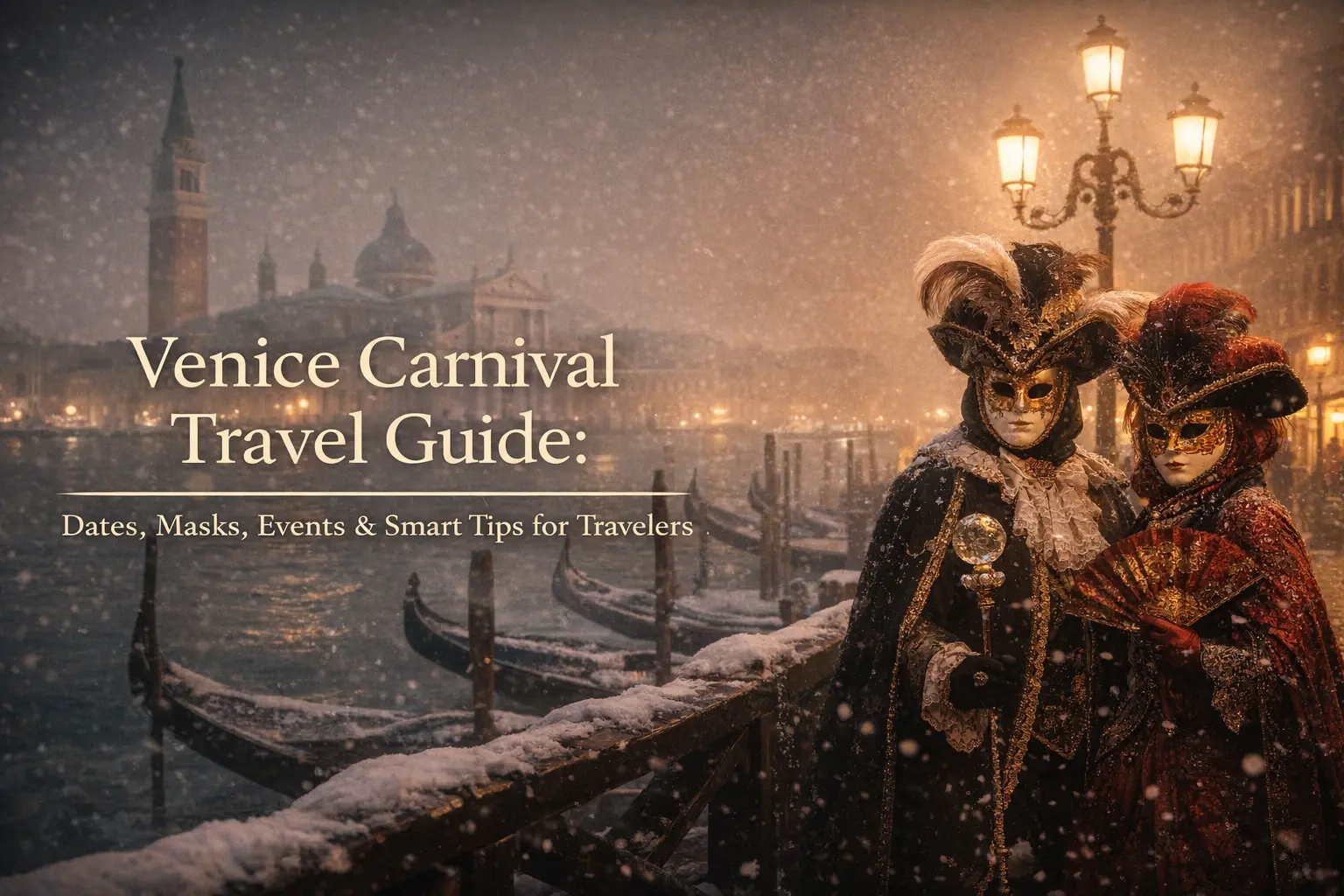
Venice Carnival Travel Guide: Dates, Masks, Events & Smart Tips for Travelers
If you’ve ever seen photos of misty canals, stone bridges, and figures in elaborate masks, there’s a good chance they were taken during Carnival in Venice. Planning a Venice Carnival trip is exciting, but it gets confusing fast: the dates change every year, events sell out, and the city can feel overwhelming if you don’t know what you’re walking into. This Venice Carnival travel guide breaks it all down clearly—dates, masks, events, crowds, and even how to keep your phone online without paying brutal roaming fees. If you’re already mapping out Italy and comparing an Italy eSIM with local SIM cards, you’re exactly the kind of traveler this guide is written for.
When Is Venice Carnival? (Dates & How the Timing Works)
One of the most common questions is simple on the surface: when is Venice Carnival and how long does it last? The tricky part is that Carnival isn’t fixed to a specific date like New Year’s Eve; it follows the Christian liturgical calendar, so the dates shift every year. Officially, Venice Carnival runs for about two weeks leading up to Shrove Tuesday (also known as Mardi Gras), which is the day before Ash Wednesday. Practically, that means the festival usually falls sometime between early February and early March, with the biggest crowds on the final two weekends.
For example, in 2026, Shrove Tuesday is on February 17, so you can expect the main Venice Carnival period to run roughly from February 7–17, with some smaller events or previews starting the weekend before. The city and tourism boards usually release the exact dates and program in late summer or early autumn of the previous year. In my experience, travelers who wait for the official program to book accommodation often find that central places in San Marco, San Polo, and Dorsoduro are already eye-wateringly expensive or fully booked. Treat the Shrove Tuesday date as your anchor and plan around it, then fine-tune once the schedule is published.
It’s also worth understanding that Venice doesn’t flip a switch overnight. The first days of Carnival are generally calmer, with more local families out in costume, especially around Campo Santa Margherita and Cannaregio. The energy ramps up as you get closer to the final weekend, when St. Mark’s Square (Piazza San Marco) becomes a full-on stage for costume parades, photo shoots, and live performances. If your Venice Carnival travel planning is flexible, decide whether you’d rather experience the quieter build-up or the intense finale. Both are “Carnival,” but they feel very different in pace, crowds, and prices.
Another timing detail many travelers miss is how events are split between day and night. Daytime is dominated by mask contests, street performances, and wandering photographers, while evenings shift toward ticketed balls, concerts, and private parties. This matters for your budget and logistics: you might be happy with free outdoor events by day and a simple trattoria dinner at night, or you may want to splurge on at least one formal ball. Either way, put your key events into a simple calendar app as soon as tickets go on sale. With solid Venice Carnival mobile data—ideally via an eSIM—you can keep track of time and locations even when you’re jet-lagged and half lost in the alleys.
What Is Venice Carnival? A Quick Cultural Background
To really enjoy Venice Carnival, it helps to know what you’re looking at. Carnival in Venice dates back to at least the 12th century, and by the 18th century it had become famous across Europe for its elaborate masks, games of chance, and a general loosening of social rules. The idea was simple: for a short period before Lent, Venetians of different classes could mingle anonymously behind masks. A noble and a fisherman could stand side by side in the crowd, and no one would know who was who. This anonymity is a big part of the magic you still feel today when you see a silent masked figure gliding past the Basilica di San Marco.
The tradition was banned for a long stretch after the fall of the Venetian Republic and only officially revived in the late 1970s and early 1980s. Modern Venice Carnival is a mix of historical re-creation, tourism spectacle, and genuine local pride. You’ll see historically inspired costumes referencing the 1700s, complete with powdered wigs and brocade coats, alongside playful modern takes like steampunk masks or characters from movies. Some Venetians still work with traditional artisans in the sestiere of San Polo or Castello to create handmade papier-mâché masks, while others grab cheaper versions from stands near the Rialto Bridge.
Understanding the cultural roots also explains some of the key events, like the “Flight of the Angel” (Volo dell’Angelo), where a performer descends on a cable from the Campanile into St. Mark’s Square. This spectacle echoes older traditions of daring acrobatics and public displays that kicked off Carnival in past centuries. Similarly, the emphasis on music, theater, and opera during the festival connects to Venice’s long history as a center of performance, with famous venues like La Fenice still active today. When you attend a concert in a small church or a masked ball in a palazzo, you’re not just at a tourist show—you’re tapping into layers of Venetian history.
From a traveler’s perspective, this background matters because it shapes how you approach the experience. If you only see Carnival as a big costume party, you might focus on nightlife and crowds. If you understand it as a brief suspension of normal social rules and a celebration of artistry, you’ll probably spend more time appreciating the craftsmanship of masks, the choreography of parades, and the way the city itself becomes a stage set. That’s also why a good Venice Carnival digital travel guide doesn’t just list events; it helps you see how they fit into the story of Venice as a whole.
Best Time to Visit Venice Carnival (Traveler Perspective)
Choosing the best time to visit Venice Carnival depends on what you care about most: crowds, budget, or photos. The first weekend is usually the most manageable in terms of people. You’ll find plenty of costumes around St. Mark’s and Rialto, but you can still stroll through Cannaregio or Dorsoduro without feeling swept along by a human tide. Hotel rates, while higher than in January, are often 20–30% lower than during the final weekend. If you’re traveling with kids or you dislike shoulder-to-shoulder crowds, that early period is ideal.
The final weekend and Shrove Tuesday are the peak. This is when major events like the big costume finals, the Flight of the Angel (usually on the second Sunday), and many of the most elaborate balls take place. In practical terms, that means you should expect packed vaporetto boats, queues for cafes around San Marco, and higher prices for everything from gondola rides to spritzes. I’ve had trips where a simple espresso at a bar counter near the square cost 1.50–2.00 EUR in early Carnival, then jumped to 3.00–4.00 EUR by the last days. If you’re sensitive to costs, factor that in.
Photographers often ask about the best time to visit Venice Carnival for photographers specifically. The sweet spot is usually midweek between the two main weekends. By then, many serious costumers are in town and happy to pose at sunrise around San Marco, the Doge’s Palace, and along Riva degli Schiavoni. At the same time, day-tripper crowds from nearby cities are lighter than on Saturdays and Sundays. I’ve had some of my best photo sessions at 7:00 a.m. on a Tuesday, when the only people in the square were masked figures, a few tripods, and the occasional delivery cart.
Weather is another factor. February in Venice is cold and damp, with temperatures often between 3–8°C (37–46°F). Foggy mornings are common, which can be magical for photos but uncomfortable if you’re underdressed. Pack layers, a warm scarf, and gloves you can still use a smartphone with, especially if you rely on navigation apps and your eSIM data to move around. If you’re combining Carnival with other winter trips—maybe skiing in the Dolomites or a city break in Paris using an eSIM for France—you’ll already have the right gear.
Must-See Events During Venice Carnival
Venice Carnival isn’t just about wandering in masks; there’s a full calendar of events that range from totally free to seriously pricey. One of the signature spectacles is the Festa Veneziana sull’acqua, usually held in Cannaregio on the opening weekend. It’s a nighttime water parade with illuminated floats and performers gliding along the canal, viewed from the fondamenta (embankments). If you want a good spot, arrive at least an hour early and bring something warm to drink—standing still by the water gets cold fast. This event is free, which makes it popular with both locals and visitors.
The Flight of the Angel is another highlight, typically on the second Sunday of Carnival around midday in Piazza San Marco. A costumed “angel” (often a local celebrity or past Carnival queen) descends from the bell tower on a cable while the crowd watches from below. You don’t need a ticket to see it, but you do need patience and a willingness to stand in a dense crowd. If you’re short or traveling with children, consider arriving very early or watching from a side angle near the Procuratie, where it’s slightly less intense. Having reliable Venice Carnival mobile data helps here, because last-minute time changes due to weather or safety can be announced on the official website and social channels.
Throughout Carnival, Piazza San Marco hosts daily costume parades and competitions. Anyone in a full costume can usually register to walk the stage, with categories like “Best Masked Costume” and “Most Original Costume.” Even if you don’t plan to compete, it’s fun to watch from the edges of the square and see the incredible craftsmanship up close. For a quieter but equally atmospheric experience, head to early morning gatherings along the waterfront near the Ponte della Paglia, where serious costumers pose for photographers against the lagoon and gondolas.
Then there are the famous masked balls, often held in historic palaces (palazzi) like Ca’ Vendramin Calergi or private venues on the Grand Canal. Ticket prices can range from around 250–300 EUR for simpler evenings up to 800–1,000 EUR for ultra-luxury events with multi-course dinners, live orchestras, and open bars. In my experience, you don’t need to attend the most expensive ball to feel the magic. Even a more modestly priced event in a smaller palazzo can give you that surreal sensation of dancing in a candlelit hall in full 18th-century dress. Just read the dress code carefully: many balls require full period costume, not just a mask and a cocktail dress.
Beyond the headline events, don’t overlook smaller concerts, theater performances, and children’s activities. Churches like San Vidal or Scuola Grande di San Teodoro often host classical music concerts that pair beautifully with the atmosphere of Carnival nights. Families will find puppet shows and kids’ costume parades in neighborhoods like Castello and Cannaregio. These events rarely make the glossy brochures but can end up being the most memorable part of your trip. To keep track of what’s happening where, save the official program PDF to your phone and access it offline, or keep a tab open using a stable Europe eSIM for travel if you’re hopping between Italy and neighboring countries.
Venice Carnival Masks & Costumes (What Travelers Should Know)
Masks are the visual heart of Carnival, and understanding them makes the whole experience richer. Traditional types include the bauta (a full-face mask with a pronounced chin and no mouth opening, often worn with a tricorn hat and cloak), the colombina (a half-mask covering the eyes and nose), and the medico della peste (the long-nosed “plague doctor” mask). You’ll see these everywhere, from artisan workshops in Calle dei Fabbri to cheaper plastic versions hanging outside souvenir shops near the Rialto. The difference in quality is huge: a handmade papier-mâché mask from a reputable workshop might cost 60–150 EUR, while a mass-produced plastic one could be 10–20 EUR.
As a traveler, you don’t need a full 18th-century costume to enjoy Carnival, but wearing at least a decent mask adds to the fun and helps you blend into the atmosphere. If you’re on a budget, consider buying a simpler but well-made colombina mask and pairing it with clothes you already own in dark or rich colors. For those who dream of going all-in, there are costume rental shops in Venice that offer complete outfits—dresses, coats, wigs, and accessories—for daily rates starting around 150–250 EUR and going up from there. Book early if you want something specific in your size; by the final weekend, the best pieces are often reserved.
There are also some unofficial “rules” and etiquette around masks and costumes. First, be respectful when photographing costumed people. Most are happy to pose—it’s part of the culture—but it’s polite to make eye contact, gesture with your camera, and say “Grazie” afterwards. If someone is clearly rushing somewhere or talking with friends, don’t block their path for a photo. Second, remember that masks can affect your vision and hearing. If you’re wearing something elaborate, be especially careful near canal edges, steps, and crowded bridges. In my experience, the combination of a long cloak, a mask with limited peripheral vision, and wet stones can be a recipe for a near fall if you’re not paying attention.
Regarding costume rules, Venice doesn’t have strict legal restrictions on what you can wear in public during Carnival, but common sense applies. Avoid anything that could be mistaken for real weapons, and keep in mind that some churches and formal venues may require you to remove your mask upon entry. If you’re attending a ticketed ball, check the dress code in detail; some specify historical periods (for example, “18th-century Venetian”) and may not admit guests in modern fancy-dress costumes. A good guide to Venice Carnival masks and costume rules is worth skimming before you pack, so you don’t end up scrambling for last-minute rentals at inflated prices.
Finally, think practically about how your costume interacts with travel logistics. If you’re flying into Venice with a tight connection and multiple bags, it’s often easier to rent a costume locally than to haul a giant gown or coat through Marco Polo Airport and onto the Alilaguna boat. I’ve seen more than one traveler struggling on the vaporetto with a garment bag the size of a small person. Packing a foldable mask and a few accessories, then arranging a rental once you’re in the city, is often the sweet spot between experience and convenience.
Practical Travel Tips for Venice Carnival
Venice during Carnival is beautiful, but it’s also crowded, damp, and logistically quirky. Start with accommodation: book as early as you can, ideally 4–6 months in advance if you want to stay in San Marco, San Polo, or Dorsoduro. If central rooms are out of budget, consider staying in Mestre on the mainland or on the Lido and commuting in by train or vaporetto. A 10–15 minute train ride from Mestre to Santa Lucia station can save you 30–40% on hotel costs, though you’ll trade some late-night convenience. Whatever you choose, make sure you know your check-in procedure and have the exact address saved in your phone; Venice’s maze of alleys makes vague directions like “near Rialto” almost useless.
Transport-wise, you’ll mostly be on foot and using vaporetti (water buses). During Carnival, popular lines like 1 and 2 along the Grand Canal can be packed, especially at sunset. If you’re arriving at Marco Polo Airport, you can take the Alilaguna boat directly into the city or a bus to Piazzale Roma. I strongly recommend having your digital tickets, hotel directions, and offline map ready before you land. This is where having an eSIM already installed on your phone makes a huge difference: as soon as your plane touches down, you can connect to a local network, check vaporetto schedules, and message your host if you’re delayed.
Food and drink during Carnival require a bit of strategy if you don’t want to overpay or get stuck in tourist traps. Around San Marco, it’s common to see cappuccinos at 6–8 EUR when you sit at a table with live music, especially in iconic cafes like Florian or Quadri. Those places are experiences in themselves, but you don’t need every coffee to cost that much. Walk a few streets back into Castello or San Polo and look for bars where locals are standing at the counter. There, a spritz might be 3–4 EUR and cicchetti (Venetian tapas) 2–3 EUR per piece. During peak days, consider eating lunch slightly earlier or later than the usual 12:30–14:00 window to avoid queues.
Money and safety are straightforward but worth mentioning. Venice is generally safe, but Carnival crowds are perfect for pickpockets, especially around Rialto and San Marco. Use a cross-body bag that closes securely and keep your phone in a zipped pocket when you’re not using it. ATMs are available, but some charge high fees and may run out of cash during busy weekends. Paying by card is widely accepted, yet small bars and mask stalls sometimes prefer cash for small amounts. If you’re juggling maps, camera, and payments, having everything synced on your phone with a reliable connection—ideally through a Europe eSIM for travel if you’re visiting multiple countries—helps you avoid fumbling with paper tickets and guidebooks.
One more practical tip: watch for acqua alta, the high tides that can flood parts of Venice, especially in winter. During Carnival, it’s less frequent than in November, but it still happens. If a high tide is forecast, the city sets up raised walkways in low-lying areas like St. Mark’s Square. Pack lightweight waterproof boots or overshoes if you’re coming for several days; buying them last-minute in Venice can cost 20–30 EUR for something you could have brought from home. Check tide forecasts using a local app or website once a day—again, easy to do if you have consistent Venice Carnival mobile data on your phone.
Staying Connected at Venice Carnival: eSIM Tips & Mobile Data
Connectivity might not be the first thing you think about when you picture a masked ball, but it quietly shapes your entire experience. Venice’s narrow alleys, crowds, and frequent need for navigation mean you’ll reach for your phone a lot: to find your hotel, check vaporetto times, coordinate meeting points with friends, and back up photos. Using your home carrier’s roaming can easily cost 10–15 EUR per day or more, especially if you’re uploading videos and using maps. That’s why more and more travelers rely on an Italy eSIM for tourists instead of traditional roaming or hunting for a local SIM on arrival.
With an EasyAlo eSIM, you buy your plan online before you travel, scan a QR code to install the profile, and then activate it once you land in Italy. Because it’s digital, there’s no need to swap plastic SIM cards or find a store at Venice Marco Polo Airport when you’re jet-lagged and trying to catch the right boat. In my experience, the biggest advantage during Carnival is that you can immediately load your hotel directions, check event schedules, and even call your accommodation via WhatsApp if you’re delayed. If you plan to combine Venice with other destinations like Istanbul or Athens, you can also compare regional options such as a Turkey eSIM package or a Greece plan for onward travel.
Setting up an eSIM is straightforward but worth doing in a calm moment before your trip. Install the profile at home on Wi‑Fi, then keep your primary SIM active for calls and texts while using the eSIM for data once you arrive. That way, you can receive verification codes from your bank, airline updates, and messages from home without paying for data roaming. During Carnival, when you might be making online reservations, buying event tickets, or checking your airline app for schedule changes, this dual setup is particularly useful. If you’re the designated planner in your group, you’ll be glad you have a stable data connection when everyone turns to you for directions.
Data usage during a three- to five-day Carnival stay can add up quickly. Between maps, social media, messaging, and translation apps, many travelers use 3–5 GB without realizing it. If you’re uploading a lot of high-resolution photos or videos, aim for at least 5–10 GB for a week-long trip. The good news is that you can always top up if needed; with EasyAlo you simply purchase another plan online and activate it, similar to how you’d handle a top-up when your data runs low in other destinations like Mexico or Brazil. For broader inspiration on how mobile data transforms festival trips, you can look at how travelers handle events like Rio’s Carnival in our Brazil Carnival connectivity guide.
One last connectivity tip: Venice’s free public Wi‑Fi is limited and often congested during Carnival. Cafes and hotels do offer Wi‑Fi, but relying on it exclusively means you’ll be offline exactly when you most need help—like when you take a wrong turn at night in Castello or you’re trying to find the meeting point for a masked ball. Having your own data connection through an eSIM is less about posting in real time and more about quietly reducing stress in the background. It turns Venice from a confusing maze into a navigable stage where you can focus on the experience instead of worrying about getting lost.
Common Mistakes Travelers Make During Venice Carnival
Even smart travelers fall into the same traps during Carnival, mostly because they underestimate how different Venice feels when it’s this busy. A big one is underestimating walking times. On a normal day, it might take 20 minutes to walk from the train station to Rialto; during peak Carnival with dense crowds and photo stops, that can easily stretch to 35–40 minutes. I’ve seen people miss pre-booked tours or dinner reservations because they assumed Google Maps’ walking time was realistic. When planning, always add a 30–50% buffer to any walking estimate if you’re passing through San Marco, Rialto, or other major hotspots.
Another common mistake is leaving costume and mask decisions to the last minute. Travelers assume they can “just pick something up” on arrival, only to find that the nicer, reasonably priced masks are sold out and costume rentals are fully booked. If you care about how you’ll look in photos—and most people secretly do—spend some time before your trip scrolling through artisan mask shops online and deciding on a style. You don’t need to reserve everything months in advance, but knowing roughly what you want and budgeting for it avoids disappointment. A good Venice Carnival travel guide will always tell you that the best costumes you see on Instagram were not thrown together the day before.
On the tech side, a lot of travelers either rely on their home roaming plan without checking the cost or assume they’ll find free Wi‑Fi everywhere. The result is either bill shock later or real-time stress when they can’t load a map or confirm a meeting point. If you’re already used to traveling with digital connectivity—maybe you read our Japan winter connectivity guide or similar resources—you’ll know that setting up an eSIM and testing it before departure saves headaches on the ground. Carnival is not the time you want to be standing in the cold outside a tabacchi shop trying to troubleshoot a physical SIM that won’t activate.
Over-scheduling is another trap. With so many events, it’s tempting to cram your days with back-to-back activities: a morning photoshoot, midday parade, afternoon concert, evening ball. In reality, Venice rewards wandering and unplanned moments. Leave space in your itinerary to follow a costumed group down a side alley, linger over cicchetti in a hidden bacaro, or simply watch the fog roll in from the lagoon. Experienced travelers know that the memories you talk about years later are often the unscripted ones. Aim for one or two anchor events per day, and treat everything else as a bonus.
Finally, many first-timers forget how tiring Carnival can be. You’re walking on stone all day, often in the cold, sometimes in less-than-practical shoes if you’re in costume. Add jet lag, late nights, and maybe a few too many spritzes, and it’s easy to hit a wall on day three. Build in small recovery rituals: a mid-afternoon coffee in a quieter square, a quick nap before an evening event, or a simple dinner at a neighborhood osteria instead of a big night out. Think of it as pacing yourself for a marathon, not a sprint. When you manage your energy, you’ll enjoy the final days of Carnival as much as the first.
Conclusion: Enjoy the Spectacle, Travel Smart
Venice Carnival is one of those rare events that really does live up to its photos. The masks are as intricate as they look, the palazzi are as grand, and the city truly transforms into a living theater for a couple of weeks each year. But the difference between an unforgettable trip and a frustrating one often comes down to preparation. Understanding when Venice Carnival happens and how the timing works, choosing the best days for your style of travel, and knowing which events matter most to you turns chaos into a curated experience. Add a basic grasp of mask traditions, costume etiquette, and neighborhood geography, and you’ll navigate the festival with much more confidence.
From a practical standpoint, think of this Venice Carnival travel guide as your checklist: book accommodation early, budget realistically for food and costumes, allow extra time for walking, and protect your energy over several days. On the connectivity side, setting up an EasyAlo eSIM before you leave home is one of those low-effort decisions that pays off constantly in small ways—smooth airport arrivals, reliable maps, quick access to event info, and easy communication with your travel companions. If you’re planning a broader European itinerary around Carnival, you can also explore regional options like a dedicated Italy data plan combined with neighboring-country eSIMs for seamless roaming-free travel.
In the end, Venice Carnival is about stepping into another world for a brief moment—behind a mask, under a cloak, or simply as an observer with a camera. With the right mix of cultural understanding, logistical planning, and smart connectivity, you can immerse yourself fully in the spectacle without getting lost in the stress. Pack your layers, pick your mask, install your eSIM, and let Venice do the rest.