






 Australia
 Greece




























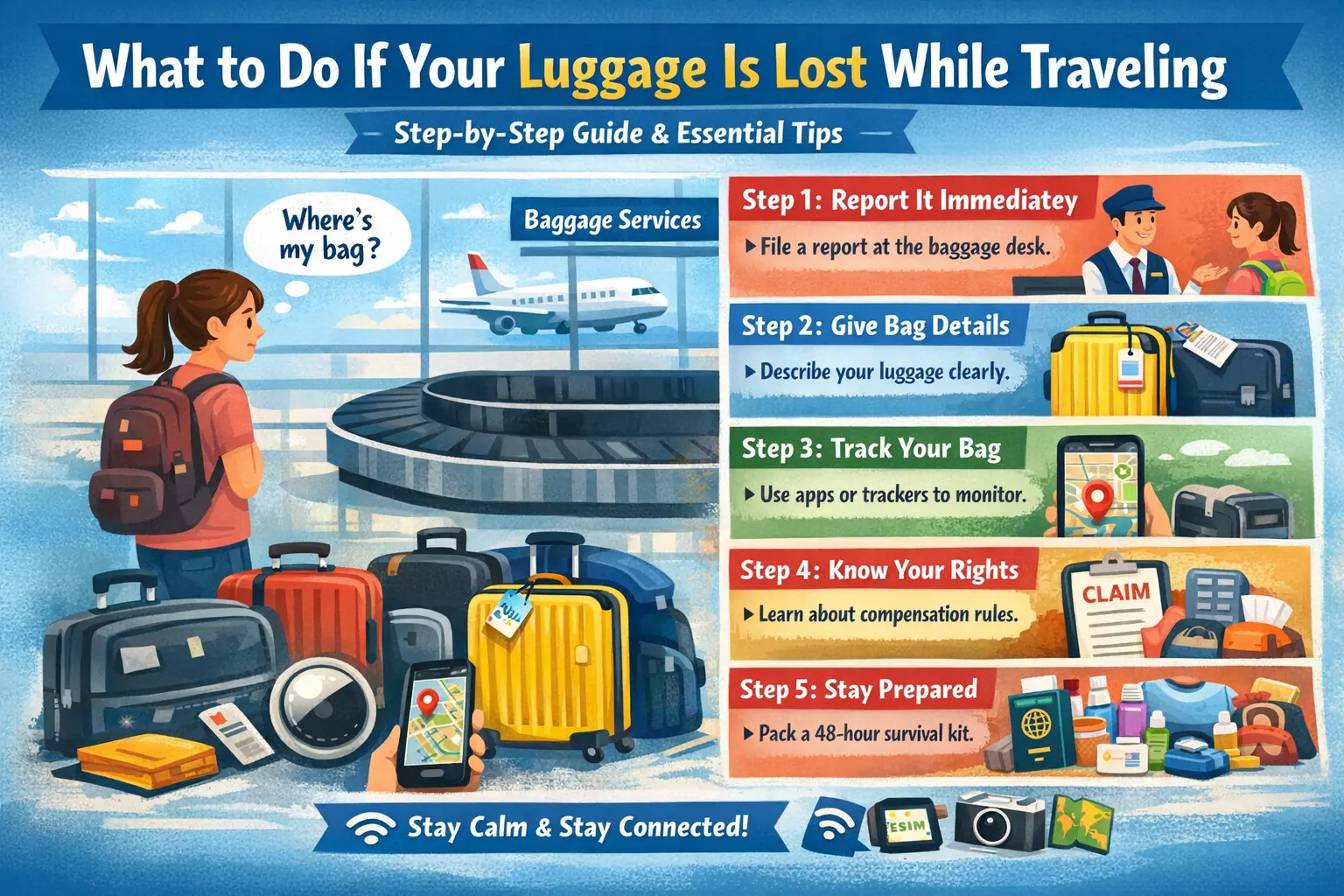
What to Do If Your Luggage Is Lost While Traveling — Step-by-Step Guide + Essential Tips
You’re standing at the baggage carousel, watching the same red suitcase circle for the fifth time, and your bag is nowhere in sight. Your hotel is an hour away, you’ve got tours booked tomorrow, and your chargers, clothes, and maybe even medication are in that missing suitcase. Knowing exactly what to do if your luggage is lost while traveling can turn this from a full-blown crisis into a manageable hiccup. In this guide, I’ll walk you through a clear, step-by-step process, share real-world tips I’ve used in airports from Rome to Singapore, and show you how tools like a reliable travel eSIM for instant data can make the whole situation much less stressful.
First 15 Minutes: Stay Put, Breathe, and Confirm Your Bag Is Really Missing
The first instinct when your bag doesn’t appear is panic, followed quickly by anger at the airline, the airport, or yourself. It’s understandable, but the first 15 minutes are about staying calm and confirming whether your bag is actually lost or just delayed. In many hubs like Istanbul, Paris Charles de Gaulle, or Mexico City, bags from the same flight can arrive on two different belts, or oversized items may appear in a separate area. I’ve had trips where my backpack showed up at a “special baggage” corner 20 minutes after the main carousel stopped. So before you assume the worst, scan the monitors again and walk the immediate area.
Start by checking the flight information screen above or near the carousel to ensure you’re at the correct belt. Sometimes flights from similar origins—like two flights from London Heathrow—get mixed in travelers’ minds, especially after long-haul red-eyes. If there’s a ground staff member nearby, ask if all bags from your flight have been unloaded. Many airlines, including major carriers in Europe and Asia, now use handheld scanners and can tell you whether the final container from your flight has arrived. This quick confirmation can save you from standing in the wrong place for half an hour.
Next, look for any side areas where “oversized” or “special” luggage is delivered. This is common for backpacks with straps, sports equipment, stroller bags, and sometimes even regular suitcases that were manually handled. I’ve seen this in airports as different as Singapore Changi and small regional hubs in Georgia and Sri Lanka. If you’re traveling with family or friends, agree on a quick plan: one person checks the special baggage area while another waits at the carousel in case the suitcase appears late.
If you still don’t see your bag after the carousel stops and staff confirm that unloading is complete, it’s time to switch from hopeful waiting to action mode. This is where having data on your phone is incredibly useful. With an active connection—whether from your home plan or a local option like an EasyAlo eSIM for France if you’ve just landed in Paris—you can open your airline’s app, check the baggage status, and even see if your suitcase was scanned onto the plane. That information will be valuable when you speak to airport staff in the next step.
Step 1: Go Straight to the Airline’s Baggage Desk Before Leaving the Secure Area
Once you’re sure your luggage is missing, do not leave the baggage hall or customs area. This is one of the biggest mistakes I see travelers make. They walk out hoping their bag will magically appear or thinking they can “sort it out later” at the hotel. In reality, almost every airline requires you to file a report before exiting, and some airports make it extremely difficult to re-enter the baggage area without a boarding pass. I learned this the hard way in Rome Fiumicino years ago and ended up spending an extra hour convincing security to let me back in to file a report.
Look for signs that say “Lost & Found,” “Baggage Services,” or the name/logo of your airline. In major hubs like Heathrow or Singapore, each airline or alliance (Star Alliance, SkyTeam, oneworld) often has its own counter. In smaller airports, several airlines may share a single baggage services desk. If you’re unsure, ask any airport staff member where to report missing luggage for your specific flight number. Have your boarding pass and passport ready; they’ll ask for both, and having them accessible speeds things up.
At the desk, explain clearly that your luggage did not arrive and provide your baggage claim tag, which is usually a small sticker attached to your boarding pass or passport cover at check-in. This tag contains the unique tracking number for your suitcase. If you used online check-in and a self-bag-drop system, the airline app may also show this number under “baggage.” In my experience, staff are much more efficient when you hand them the tag right away rather than searching through your bag or email while they wait.
Most airlines will then create a Property Irregularity Report (PIR). This is the official record that your bag is missing and is essential for any compensation claims later. Make sure the PIR includes your correct contact details, the address of your accommodation (at least for the next 24–48 hours), and a working phone number or email you can access. If you’re changing cities quickly—say you’re landing in Milan and taking a train to Florence—explain your itinerary so they know where to send the bag once it’s found. This is where a local data plan, like an Italy eSIM for multi-city trips, helps you share accurate hotel addresses and updates on the spot instead of guessing or relying on patchy airport Wi‑Fi.
Step 2: Provide Detailed Bag Information and Keep All Documentation
After opening a report, the next crucial step is giving the most precise description of your bag possible. Many people just say “black suitcase,” which doesn’t help much when there are hundreds of similar bags moving through the system. Think of the description like a missing person report: the more specific, the better the chance of a match. Mention the brand (Samsonite, Away, Delsey), size (cabin, medium, large), type (hard-shell, soft fabric, duffel), and distinguishing features like stickers, colored straps, or a unique luggage tag.
Most modern baggage systems allow staff to input these details into a global tracking database like WorldTracer, used by many international carriers. When I lost a bag on a connection through Istanbul, the agent asked me to describe not only the outside of the suitcase but also a few items inside, such as a bright red jacket and a pair of hiking boots. Two days later, when my suitcase surfaced in Madrid, those internal item descriptions helped confirm it was mine before it was shipped onward. If you have a photo of your bag on your phone—which I now make a habit of taking before every trip—show it to the agent so they can attach it to the report.
Once the details are entered, you should receive a printed copy of the report or at least an email confirmation with a reference number. Guard this like gold. You’ll need it to check your bag’s status, claim expenses, and, in worst-case scenarios, file for compensation if the bag is declared lost after a certain period (usually 21 days under many international rules). Store a photo of the report on your phone as a backup. If you’re traveling with someone else, share that photo via messaging apps so at least two people have it accessible.
This is also a good moment to clarify the airline’s immediate support. Ask directly: “What essentials allowance do you provide for delayed luggage?” Some carriers issue prepaid cards or vouchers on the spot; others tell you to buy items and claim them later. Policies vary widely between low-cost airlines in Europe, full-service carriers in Asia, and long-haul operators flying into places like Mexico or Turkey. Having instant access to your email via a connection like an EasyAlo Turkey data plan means you can quickly pull up the airline’s baggage policy while you’re still at the counter and negotiate from a position of knowledge.
Step 3: Use Technology to Track and Monitor Your Lost Luggage
In the last few years, technology has changed the lost-luggage game dramatically. If you’ve packed a Bluetooth tracker like an Apple AirTag, Tile, or Samsung SmartTag inside your suitcase, you may actually know more about your bag’s location than the airline does. I’ve had situations where my AirTag showed my suitcase sitting in a different terminal, even while the airline system still listed it as “location unknown.” In one case at London Gatwick, that live location data helped staff realize my bag had missed a transfer belt and was stuck in a holding room.
To use this information effectively, you need a reliable data connection as soon as you land. Airport Wi‑Fi is often overloaded, time-limited, or requires SMS verification that doesn’t work with foreign numbers. This is where having a pre-installed eSIM from a provider like EasyAlo makes a real difference. For example, when I landed in Tokyo last winter, my physical SIM from home didn’t connect right away, but my eSIM kicked in within seconds, letting me open my tracker app and confirm my ski bag had made it to the right terminal. That peace of mind is worth a lot when you’re already sleep-deprived from a long-haul flight.
Even if you don’t use a tracker, most major airlines now offer baggage tracking in their apps. Carriers like Delta, Lufthansa, and Singapore Airlines will show when your suitcase was checked in, loaded onto a plane, and scanned at transfer points. If the app shows your bag never left your departure airport, that suggests it will likely arrive on the next flight. If it was scanned at a connection point but not on your final flight, it may be sitting in a transit warehouse waiting for the next available route. This information can help you decide how much to buy in terms of replacement items and how aggressively to push for support.
Keep checking the status periodically for the first 24–48 hours, but don’t obsess over it every 10 minutes. In my experience, updates often happen in batches when bags are scanned during handling, not in real time. Set a reminder on your phone to check every few hours. Meanwhile, make sure your contact details in the airline app and in the PIR are fully up to date. If you’re traveling across multiple countries in a week—say, starting in Athens and then heading to Istanbul—consider a regional data plan like those covered in EasyAlo’s Europe eSIM setup guide for iPhone and Android so you can stay reachable as your itinerary evolves.
Step 4: Know Your Rights and What You Can Claim for Lost or Delayed Luggage
Understanding your rights is where many travelers feel lost, especially when dealing with airlines in different regions. The rules are not identical everywhere, but there are some common frameworks. On most international flights, your rights are governed by the Montreal Convention, which sets a maximum liability amount for lost or delayed luggage (roughly 1,288 Special Drawing Rights, which fluctuates but is often around US$1,600–1,800). This doesn’t mean you automatically receive that amount; it’s a cap, and airlines will ask for receipts and proof of value for high-ticket items.
Within the European Union, additional consumer protections may apply, especially if your flight departs from an EU airport or is operated by an EU carrier. However, it’s important not to confuse lost-luggage rules with flight delay compensation under EU261—they’re separate issues. In many cases, airlines will reimburse “reasonable expenses” for essentials like clothing, toiletries, and basic items you need while separated from your bag. What counts as “reasonable” can be subjective. A €25 T‑shirt at H&M is usually fine; a €500 designer jacket may be challenged unless you can justify it in context.
To make a successful claim, keep every relevant receipt from the moment your bag goes missing: toiletries from the airport pharmacy, underwear and a T‑shirt from a nearby mall, a charger from an electronics store, and even a basic swimsuit if you’re in a beach destination like Bali or Mexico. When my suitcase missed a connection to Jakarta, I bought a small set of clothes and a cheap pair of sandals, then submitted the receipts with a short explanation of why each purchase was necessary. The airline reimbursed everything within six weeks, minus a small amount for items they considered “non-essential.”
Travel insurance can also play a big role here. Many comprehensive policies offer delayed baggage coverage that kicks in after a certain number of hours—commonly 12, 24, or 48. Unlike airlines, some insurers are more generous about what they consider essential, especially if you’re on a special-purpose trip like a ski holiday or business conference. If you’re planning a complex itinerary, it’s worth reading your policy in advance and saving a PDF in your phone’s cloud storage so you can access it easily using mobile data, even if you’re standing in a hotel lobby in Mexico or a guesthouse in Sri Lanka. Guides like EasyAlo’s Sri Lanka smart travel tips often remind travelers to check this before departure, and it really does pay off when something goes wrong.
Step 5: Surviving 24–72 Hours Without Your Checked Bag
Once the initial airport admin is done, you’re left with a practical question: how do you actually live your life for the next one to three days without your main luggage? The answer depends on what you packed in your carry-on and how prepared you were, but there are strategies that work even if you’re caught off guard. The goal is to stay functional, comfortable, and able to enjoy at least part of your trip while the airline hunts for your suitcase.
Start by taking inventory of what you do have. Open your carry-on or personal item and lay things out on the hotel bed. If you followed the common advice to pack at least one change of clothes and essential toiletries in your cabin bag, you’re already ahead. If not, focus on the basics: underwear, a T‑shirt, something to sleep in, and anything critical like medication, glasses, or contact lenses. Airlines and insurers are much more sympathetic—and faster to reimburse—when you prioritize necessities over impulse shopping sprees.
Next, head to a nearby supermarket or budget-friendly clothing store rather than the most expensive shop in the airport. In cities like London, Paris, or Singapore, chains like Uniqlo, Decathlon, or local supermarket brands offer reasonably priced underwear, socks, and T‑shirts that are perfectly adequate for a few days. When my bag went missing on a trip to Athens, I spent about €40 on two T‑shirts, underwear, and basic toiletries at a local store, all of which were reimbursed later. Keep the receipts flat and readable; take photos as a backup in case paper copies get crumpled or lost.
Connectivity is especially important during this period because the airline may call or email with delivery details, and you’ll likely need maps, translation apps, and messaging to coordinate drop-off at your accommodation. If you’re traveling through multiple countries—say, starting in Italy and then moving on to Greece—consider a multi-country solution like an EasyAlo Greece eSIM that complements regional coverage so you’re not scrambling for a new SIM at every border. Having stable data lets you share your live location with delivery drivers, respond quickly to airline messages, and keep your travel plans flexible without constantly hunting for Wi‑Fi.
Step 6: Following Up, Escalating, and Knowing When a Bag Is Truly Lost
Most delayed bags are found and delivered within 24–72 hours, especially on routes between major hubs. However, there are cases where a suitcase goes missing for longer, and this is where consistent, calm follow-up makes a difference. Use the reference number from your PIR to check the status on the airline’s website or baggage-tracking portal. If there’s no update after 24 hours, call the baggage services number listed on your report or in the airline app. Be polite but firm, and always note the name of the person you spoke to and the time of the call.
In my experience, calling early in the local morning tends to work best, as phone queues are shorter and staff are less overwhelmed. If you’re in a different time zone from the airline’s main baggage office, use your phone’s world clock to plan a sensible time to call. Again, having reliable data through your eSIM means you can use internet-based calling apps like WhatsApp or Skype if your regular voice plan is expensive or unreliable abroad. This is particularly helpful in destinations like China, where you may also need to follow guides such as EasyAlo’s detailed China connectivity and app access guide to ensure your tools work correctly.
If your bag hasn’t been located after several days, ask the airline to explain the next steps in writing. Many carriers officially declare a bag “lost” after 21 days, at which point you can submit a detailed claim for the contents. Start preparing this list early rather than waiting until day 21. Go through your memory, photos from packing, and any purchase records to reconstruct what was in the suitcase. Group items into categories—clothing, electronics, toiletries, sports gear—and estimate values realistically. Overstating values can slow down processing and trigger extra scrutiny.
Once the bag is declared lost, you’ll typically submit your claim via an online form or email, attaching receipts where possible. If you’ve purchased big-ticket items such as a camera, laptop, or designer clothing, receipts or bank statements help a lot. Keep in mind that airlines often depreciate values, so a three-year-old jacket may not be reimbursed at full original price. This is where travel insurance can again fill the gap, especially if you chose a policy with higher baggage limits. In complex cases—like if your bag was lost on a multi-airline itinerary involving connections in hubs like Singapore, Dubai, or Istanbul—it may take persistence and several follow-ups to get a clear resolution.
Proactive Packing and Connectivity Strategies to Reduce Lost-Luggage Pain
While you can’t always prevent an airline from misrouting a bag, you can dramatically reduce the impact when it happens. Over a decade of frequent travel, I’ve adjusted how I pack and how I stay connected precisely because of a few painful luggage mishaps. One of the most effective strategies is to treat your carry-on as your “48-hour survival kit.” That means always keeping medication, one full change of clothes, essential toiletries (within liquid limits), chargers, and at least one warm layer in your cabin bag, even on short flights between nearby countries like Italy and France.
Another smart move is to split essentials across bags when traveling with a partner or friend. Instead of each person putting all their clothes in their own checked suitcase, mix them so that each bag contains outfits for both people. That way, if one suitcase goes missing, you both still have something to wear. I used this approach on a winter trip to Hokkaido, and when one of our bags was delayed, we both still had ski gear and warm clothing in the surviving suitcase. It wasn’t ideal, but it meant we didn’t lose valuable days on the slopes while waiting for the airline.
From a connectivity perspective, setting up your eSIM before you leave home is one of the best pre-trip decisions you can make. Instead of landing in a new country, discovering your physical SIM doesn’t roam properly, and then trying to troubleshoot in a crowded airport, you can scan a QR code at home, install your EasyAlo plan, and simply toggle it on when the plane touches down. For multi-stop itineraries—say, flying into London, connecting to Italy, and then heading to Greece—having a preloaded plan like an EasyAlo UK eSIM for your first leg plus a regional or country-specific option for the rest of Europe means you’re never stuck without maps, email, or airline apps.
Finally, consider photographing or scanning key documents and storing them in the cloud: your passport ID page, travel insurance policy, luggage receipts, and even a simple list of what you packed. If your physical bag disappears, you still have everything you need to make claims, prove ownership, and navigate bureaucracy. Combine that with instant access to your email, airline app, and messaging through a stable data connection, and you’ve transformed a potential travel nightmare into an inconvenience you can handle with confidence.
Conclusion: Turn a Lost-Luggage Crisis into a Manageable Detour
Having your suitcase disappear at the start of a trip feels awful, but it doesn’t have to derail your entire journey. When you know exactly what to do if your luggage is lost while traveling—from staying in the baggage hall, filing a detailed report, and using tech tools to track your bag, to understanding your rights and smartly buying essentials—you shift from helpless passenger to informed problem-solver. Most bags do come back within a few days, and the difference between chaos and a manageable detour often comes down to preparation and connectivity.
The more you travel, the more you realize that control over your information is just as important as control over your belongings. That’s where reliable mobile data, through tools like EasyAlo’s country and regional eSIMs, becomes part of your travel safety net. Being able to open airline apps, contact support, coordinate deliveries, and navigate unfamiliar cities without depending on patchy airport Wi‑Fi takes a huge layer of stress off an already frustrating situation. Instead of spending your first day in a new destination fighting with connectivity, you can focus on enjoying the city while the airline does its job.
Before your next trip, take a few simple steps: photograph your bags, pack a 48-hour survival kit in your carry-on, double-check your insurance, and activate an eSIM so you land connected. If your luggage does go missing, you’ll know exactly what to do, who to talk to, and how to stay in control from the first anxious minutes at the carousel through to final resolution. Travel will always come with surprises, but with the right plan and the right tools in your pocket, even lost luggage becomes something you can handle—not something that ruins your adventure.