






 Australia
 Canada
 Spain
Spain



























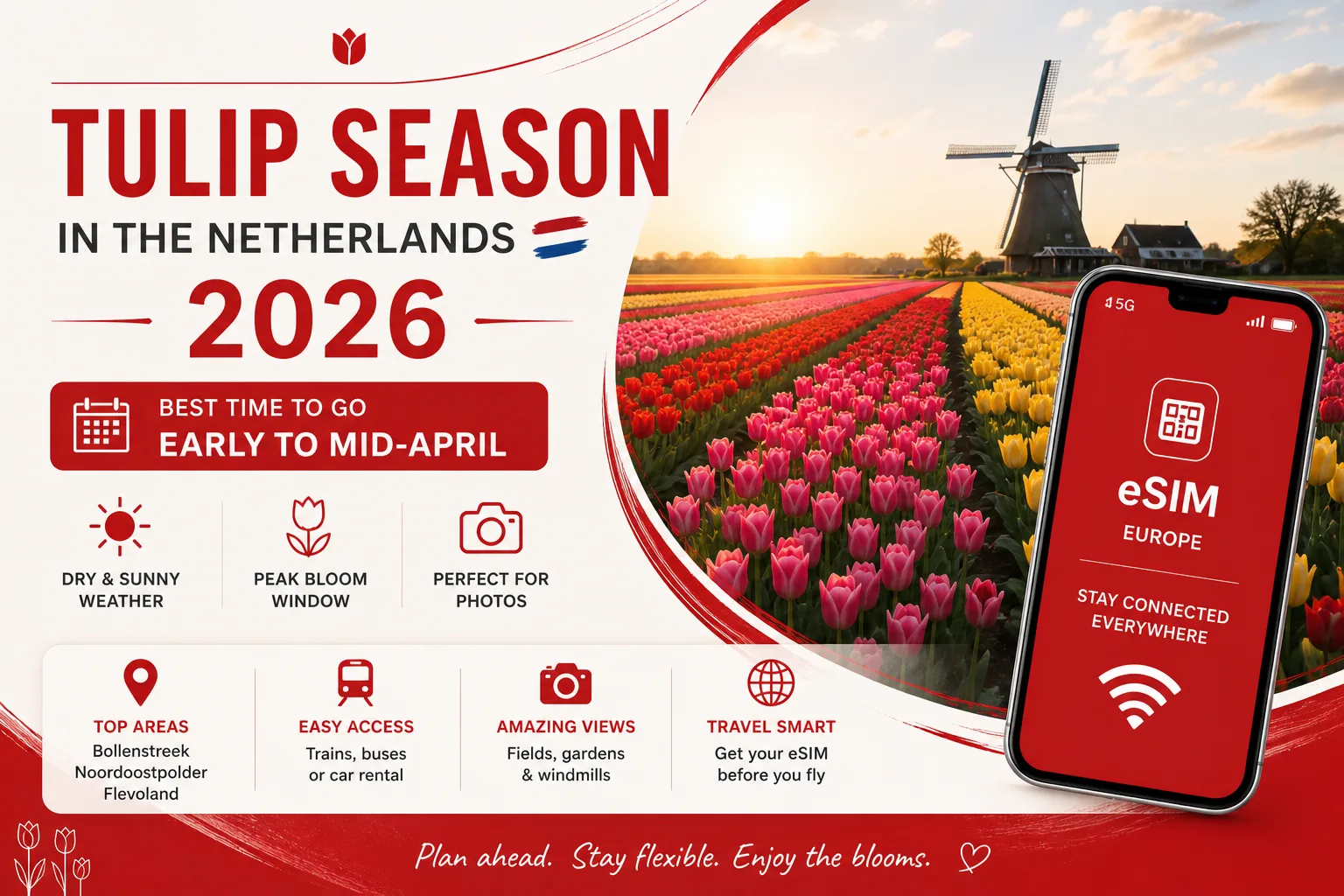
When Is Tulip Season in the Netherlands 2026? Best Time, Bloom Dates & Travel Tips
You booked spring dates, you pictured endless color, and now you’re asking: When Is Tulip Season in the Netherlands 2026? Best Time, Bloom Dates & Travel Tips — exactly when should you go so fields and parks are at their peak? I’ve planned four tulip trips to the Netherlands, missed bloom windows once because of an unusually warm March, and learned the hard way about timing and transport. In this guide I’ll give you a realistic 2026 timeline, regional differences (Bollenstreek vs. Noordoostpolder), and step-by-step travel and connectivity tips so you can actually see the tulips at their best. Before you leave home, consider reading our Europe eSIM setup guide for iPhone and Android to get online as soon as you land and avoid frantic airport Wi‑Fi hunts.
Quick answer: expected 2026 tulip bloom window and why dates vary
The short answer is that tulip season in the Netherlands typically runs from late March through mid-May, with the most reliable peak weeks in early to mid-April. This pattern holds because of planting schedules and the country’s temperate maritime climate, but exact timing shifts year to year based on winter temperatures and spring warmth. For example, a cold March followed by a warm April tends to delay the peak until mid-April, while a warm February and March can bring forward peak color to late March; in 2019 several fields were at peak by March 25 after an early spring. Keukenhof Gardens, the single most famous display in Lisse, typically opens around late March and runs through mid-May and annually plants around 7 million bulbs across 32 hectares, which makes it a practical barometer for the season.
Why does this matter for your trip? Because weather-driven variability means a fixed travel date isn’t a guarantee of peak blooms; your best strategy is to book a flexible window and monitor live indicators a few weeks out. I always keep three dates in mind — arrival week, peak-flex week (±7 days), and a fallback week — and buy refundable train tickets and flexible hotel rooms when possible. If you want to lock plans, aim for the first two full weeks of April for the highest probability of seeing both park displays and roadside fields in full bloom.
Actionable steps for travelers planning around the bloom: set calendar alerts for mid-March to check the Keukenhof official announcements, subscribe to local weather services such as KNMI (Royal Netherlands Meteorological Institute), and follow growers’ updates from the Bollenstreek bulb consortium. These resources will give you a heads-up if the season is early or late, letting you move flights or an extra night at a nearby hotel when necessary.
Regional breakdown: where to see tulips in 2026 (Bollenstreek, Noordoostpolder, Flevoland)
Not all tulip displays are the same, and where you go affects what you’ll see and when. The three main areas to plan around are the Bollenstreek (Bulb Region) around Lisse and Haarlem, the Noordoostpolder fields in Flevoland, and smaller displays in provinces like South Holland and North Holland. The Bollenstreek is home to Keukenhof and hundreds of fields stretching from Haarlem through Lisse to Noordwijkerhout; it’s easiest to visit from Amsterdam (30–45 minutes by train to Leiden, then a short bus or bike ride). Noordoostpolder offers vast, postcard-wide swathes of planted fields—think uninterrupted horizons and large-scale color bands—reachable by car from Zwolle in about 1.5 hours.
Concrete examples help. If you arrive at Amsterdam Schiphol and take the NS train to Leiden Centraal (around €4.40–€7.50 depending on railcards and discounts) and then Bus 858 to Keukenhof (€6–€9 return on bus or park-and-ride shuttles), you’ll be in the heart of the Bollenstreek in under an hour. Alternatively, consider taking a rented bicycle from the village of Lisse and following the Tulip Cycle Route (route signs and maps available at local VVV tourist offices). In Noordoostpolder, where fields often require driving between viewpoints, renting a car that can be parked roadside is more practical; daily car rental prices in April commonly range from €35–€70/day for compact cars if booked a few weeks ahead.
Why these regional differences matter: Keukenhof offers curated gardens, themed shows, and predictable displays (great for families and photographers), while roadside fields in Noordoostpolder and the Bollenstreek are more variable but offer authentic rural scenes and less crowding if you time it right. If you prefer quieter, wide-open landscapes and dramatic horizon shots, I recommend allocating at least one full day to Flevoland/Noordoostpolder. If you want tulip gardens, themed exhibitions, and easy public-transport access, base yourself near Lisse, Haarlem, or Leiden and visit Keukenhof early in the morning to beat buses and tour groups.
Bollenstreek: Lisse, Leiden, Haarlem — best logistics and tips
The Bollenstreek is the classic tulip corridor and the easiest for combining with Amsterdam. From Amsterdam Centraal you can get to Haarlem in 15–20 minutes by intercity train (prices around €3.60–€6), then take local buses or cycle to nearby fields. Keukenhof is in Lisse, open daily during the season and reachable by direct bus shuttles from Schiphol and Leiden. For example, if you plan a morning shoot, arrive at Keukenhof between 08:00–09:00 to use soft morning light and avoid crowd surges after 10:30.
Practical booking tip: reserve Keukenhof tickets in advance online — in recent years adult tickets have been around €19–€22 when pre-booked. Parking is limited and can cost about €6–€10, so public transit or cycling is both cheaper and often faster. If you’re staying in Haarlem, choose a hotel near Haarlem Station so you can leave the car parked and take short trains; experienced travelers know this reduces stress because parking in Lisse and Leiden can fill up on peak days.
Noordoostpolder and Flevoland: big sky tulip shots and quieter roads
Noordoostpolder is on the opposite end of the visual spectrum: wide, uninterrupted field patterns with much less tourist infrastructure. The best viewing zones are around towns like Emmeloord and Vollenhove, and the area is most accessible by car from Zwolle (about 75–90 minutes). Because public transit is sparse, I recommend renting a car and mapping specific coordinates ahead of time; Google Maps and local tulip route maps list fields and farm stands, and most growers will have notes on which parcels are public viewing. Farmers rely on us to be respectful—no trampling—and many fields are private, so stay on road verges or designated viewpoints.
One practical example from my last trip: I planned a sunrise visit to a Noordoostpolder field, arrived at 06:15, and had a 90-minute window of near-empty roads and perfect direct light. That morning I used an offline map (downloaded from Google Maps) because cell coverage was patchy in spots despite strong 4G in nearby towns. This is why I recommend carrying an eSIM with a reliable Europe plan and downloading offline routes before you head out; see EasyAlo’s about eSIM page for more on how to prepare your device and avoid losing time searching for connectivity.
Predicting peak bloom in 2026: weather, degree-days, and reliable trackers
Predicting the exact week of peak bloom is partly science and partly educated guessing, and 2026 will be no different. Bulb phenology responds to cumulative warmth, so meteorologists often use “growing degree days” (GDD) to estimate flowering windows. Practically speaking, a cooler March and warm April often shift the bloom later; a warm late February and March tend to push peak color into late March. For travelers, the best real-world trackers are the Keukenhof status updates (official site and social channels), Dutch bulb grower associations, and local webcams that show actual field conditions. KNMI weather forecasts, local growers’ Twitter/Instagram updates, and live cams from Lisse are actionable sources that give you a week-or-two lead time.
Here’s a step-by-step way I monitor potential peak weeks: first, set calendar alerts for March 15 and April 1 so you remember to check the Keukenhof opening news and regional bloom reports. Second, follow three sources: Keukenhof’s official feed for garden status, KNMI for temperature trends, and a local grower or tulip-route Facebook group for field-level photos. Third, if you see a consistent two-week warming trend in late March, be ready to move a flexible ticket or add nights. In my experience, having one refundable train ticket and one flexible hotel reservation makes last-minute shifts affordable and practical.
Concrete example: when fields peaked early in 2019, travelers who followed growers’ Instagram accounts spotted field photos a full week before official garden announcements, allowing them to rearrange plans. This means that being plugged into local social channels can directly affect whether you see peak color or arrive a week late. For those who prefer not to chase day-to-day changes, plan for the highest-probability window (first two full weeks of April) while keeping one backup day for flexibility.
Practical travel planning: booking, sample itineraries, and costs
Booking the right mix of transport and lodging is the difference between a magical trip and an exhausted one. Start by reserving accommodation in Amsterdam, Haarlem, Leiden, or Lisse depending on your priorities; Schiphol to Amsterdam hotels is 15–25 minutes by train and typically costs €5–€6 per person for a single ride. If Keukenhof and the Bollenstreek are your focus, staying in Lisse or Leiden saves commuting time, while Haarlem provides a charming city base and slightly lower hotel prices. Hotel rates in late March–April vary widely, but expect Amsterdam nightly rates to be around €120–€220 for mid-range hotels and higher for central options—booking 8–12 weeks ahead avoids price spikes during peak bloom weekends.
Sample 4-day tulip itinerary: Day 1 arrive Schiphol and settle into Amsterdam, explore canals and a short evening visit to Haarlem; Day 2 early train and bus to Keukenhof, afternoon cycling in Bollenstreek; Day 3 rent a car and drive to Noordoostpolder for sunrise fields and then to the fishing village of Volendam; Day 4 optional market visit in Leiden and fly out. This plan balances a curated garden visit with open-field photography. For costs, factor in Keukenhof tickets (~€19–€22 pre-booked), local transport (NS trains and bus shuttles €10–€20 per day), and a car rental day if you want Noordoostpolder (around €40–€70/day). Experienced travelers will add travel insurance and flexible cancellation options for spring weather unpredictability.
Booking tips I use: reserve Keukenhof entry and any guided farm tours 6–8 weeks ahead for mid-April trips, look for rail discounts or group day passes (NS offers off-peak discounts), and use price alerts for flights into Schiphol. If a long weekend in the Netherlands coincides with your travel, shift one day earlier or later to avoid the busiest park days and get better hotel rates. Also consider weekday visits: Tuesday through Thursday often have 20–40% fewer visitors compared to weekends during peak season.
Photography, etiquette, and lesser-known tips (including drone rules)
Whether you’re a serious photographer or a casual Instagrammer, maximizing your tulip photos requires timing, respect, and a little insider knowledge. Best light is early morning and late afternoon; sunrise reduces tourist clutter and creates soft front lighting across fields, while late afternoon gives richer shadows and saturated color. For example, in April sunrise in the Netherlands is typically around 06:30–07:15 depending on the date, so plan to be on location at least 30–45 minutes before sunrise to set up gear and find composition. Keukenhof has curated photo spots but restricts tripods in some indoor pavilions; in outdoor fields you’ll get better results using a wide-angle lens for large field shots and a 50–100mm lens for pattern details.
Respect farm rules. Many fields are private and posted with signs or have thin hedgerows separating farm drives from planted land; trampling and entering fields is illegal and can result in fines or angry farmers. Drones are tightly regulated in the Netherlands: flying a drone over people, near airports (Schiphol is a major no-fly zone), or above Keukenhof is prohibited without permits. If you plan aerial photography, secure permits well in advance and consult the Dutch drone registry (RDW) rules and local municipality restrictions. A counterintuitive tip from my own trips: sometimes the most striking photos are taken from secondary roads or small canal bridges where you get a layered composition with fields, windmills, and low Dutch skies—no drone required.
Practical etiquette steps: stay on designated paths, ask farmers for permission if a field appears to have an access point, and avoid buying bulbs from questionable sellers who don’t disclose cultivar names (international bulb import rules matter if you plan to take bulbs home). For families and groups, consider booking a private farm visit or guided floral tour if you want hands-on experiences without the risk of unintentionally damaging crops. These tours often cost between €25–€60 per person and provide access, local stories, and safe photo spots that casual visitors can’t reach.
Staying connected in the field: eSIM, carriers, and offline prep for 2026
Connectivity matters more than ever when you’re chasing color across rural roads. In my experience, installing a travel eSIM before you depart saves multiple headaches: airport logistics, coordinating with drivers, and checking live bloom cams all rely on stable data. The Netherlands has excellent mobile infrastructure in cities and towns from major carriers like KPN, T-Mobile Netherlands, and Vodafone NL, offering 4G LTE speeds commonly between 30–150 Mbps and growing 5G coverage in urban areas (peak 5G speeds can exceed 300 Mbps in ideal conditions). In rural field areas you should usually expect stable 4G with occasional gaps depending on local towers.
Actionable eSIM steps I follow: buy and install an EasyAlo Europe regional eSIM before leaving home, test it on Wi‑Fi to confirm activation and APN settings, and keep your primary SIM in airplane mode if you want to avoid unexpected roaming charges. For dual‑SIM phones (for example, iPhone 14 or Google Pixel 7), set your data line to the EasyAlo eSIM and your voice line to your home carrier if you need to receive calls. If you’re unsure how to set this up, follow the EasyAlo About eSIM page for step-by-step guidance and troubleshooting tips tailored to iOS and Android devices.
Practical connectivity checklist: download offline maps for planned routes in Google Maps or Maps.me and save waypoint coordinates for fields and farm access points, install your eSIM and verify a data connection at home, and carry a small power bank for full-day shoots (I use a 20,000 mAh pack for long photography days). If you plan multi-country travel after the Netherlands, compare regional bundles—for example, travelers continuing to France or Italy can look at specific plans on our France eSIM plans and Italy eSIM page to keep seamless connectivity across borders without changing profiles.
Costs, sustainability, and final planning checklist
Budgeting for a tulip trip includes ticketed gardens, transport, accommodation, and optional extras like tours or rental cars. Expect overall mid-range per-day costs of around €80–€160 excluding flights if you choose mid-range hotels and public transport, and higher if you rent a car or stay in central Amsterdam. Keukenhof tickets and guided tours are additional but provide value if you want structured experiences and cover stories behind cultivars and bulb farming. Sustainable travel choices—taking trains, using public transit shuttles to Keukenhof, and supporting local farm stands—help reduce your footprint and benefit local growers.
Checklist before you go: confirm Keukenhof opening dates for 2026 (check the official site), pre-book tickets and any guided farm tours, install and test your EasyAlo eSIM for Europe, download offline maps and coordinates for fields you want to photograph, and book accommodation with flexible cancellation for ±7 days of your target window. I always keep a small folding bike lock and a printed list of roadside coordinates because sometimes the phone battery dies after long photo sessions in remote spots. These small preparations make the difference between a rushed scramble and a relaxed day in bloom.
Conclusion: plan smart, stay flexible, and get connected
So, when is tulip season in the Netherlands 2026? Expect the season to run late March through mid-May, with the safest probability of peak blooms in the first two full weeks of April. However, weather-driven variance means the exact week can shift, so keep flexible plans, monitor local growers and Keukenhof updates, and be ready to adjust by a few days if needed. In my experience, travelers who combine an early-morning Keukenhof visit with at least one drive into Noordoostpolder or a Bollenstreek cycle route walk away with the best variety of images and memories.
If you want to avoid connectivity headaches while chasing blooms, set up your EasyAlo eSIM before departure and test it at home; having reliable data on the road will help you check bloom cams, route around crowds, and coordinate with local guides. For next steps, check our Europe eSIM setup guide and the EasyAlo about eSIM page to pick a plan that fits your travel length and data needs, then set calendar reminders in March 2026 to start following live bloom reports and lock in the best days.