





 Canada
 China
China Georgia
 United Kingdom
 United States





























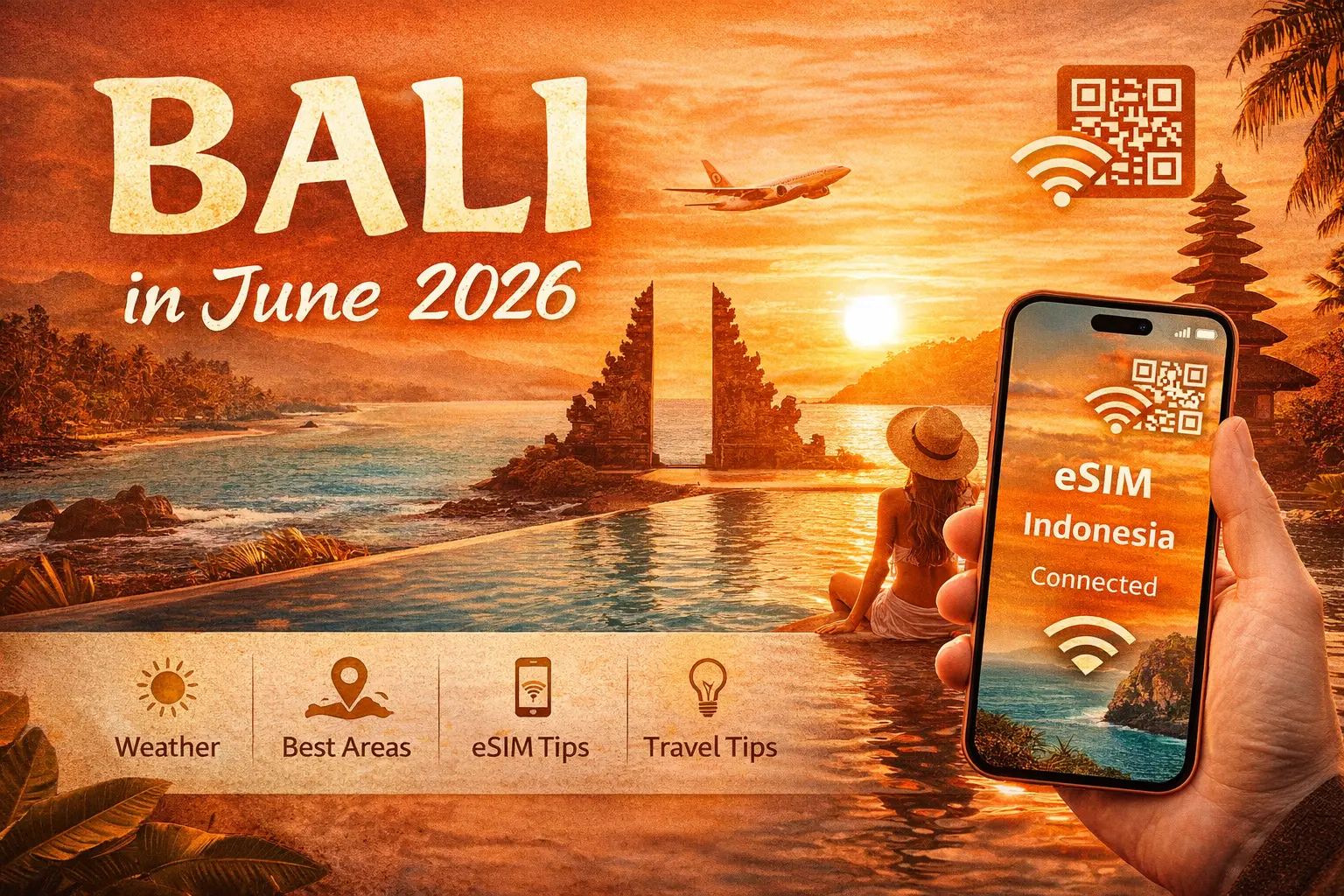
Bali in June 2026: Weather, Best Areas and Smart eSIM Tips
If you are thinking about Bali in June 2026, you are looking at one of the sweetest spots of the year to visit the Island of the Gods. June usually brings dry skies, long sunny days and that early-summer buzz before the heaviest crowds and peak prices of July and August. It is also a month when staying connected really matters, because you will be using maps, ride-hailing apps, restaurant reviews and surf reports almost every day. That is where planning an Indonesia eSIM for tourists before you fly can turn a good trip into a stress-free one. In this guide, I will walk you through June weather, the best areas to stay, what to expect on the ground, and exactly how to stay online without hunting for a SIM card kiosk at the airport.
Why Bali in June 2026 Is a Smart Choice
June sits right at the start of Bali’s traditional dry season, which usually runs from May to September. In practical terms, this means clearer skies, less humidity than March or April and a much lower chance that your beach day or waterfall hike will be washed out. Historically, average daytime temperatures in June hover around 27–30°C (81–86°F) along the coast, with evening lows around 23–24°C (73–75°F). You will still feel the tropical heat, but it is a more comfortable, less sticky heat than in the heart of the rainy months. In my experience, this is when you can walk around Seminyak or Ubud in the afternoon without feeling like you need a second shower by lunchtime.
Another reason June 2026 is attractive is crowd levels. Bali is never truly quiet anymore, but June tends to be lighter than July and August, when Australian school holidays and European summer breaks collide. In June you can often still find good mid-range hotels in Canggu or Uluwatu for under USD 60–80 per night if you book a couple of months in advance. Restaurant queues are shorter, beach clubs feel busy but not chaotic, and popular sunrise spots like Mount Batur are crowded without being overwhelming. This balance is ideal if you want energy and atmosphere without feeling like you are in a theme park.
Connectivity-wise, June is also a good month because the island’s tourism infrastructure is fully “awake” after any slower shoulder months. Cafés that cater to digital nomads, like those in Berawa or Pererenan, are running full hours, coworking spaces are lively, and you will find plenty of places with solid Wi‑Fi. That said, Bali’s Wi‑Fi can still be patchy when you move away from tourist hubs or during peak evening hours. This is why many travelers rely on Bali mobile data for travelers through an eSIM as their primary connection, and treat café Wi‑Fi as a bonus rather than a lifeline.
There is also a subtle cultural advantage to coming in June. Major Balinese Hindu festivals shift each year according to the local calendar, but June often falls between the busiest local ceremonial periods. This means fewer big road closures due to processions in some areas, while you can still witness daily offerings, small temple ceremonies and village life without the island being in full festival mode. You still need to pack modest clothing for temple visits, but you are less likely to encounter sudden all-day closures of certain streets in the core tourist areas.
June 2026 Weather in Bali: Dry Season, Surf and Packing Tips
When people ask, “What is the weather like in Bali in June 2026?”, the short answer is: generally sunny, warm and relatively dry. However, that does not mean zero rain or perfectly blue skies every day. Based on climate data from previous years, Denpasar and the southern coast usually see around 40–70 mm of rainfall in June, compared with over 250 mm in peak rainy months like January. That typically translates to short showers every few days, often in the late afternoon or at night, rather than long, trip-ruining downpours. The Bali rainy season in June is essentially tapering off, so you get the lush green landscapes without constant storms.
Humidity averages around 70–80% in June, which still feels tropical but is noticeably less oppressive than March or April. UV index readings are high, often 10 or above at midday, so sun protection is non-negotiable. I have seen more than one traveler underestimate the equatorial sun because of a light breeze on the beach and end up lobster-red after a single afternoon at Double Six Beach. Pack a high-SPF reef-safe sunscreen, a wide-brimmed hat and a light long-sleeve shirt you can throw on if you are out on a scooter or boat for several hours. Hydration salts are also handy, especially if you are doing hikes or surf sessions in the heat.
If you are interested in Bali June 2026 weather and surf conditions, June is generally solid for surfers, especially on the west and southwest coasts. The dry season brings more consistent offshore winds to breaks like Uluwatu, Padang Padang, Bingin and Canggu. Swells can range from 3–8 feet on average, with bigger days on exposed reefs. Beginners will find friendlier waves at Batu Bolong in Canggu or Kuta Beach, where plenty of surf schools offer 2‑hour lessons for around IDR 300,000–450,000 (USD 20–30). More advanced surfers often base themselves in Uluwatu or Bingin in June for easy access to world-class reef breaks that light up at this time of year.
Packing for June requires a balance between beachwear and light layers. You will live in shorts, dresses, t‑shirts and sandals during the day, but it is smart to bring one light sweater or hoodie for evenings in the central highlands around Ubud or Bedugul, where temperatures can drop to 18–20°C (64–68°F) at night. A compact rain jacket or poncho is still useful, as the odd shower can catch you on a scooter ride. From a connectivity standpoint, I always recommend downloading offline maps on Google Maps and saving key locations like your hotel, nearest clinic and pharmacy while you are still on strong Wi‑Fi. Even if you have robust Bali internet for tourists through your eSIM, having offline backups is reassuring when a storm briefly knocks out power in a neighborhood.
One slightly counterintuitive tip for June: do not assume that every day will be crystal clear for sunrise or sunset photos. Haze from humidity and occasional cloud cover can soften the light. If you are planning a sunrise trek up Mount Batur, try to book it early in your trip so you have flexibility to reschedule if the forecast looks cloudy. Also, consider bringing a small microfiber towel and a dry bag if you are doing island-hopping day trips to Nusa Penida or Nusa Lembongan, as June seas can be choppy on windy days and you will appreciate keeping your phone and eSIM QR code dry.
Best Areas to Stay in Bali in June 2026
Choosing where to stay can make or break your experience of Bali in June 2026, because traffic and distances on the island often surprise first-time visitors. What looks like a 15‑minute drive on the map can easily become 45 minutes in late-afternoon congestion. That is why it helps to pick a base that matches your priorities rather than trying to “do it all” from one spot. The best areas to stay in Bali in June generally fall into a few clusters: the south coast for beaches and nightlife, Ubud for culture and nature, and quieter pockets for those who want a slower pace.
For first-timers who want easy beach access, cafés and nightlife, Seminyak and Canggu remain strong choices. Seminyak offers a denser mix of restaurants, boutiques and mid- to high-end hotels, with beach clubs like Potato Head and Ku De Ta drawing sunset crowds. In June, you can expect a lively but not yet peak-season atmosphere, with double rooms in decent guesthouses starting around IDR 500,000–800,000 (USD 35–55) per night. Canggu, particularly Berawa and Batu Bolong, skews younger and more surf- and café-focused, with many digital nomads and long-stay visitors. Here you will find plenty of coworking spaces and villas with fast Wi‑Fi, making it one of the best places to stay in Bali in June 2026 for digital nomads who want to mix work and play.
If you are after culture, rice terraces and yoga studios rather than beach clubs, Ubud is still the go-to. Staying within 10–15 minutes’ walk of the central area (near Jalan Monkey Forest or Jalan Hanoman) lets you access restaurants, markets and yoga studios like Yoga Barn without constantly relying on taxis. June is a lovely time in Ubud because the surrounding rice fields are often at their greenest after the rainy season, yet paths are dry enough for scenic walks. I have stayed in simple homestays for under IDR 400,000 (USD 25) per night that included breakfast and views over rice paddies, as well as more upscale boutique hotels with infinity pools that run USD 100–150 per night in June.
For travelers prioritizing beaches and sunsets over nightlife, consider Jimbaran or Uluwatu on the Bukit Peninsula. Jimbaran is known for its long, calm bay and seafood restaurants that set up tables directly on the sand. It is quieter than Seminyak but still within 20–30 minutes of the airport without heavy traffic. Uluwatu, Bingin and Padang Padang offer dramatic cliffs, surf breaks and some of the island’s most spectacular sunset views from clifftop bars. In June, the Bukit area catches cooling ocean breezes, which can make evenings feel fresher than in more built-up parts of the south. Just be prepared for lots of stairs down to beaches and consider a scooter rental if you are comfortable driving.
Finally, if you want a slower, more local feel, Sanur on the east coast or the north coast around Lovina can be appealing. Sanur has a long beachfront promenade, calmer waters and a more relaxed pace, with plenty of family-friendly hotels. It is also a common departure point for boats to Nusa Lembongan and Nusa Penida. Lovina, several hours’ drive north of the airport, offers black-sand beaches, dolphin tours and a quieter village atmosphere. In these areas, mobile coverage is generally good on the major networks, but Wi‑Fi speeds can vary more than in Canggu or Seminyak. This is where having a reliable Indonesia eSIM for tourists becomes especially valuable, because you are not dependent on a single hotel router for everything from banking apps to ride-hailing.
Getting There and Around: Airports, Transport and Connectivity
Most international visitors to Bali in June 2026 will arrive at Ngurah Rai International Airport (DPS), located near Kuta. Immigration procedures have improved over the years, but queues can still be long when several flights land at once. If your hotel offers a pickup, it is worth arranging in advance so you can walk straight out to a driver holding your name. Otherwise, you can use official taxi counters or ride-hailing apps like Grab and Gojek once you are outside the main arrivals area. This is one of those moments when having Bali internet for tourists active on your phone the instant you land saves time and confusion, because you can compare prices and routes in real time rather than guessing.
In terms of visas, many nationalities are eligible for Indonesia’s Visa on Arrival (VoA), which was around IDR 500,000 (about USD 35) in recent years, valid for 30 days with the option to extend once. Regulations can change, so always check official government sources a few weeks before your trip. Payment is usually accepted by card or cash, but card terminals can occasionally be down. I always keep some spare USD or EUR in small denominations just in case. While you are in the immigration queue, it is a good time to switch on your eSIM data plan so you can message your accommodation, pull up your hotel address and check your transfer details once you clear customs.
Getting around Bali once you are settled depends on your comfort level with scooters and local traffic. Many visitors rent scooters for IDR 70,000–100,000 (USD 5–7) per day, which gives you flexibility and saves time in congested areas. However, traffic in Canggu, Seminyak and Kuta can be chaotic, and police do check for international driving permits. If you are not confident on two wheels, using ride-hailing apps for motorbikes or cars is a safer and still affordable option. A 20‑minute car ride within the south might cost IDR 40,000–80,000 (USD 3–6), while a bike ride is often half that. Reliable mobile data is essential here, because Grab and Gojek bookings rely on accurate GPS and messaging to coordinate pickups.
For longer trips, such as going from Canggu to Ubud or from Ubud to the Bukit Peninsula, hiring a private driver for a half or full day is common. Rates for a full day (8–10 hours) typically range from IDR 600,000–800,000 (USD 40–55) depending on the itinerary. Many drivers will wait while you visit temples, waterfalls or cafés, and they often know the best back roads to avoid traffic. I like to share my live location with drivers using WhatsApp, which works flawlessly when you have solid Bali mobile data for travelers through an eSIM. This is especially handy when you are trying to find your driver in a crowded temple parking lot or after a show at Uluwatu Temple.
If you are combining Bali with other destinations, such as a stopover in Singapore or Europe on the way home, it can be useful to read broader connectivity guides like this Europe eSIM setup guide for iPhone and Android. The basic principles of installing and managing eSIM profiles are similar, and understanding them before you travel makes it much easier to switch between regional and country-specific plans as you move around. In practice, that means you can land in Bali with your Indonesia eSIM already installed, and then swap back to a Europe or home-country eSIM on your flight home without visiting a single phone shop.
Staying Connected: Local SIM vs eSIM and How to Set Up Before June 2026
Staying online in Bali is not just about posting sunset photos. You will use your phone for navigation, translation, ride-hailing, restaurant bookings, digital payments and staying in touch with family back home. Bali internet for tourists is a mix of café and hotel Wi‑Fi plus mobile data from local carriers like Telkomsel, Indosat and XL Axiata. The question is whether you should buy a physical local SIM on arrival or sort out an eSIM before you travel. Having tried both, I now almost always go with an eSIM because it removes the stress of hunting for a kiosk after a long flight and avoids any language barrier issues when choosing plans.
With a physical SIM, you will usually find booths at the airport selling tourist packages. Prices can be reasonable, but they are sometimes higher than in town. You also need to hand over your passport, wait for the staff to register your SIM and physically swap out your home SIM card, which you then have to keep safe. If your phone is dual-SIM, this is less of an issue, but for many people it is one more small thing to worry about. In busier arrival periods, I have seen travelers spend 20–30 minutes just sorting out their SIM card while their driver waits outside. That is not how you want to start your holiday.
An eSIM, by contrast, lets you set everything up before you leave home. With EasyAlo, you can browse detailed information about how eSIM works, then choose an Indonesia or regional plan that fits your dates and data needs. Once you purchase, you receive a QR code and simple instructions. You can install the eSIM profile on your phone at home a day or two before departure, without activating it yet. The plan only starts counting down when your phone first connects to a supported Indonesian network, so you are not “wasting” days before you arrive. This pre-installation step is especially helpful if your home Wi‑Fi is fast, because downloading the eSIM profile over a strong connection is smoother.
When thinking about how to get an eSIM for Bali before you travel, the process is typically: check your phone compatibility, choose your plan, purchase, install the eSIM profile and then activate data roaming once you land. Most flagship phones since 2018 support eSIM, including iPhone XR and newer, Google Pixel 3 and up, and many Samsung Galaxy S and Z series devices. On iPhone, you go to Settings → Mobile Data → Add eSIM, then scan the QR code. On Android, the menu names vary slightly, but you are generally looking for “SIM Manager” or “Mobile Network” and then “Add eSIM.” If you are unsure whether your device will work, EasyAlo maintains up-to-date compatibility lists similar to the way it details which phones support regional products like the Turkey and Europe eSIMs described in their Turkey eSIM plans page.
For best eSIM data plans for Bali in June, think realistically about your usage. If you are a light user who mainly needs maps, messaging and occasional restaurant searches, 3–5 GB for a week might be enough. If you are streaming music, uploading lots of videos or working remotely, 10–20 GB for two weeks is more comfortable. In my experience, navigation and messaging alone can use around 0.3–0.5 GB per day if you are out and about a lot. One good strategy is to start with a moderate plan and top up if needed, instead of buying a massive package you never fully use. EasyAlo’s dashboards make it straightforward to see your remaining data in real time, so you are not guessing.
Once you land in Bali, turn off airplane mode, make sure your EasyAlo eSIM is switched on and your home SIM is set to “data off” to avoid roaming charges. Within a minute or two, your phone should latch onto a local partner network, and you will see 4G or 5G bars appear. Test it by loading a simple website or pulling up your hotel on Google Maps. If you plan to work remotely, do a quick speed test at your accommodation; speeds in tourist areas often range from 10–50 Mbps on mobile data, which is fine for video calls and cloud-based work. For extra security, use a VPN for sensitive tasks like online banking, which you can install while still at home on fast Wi‑Fi.
Top Things to Do in Bali in June: Beaches, Temples and Nature
June is one of those months when you can comfortably mix beach days, cultural outings and nature adventures without worrying too much about rain. On the beach side, the west coast stretches from Kuta through Legian, Seminyak and up to Canggu, offering everything from beginner surf lessons to sunset cocktails. In Canggu, Batu Bolong and Echo Beach are popular for both surfing and people-watching, with board rentals around IDR 50,000–70,000 (USD 3–5) per hour. If you prefer calmer waters, head to Sanur on the east coast, where the reef creates a gentler lagoon that is ideal for families and paddleboarding.
No visit to Bali is complete without seeing at least a few temples. Uluwatu Temple, perched dramatically on cliffs above the ocean, is particularly stunning at sunset. In June, the weather is usually clear enough that you get sweeping views and a good chance of a fiery sunset. The Kecak fire dance performance held there in the early evening is touristy but atmospheric, with tickets typically around IDR 150,000–200,000 (USD 10–13). Tanah Lot Temple, set on a rocky outcrop on the west coast, is another iconic sunset spot. Both sites can be crowded, so I recommend arriving at least an hour before sunset to find a good vantage point and to avoid rushing through the entrance queues.
Inland, Ubud serves as a base for rice terraces, waterfalls and yoga retreats. Tegallalang Rice Terrace, about 20 minutes north of Ubud, is one of the most photographed spots on the island. In June, the terraces are usually lush and green, with drier paths that make it easier to walk down into the valley. Nearby waterfalls like Tegenungan or Tibumana are also more accessible in June, as water levels have usually stabilized after the heaviest rains. Entrance fees to most waterfalls are modest, often around IDR 20,000–30,000 (USD 1.50–2), but bring small cash and a waterproof pouch for your phone.
For those chasing sunrise views, a Mount Batur trek is a classic. You leave Ubud or the south around 2:00–2:30 a.m., hike with a guide for 1.5–2 hours and reach the summit in time for sunrise over the caldera lake. June is a good month because trails are usually dry and temperatures at the summit, while cool, are not bone-chilling. Still, you will want a light jacket and maybe a beanie, as it can dip to 10–15°C (50–59°F) at the top. I strongly recommend downloading offline maps and keeping your phone charged for emergency contact, as well as checking your eSIM data balance the night before. Even if you lose mobile signal briefly on the mountain, you will need it again once you are back on the road.
If you are looking for more inspiration on pairing Bali with other destinations during specific months, it is worth browsing broader planning resources like this 12‑month destination guide for smart, connected travelers. It can help you see how Bali in June fits into a wider regional itinerary, whether you are combining it with Thailand, Singapore or a longer Asia loop. The key is to think about both climate and connectivity across your whole route, so you are not stuck with a dead SIM in one country and a surplus of unused data in another.
Practical Bali June Travel Tips: Money, Culture and Safety
On the practical side, Bali runs on the Indonesian rupiah (IDR). In June 2026, exact exchange rates will vary, but historically USD 1 has hovered around IDR 14,000–16,000. ATMs are widely available in tourist areas, though it is smart to use machines attached to banks rather than standalone units. Many mid-range and upscale restaurants, hotels and shops accept cards, but smaller warungs, markets and temple entrance fees are often cash-only. I usually withdraw a moderate amount of cash on arrival and then top up as needed, using my banking app over mobile data to monitor balances and freeze cards if anything looks suspicious.
Language-wise, Bahasa Indonesia is the national language, while Balinese is widely spoken locally. English is common in tourist areas, especially among younger people working in hospitality. Learning a few basic phrases like “terima kasih” (thank you) and “tolong” (please/help) goes a long way. Culturally, Bali is predominantly Hindu, and you will see daily offerings (canang sari) on sidewalks, shrines and temple steps. In June, these offerings are as abundant as ever, and it is important to avoid stepping on them. When visiting temples, dress modestly: shoulders covered, knees covered and a sarong around your waist, which many temples provide for a small fee or deposit.
Safety in Bali is generally good, but there are a few common-sense points to keep in mind. Petty theft like bag snatching or phone grabbing can happen in crowded areas or from passing scooters, so keep valuables close and avoid waving your phone near the roadside. Scooter accidents are unfortunately common, especially among visitors unused to local traffic patterns. If you are not experienced, consider sticking to cars and motorbike taxis instead of renting your own scooter. Also, be cautious with alcohol; some bars have had issues with adulterated spirits in the past, so stick to reputable venues and avoid extremely cheap mixed drinks.
Another practical tip that often gets overlooked is travel insurance. June is dry season, but trip disruptions can still happen—missed connections, lost luggage or minor injuries from scooter spills or surf mishaps. Having a policy that covers medical care, theft and trip interruptions is worth the peace of mind. If your luggage does go missing en route, resources like this step-by-step guide to dealing with lost luggage can be a lifesaver while you are standing at the airport carousel realizing your bag is not coming. In those stressful moments, being able to call your airline over Wi‑Fi calling or message your accommodation via WhatsApp depends on having working data—another quiet reason to sort out your eSIM before you leave.
Finally, be mindful of Bali’s ongoing efforts to manage tourism sustainably. Respect local rules about not climbing on sacred structures, not touching or disturbing wildlife and not trespassing into rice fields for photos without permission. Plastic waste is a real problem on the island, especially after storms, so carry a reusable water bottle and shopping bag. Many cafés and hotels now offer filtered water refills, which saves money and reduces plastic use. Having reliable connectivity also lets you quickly look up local regulations or check temple opening times, so you are not inadvertently causing offense or wasting a long drive on a closed site.
Best Time to Visit Bali: How June Compares to Other Months
When people ask, “Which area of Bali is best to stay in June?” they are usually also wondering if June is actually the best time to visit overall. The honest answer is that Bali works year-round, but different months suit different priorities. December through February bring the most rain, especially on the south and west coasts. This can mean grey skies, choppy seas and more frequent downpours, though the island is quieter after New Year. March and April are transitional, with humidity still high but rainfall starting to ease. By May, things usually dry out, and June through early September are the classic “sweet spot” for weather.
Compared with July and August, June often has slightly lower prices and fewer crowds, while still offering the same dry, sunny conditions. If you are sensitive to crowds or traveling with kids who do not cope well with long queues or packed beaches, June can be kinder. On the other hand, if you are chasing peak party vibes or want to meet as many fellow travelers as possible, July and August will feel busier and more high-energy. Shoulder months like May and late September are also excellent, with similar weather to June but sometimes even quieter beaches and better deals on accommodation.
From a connectivity perspective, the “best” time to visit is less about the calendar and more about your preparation. Mobile networks operate year-round, and Bali mobile data for travelers is readily available in every month. However, during peak holiday periods like late December or high-season events, networks in very dense areas can feel slightly more congested in the evenings, which can slow speeds. In June, this is less of an issue, and you will typically find 4G or 5G coverage in most populated areas, with occasional slower spots in deep valleys or remote north-coast villages.
If you like planning your travels around climate windows and cultural events, pairing Bali in June with other seasonal highlights can make sense. For example, you might spend June in Bali, then head to Europe in July or August. In that case, getting comfortable with eSIMs in Bali first can make it easier to navigate more complex connectivity environments later on, such as China, where you need to think about access to certain apps and services. Guides like this detailed resource on accessing Google and WhatsApp in China show how understanding local connectivity rules can be just as important as knowing the weather.
Ultimately, if your main goal is beach time, outdoor activities and relatively predictable weather, June is one of the safest bets. You get long daylight hours, comfortable evenings and a good chance of clear mornings for hikes and photo missions. Combining that with a bit of planning around where you stay and how you stay connected means you can spend more time enjoying Bali and less time troubleshooting logistics.
Using an eSIM in Bali for Remote Work and Longer Stays
More and more travelers are not just vacationers; they are remote workers, freelancers or digital nomads who need reliable connectivity to get things done. If you are planning to work from Bali in June 2026, especially from hubs like Canggu, Ubud or Pererenan, your connectivity needs will be higher than someone who just checks email once a day. A solid guide to using eSIM in Bali for remote work starts with understanding that you should treat your mobile data as your primary connection and public Wi‑Fi as a backup, not the other way around. Café Wi‑Fi can be great one day and unstable the next, particularly if there is a power cut or a sudden surge of people streaming video.
In practice, this means choosing an eSIM plan with enough data to comfortably cover video calls, file uploads and cloud-based tools. A Zoom or Google Meet video call can use anywhere from 0.5–1.5 GB per hour depending on settings. If you expect to have daily calls plus regular browsing, cloud document syncing and messaging, 20–30 GB per month is a safer baseline. Many remote workers combine a home base in Bali with side trips to nearby countries like Thailand or Singapore. Reading destination-specific guides, such as this article on Thailand connectivity and eSIM tips, can help you structure multi-country plans that keep you online across borders without buying a new SIM in every airport.
Device-wise, working remotely from Bali with an eSIM is easiest if your phone supports dual-SIM and hotspot tethering. You can use your EasyAlo Indonesia eSIM as the data source and then tether your laptop or tablet via Wi‑Fi hotspot when needed. Most modern iPhones and Android phones allow personal hotspot, but some carriers restrict it; EasyAlo’s data-focused plans are designed with hotspot usage in mind, which is a big plus for remote workers. Just remember that tethering can drain your phone battery faster, so carrying a 10,000–20,000 mAh power bank is almost mandatory if you are working from beaches or cafés for long stretches.
Longer-stay visitors also need to think about redundancy. Even with a robust Indonesia eSIM for tourists, there may be moments when one network has a local outage or slows down. Some experienced digital nomads in Bali keep a second local SIM or eSIM from a different carrier as a backup, especially if they are on tight deadlines. Others choose accommodations that advertise dedicated fiber connections and then use their eSIM as a failover when the building’s Wi‑Fi hiccups. In any case, testing speeds at your chosen villa or guesthouse in the first 24 hours is key. If you are consistently getting under 5 Mbps on both Wi‑Fi and mobile, it may be worth switching accommodations early rather than suffering through unstable calls for weeks.
Finally, consider basic digital hygiene. Use strong passwords and two-factor authentication for your work accounts, ideally through an authenticator app rather than SMS, which can be unreliable when switching SIMs or numbers. Keep your device software updated and use a reputable VPN, especially on public Wi‑Fi. The combination of a well-configured eSIM, sensible security practices and realistic data planning will let you enjoy Bali’s beaches and cafés without constantly worrying that a dropped connection will derail your workday.
Conclusion: Making the Most of Bali in June 2026 with Smart Connectivity
Bali in June 2026 offers a compelling mix of dry, sunny weather, manageable crowds and vibrant island energy. You can surf west-coast breaks in the morning, wander Ubud’s rice terraces in the afternoon and watch the sun sink into the ocean from a clifftop bar in Uluwatu, all with a high chance that the skies will cooperate. Choosing the best areas to stay in Bali in June—whether that is Canggu for cafés and coworking, Seminyak for dining and shopping, Ubud for culture or Sanur for a calmer pace—sets the tone for your trip. Layer on some practical awareness around money, local customs and transport, and you have the foundations of a smooth, rewarding stay.
The thread that ties all these pieces together is connectivity. From ordering a Gojek bike in the rain to finding a late-night pharmacy or rebooking a missed flight, having reliable Bali mobile data for travelers is not a luxury; it is the quiet infrastructure that keeps your trip from unraveling when plans change. Sorting out an EasyAlo Indonesia eSIM for tourists before you fly means you land with working data, can contact your accommodation immediately and start exploring without detours to phone shops or airport kiosks. It also gives you the flexibility to work remotely, coordinate with friends and family and navigate the island with confidence.
If you take one thing away as you plan your June 2026 trip, let it be this: treat your connectivity planning with the same seriousness as your accommodation and flights. Check your phone’s eSIM compatibility, estimate your realistic data needs and install your eSIM profile while you are still at home on fast Wi‑Fi. That small bit of preparation pays off every time you open a map, call a driver or upload a photo from a cliffside temple. With the logistics handled and your phone reliably online, you are free to focus on what Bali does best: delivering those slow, golden evenings, the sound of waves at night and the feeling that you have stepped into somewhere genuinely special.