






 Georgia
 Greece
 Italy
Italy United Kingdom



























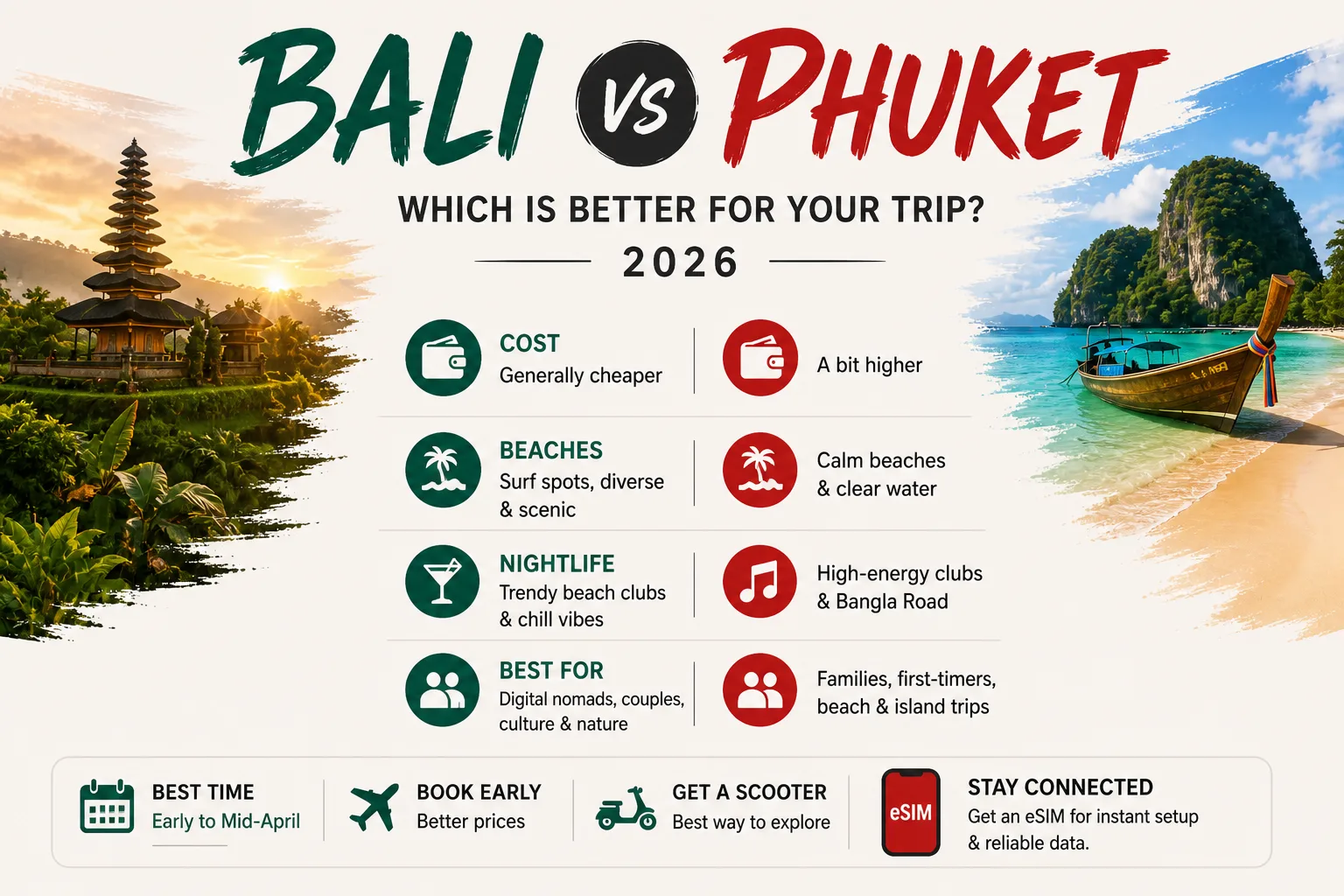
Bali vs Phuket 2026: Which Is Better for Your Trip?
Landing that perfect island holiday feels easier when you match the destination to your priorities, so if you’re weighing Bali vs Phuket 2026 you’ve already taken the first smart step. In my experience, the decision usually boils down to four things: budget, beach type, nightlife vibe, and how important reliable mobile data is to your trip. Before you commit to flights and a villa, take a look at local connectivity options — for example, many travelers pre-buy Indonesia eSIM plans so they can call or message the hotel as soon as they land at Ngurah Rai (DPS) without hunting for an airport SIM counter.
1. Cost of Travel: Bali vs Phuket 2026 (Budgeting & Real Prices)
Cost is often the deciding factor, and the truth is Bali and Phuket both offer low-cost and luxury options — but with notable differences in 2026. For budget travelers, Bali can be cheaper for accommodation: a basic private room in Canggu or Ubud often runs IDR 200,000–450,000 per night (about $12–$27), while comparable budget hotels in Phuket’s Patong or Kata start around THB 800–1,500 ($22–$45) per night. Mid-range hotel prices in Bali are commonly $50–$120 per night for a boutique villa or comfortable 3-star, while Phuket mid-range resorts average $70–$150 in high season. This matters because the same daily budget will get you more private space and often better breakfast options in Bali compared to Phuket.
Food and transportation costs also differ in useful ways. In Bali you’ll find warung meals for IDR 20,000–50,000 ($1.20–$3.00) and western-style restaurants priced $5–$15 for a main, whereas in Phuket street food and local restaurants typically cost THB 50–150 ($1.50–$4.50) per meal and beachside dining can easily push $10–$25 per dish. If you’re budgeting daily expenses, expect about $25–60/day in Bali on a shoestring and $30–70/day in Phuket, excluding accommodation. These are averages and your mileage will vary if you prefer upscale dining or frequent boat trips to nearby islands.
Here’s a practical step-by-step budgeting tip I use when planning: (1) choose your neighborhood (Canggu vs Seminyak; Patong vs Kata), (2) pick accommodation level (hostel/private room/villa), (3) add three daily meal types (street/café/restaurant), (4) include transport (scooter rental vs taxis) and (5) add a data plan or eSIM. That last step — budgeting for mobile data — is often overlooked but can change your total by $5–$25 for a week depending on plan size and whether you buy a local SIM or eSIM. If you want more granular seasonal tips, our Bali-in-June guide explains peak vs shoulder price differences and timing strategies in detail (Bali in June 2026 guide).
Accommodation: Where your money goes
Accommodation is the biggest variable. In Bali you can book a private pool villa in Ubud or Pererenan for $70–$150 per night during shoulder seasons, while beachfront villas in Seminyak and Nusa Dua jump to $120–$350 in high season. In Phuket beachfront resorts in Kamala, Kata and Surin commonly charge $90–$300 per night, with Patong cheaper but noisier in the evenings. Consider this: a $100-per-night Bali villa often includes a compliment breakfast, gardens and better long-stay discounts; a $100 Phuket room will usually be smaller and focused on proximity to tourist areas. I’ve booked both and found longer stays in Bali deliver better per-night value for the same price point.
Transport & Getting Around
Scooters are the cheapest way to move in both places but insurance and local driving norms differ. Scooter rental in Bali averages IDR 50,000–80,000/day ($3–$5), while in Phuket expect THB 250–500/day ($7–$14). Taxis and app-based rides like Grab and Gojek operate widely in Bali with fares from IDR 30,000 for short hops; in Phuket, Grab is available but local metered taxis and minibus transfers remain common with 40–60% higher fares than Bali for similar distances. This is relevant because if you plan island-hopping and long commutes, transport can tip the budget substantially.
2. Beaches & Scenery: Bali vs Phuket Beaches 2026
People searching for “Bali vs Phuket beaches 2026” are usually imagining postcard images, but the beaches on both islands are very different in character. Bali’s coastline offers dramatic contrasts: the rugged cliffs and surf breaks at Uluwatu and Bingin, the wide, golden sands of Kuta and Seminyak, and the calmer white-sand swimming coves around Nusa Dua and Sanur. In contrast, Phuket tends to offer larger, more sheltered bays: Patong is a high-energy tourist beach with jet-skis and crowds, Kata and Karon are family-friendly with clearer water, and quieter beaches like Nai Harn and Freedom Beach provide more secluded swimming. This matters because the beach type you pick will shape your daily activities — surf lessons at Kuta and Uluwatu vs long snorkel trips from Phuket’s Kata Beach.
For example, consider a traveler who loves snorkeling and calm water. In Phuket they can catch a day boat to the Phi Phi Islands or Racha Islands with guaranteed snorkel stops and clear seas, with organized tours often priced THB 1,200–2,500 ($35–$75) including lunch and gear. In Bali, coral snorkeling options are more island-specific: Nusa Lembongan and Nusa Penida provide spectacular snorkeling and manta sightings, but you’ll pay IDR 500,000–1,000,000 ($30–$60) for a half-day boat trip and must account for rougher sea conditions and boat transfers from Sanur. Knowing these differences helps pick the right base depending on your priorities.
Actionable beach day planning: (1) choose your base beach (Seminyak/Kuta for surf and nightlife, Uluwatu for surf breaks, Nusa Dua for calm swimming), (2) pre-book any island boat trips (check inclusion of snorkel gear), (3) bring reef-safe sunscreen and a lightweight dry bag, and (4) install offline maps and offline translations in case you lose signal while island hopping. These four steps will save time and money and keep you flexible when weather changes the plan.
3. Nightlife, Food & Culture: Bali vs Phuket Nightlife 2026
When you compare Bali vs Phuket nightlife 2026, you’re choosing between two different flavors of after-dark entertainment. Bali’s nightlife, centered around Seminyak and Canggu, often blends upscale beach clubs like Potato Head and KU DE TA with lively bars like Motel Mexicola and rooftop venues in Seminyak. The vibe leans towards stylish parties, sunset DJs, and late-night beach club crowds; cover charges range from IDR 100,000 to 300,000 ($6–$18) when international DJs are booked. In Phuket, the epicenter is Patong’s Bangla Road with high-energy clubs like Illuzion and Seduction and a heavier focus on night markets, cabaret shows and go-go bars; cover charges and drinks in Phuket’s large clubs can be similar or slightly lower depending on promotions.
Food scenes differ too and are worth considering. Bali is a food-lover’s paradise with a huge range: local warungs serving nasi campur from IDR 20,000 ($1.20), trendy cafés in Canggu with specialty coffee and bowls for IDR 60,000–120,000 ($4–8), and high-end restaurants offering tasting menus for $40–100+. Phuket’s culinary strengths include seafood restaurants in Rawai and Kata, excellent street food in local markets with meals THB 50–120 ($1.50–$3.50), and international beachfront dining where a seafood platter for two might run THB 600–1,500 ($18–45). If your trip priorities include food exploration, both islands score highly but Bali offers more variety for plant-based and specialty-diet dining scenes.
Here’s a nightlife safety tip I always tell friends: set a meeting point and carry a charged phone and local data plan before heading out. If you land at Phuket International (HKT) late and need to find your hotel on arrival, having an active eSIM or local SIM will save you time and stress. Many venues have unofficial cover fees for foreigners; ask for prices beforehand, and keep a small stash of local cash since card machines sometimes fail in island-side stalls.
4. Bali vs Phuket for Digital Nomads in 2026 (Coworking & Connectivity)
Digital nomads often ask “Which is the best island for remote work 2026 — Bali or Phuket?” My take after extended stays on both islands is that Bali currently holds a slight edge for community, coworking spaces, and long-term lifestyle value, while Phuket is catching up with better infrastructure in specific pockets. Bali’s well-known coworking spaces include Dojo Bali in Canggu and Outpost in Ubud and Canggu, which offer memberships from around $80–$200 per month, reliable fiber or bonded 4G/5G Wi‑Fi, and community events that make networking easy. These spaces also provide meeting rooms and filming-friendly backgrounds, which matter for creators and remote teams.
Phuket’s coworking scene is smaller but growing fast, with spots like Hatch Workspace and The Circle offering day passes THB 300–500 ($9–15) and monthly memberships around THB 3,000–8,000 ($90–240). In Phuket you’ll find fewer coworking communities focused on digital nomads, but the island offers strong 4G/5G coverage from AIS, TrueMove H and dtac in major towns and tourist hubs. That connectivity is crucial when running client calls or uploading large files; in my experience, urban Phuket often delivers stable speeds of 50–150 Mbps on 5G, while Bali can be more variable depending on the area and your ISP or mobile carrier.
From a practical perspective, here are exact steps I recommend for nomads choosing between the two: (1) verify your accommodation’s upload speed with a speed-test screenshot, (2) check coworking memberships and trial days, (3) buy an eSIM as backup from a reliable provider and test speeds on arrival, and (4) budget for occasional co-working days in a stable office on heavy upload days. For eSIM background and compatibility details, read more on our about eSIM page which explains device models and activation tips (about eSIM).
5. Practicalities: Getting There, Getting Around, Visas & Safety
Practical logistics can make or break a trip, and they differ between Bali and Phuket in helpful ways. Bali’s international airport is Ngurah Rai (DPS), located about 13 km south of Denpasar with a taxi to Seminyak typically costing IDR 150,000–300,000 ($9–18) depending on time and traffic. Phuket’s airport (HKT) sits about 30–45 minutes from Patong and offers multiple transport options: airport buses to Patong start at THB 150 ($4.50), while taxis to town are usually THB 700–1,000 ($20–30). These transit differences matter, especially for late arrivals when services may be reduced and private transfer rates spike.
Visa rules in 2026 continue to vary by nationality. Many nationalities enjoy visa exemptions or visa-on-arrival for Indonesia and Thailand, but it’s essential to confirm the latest rules before travel because policies shift. For example, some travelers who plan multi-month stays should verify whether visa runs or social/retirement/long-stay visas fit their plans and budget. Safety-wise, both islands are generally safe for tourists but watch out for scooter accidents, petty theft in crowded tourist spots, and seasonal hazards like southward currents on certain beaches in Phuket. I always recommend travel insurance that explicitly covers scooter incidents and water activities for island travel.
Lost luggage is a common stress point after long international flights. If this happens to you, follow our step-by-step lost-luggage guide which explains airline claims, receipts you’ll need, and how to replace essentials locally (lost luggage guide). Carry a small daypack with one change of clothes, chargers, and a printed reservation copy for your first night so you can manage a lost-bag situation without panic.
6. eSIM for Bali vs Phuket: Data, Costs, Providers & How to Set Up
Connectivity is a deciding factor for many travelers, and the good news is eSIMs work well in both Bali and Phuket in 2026. Do eSIMs work in Bali and Phuket? Yes — but device compatibility and carrier partnerships matter. For Bali you’ll usually connect to Telkomsel, XL Axiata or Indosat depending on location, while in Phuket you’ll see AIS, TrueMove H and dtac as the primary networks. Speeds vary: Telkomsel offers wide coverage in Bali but rural pockets can drop to 10–20 Mbps; in Phuket, AIS and TrueMove H provide strong 4G/5G coverage around tourist areas with frequent mid-50s to 150+ Mbps speeds in urban pockets. These technical differences matter when you plan uploads, video calls and GPS-dependent activities.
Typical eSIM price points in 2026 for short trips look like this: Indonesia eSIM packages commonly start at roughly $3–$5 for 1GB up to $18–$25 for 10–20GB packages valid 7–30 days, while Thailand eSIM plans usually start around $3–$6 for 1–3GB and $8–$20 for larger 7–30 day bundles. If you use more than 5GB for streaming and navigation, budget $12–$25 for a reliably sized plan for a week. In my experience, buying an eSIM before you fly avoids airport queues and ensures you have data for last-mile directions and messaging as soon as you clear immigration.
Step-by-step eSIM setup I follow every trip: (1) check device compatibility (iPhone XS or newer, Google Pixel 3 or newer, Samsung Galaxy S20+ and later are common supported models), (2) purchase a plan from a reputable provider, (3) install the eSIM QR code and label the profile clearly, (4) test mobile data and a quick speed test at the gate or curbside, then (5) keep your home SIM active in the physical slot for any SMS-based two-factor authentication. If you want setup walkthroughs for iPhone and Android devices, our device guide covers activation and troubleshooting in practical detail (iPhone and Android eSIM setup).
Fallback options and reliability
Despite the convenience of eSIMs, I always advise carrying a small contingency plan. Buy a modest local physical SIM if your device doesn’t support eSIM or if you’ll be in remote areas where a second SIM provider offers better coverage. Also, download offline maps and keep a cached copy of your hotel booking in email. In one trip to Nusa Penida I lost signal during a boat transfer and needed cached directions and an offline message to coordinate with the driver; having those local downloads saved the day.
7. Sample 7-Day Budgets & Itineraries: Is Bali or Phuket Cheaper in 2026?
To make this concrete, here are two realistic 7-day sample budgets including estimated eSIM or local data costs so you can compare apples-to-apples. These examples assume a mid-range traveler who wants comfort without luxury and uses local transport and occasional tours.
Sample 7-day Bali budget (Canggu/Ubud split): Accommodation $420 (7 nights at $60), Food $140 (3 meals/day average $6), Transport $70 (scooter rental + occasional taxi), Activities & day trips $150 (Nusa Lembongan day trip $60, temple visits, classes), eSIM/data $12 (7–10GB). Total ≈ $792. This budget highlights how Bali gives you private villas and more mid-range villa options for the same price you might pay for a smaller room in Phuket.
Sample 7-day Phuket budget (Kata/Patong split): Accommodation $560 (7 nights at $80), Food $210 (3 meals/day average $10), Transport $120 (scooter + airport transfers), Activities & day trips $200 (Phi Phi boat trip $60–80, island tours), eSIM/data $10 (7–10GB). Total ≈ $1,100. The higher accommodation and activity costs in Phuket — especially when including speedboat island tours — explain the price gap. Note that peak-season rates (Christmas–New Year in Phuket, July–August in Bali) can push both totals up significantly.
These examples show that Bali tends to be cheaper overall for mid-range travelers while Phuket can become pricier if you prioritize organized island tours and beachfront resorts. If you’re traveling with a family or planning many paid activities, Phuket’s convenience and tour infrastructure may justify the higher cost. Conversely, solo travelers and digital nomads often get more value in Bali.
Conclusion: Which Should You Choose — Bali or Phuket in 2026?
So, which is better: Bali vs Phuket 2026? The best answer depends on your priorities. Choose Bali if you want a broader variety of landscapes, stronger digital-nomad communities, often better accommodation value, and a creative food and café culture. Choose Phuket if your top priorities are straightforward island-hopping to iconic snorkeling locations, a resort-oriented stay with family-friendly beaches, and a more consolidated tourist infrastructure. In my experience, Bali wins for long stays, remote work, and variety; Phuket wins for short beach breaks focused on marine excursions and easy transfers between beach hubs.
If you’re still undecided, here’s a simple next step: list your top three priorities (budget, beach type, nightlife/culture) and match them to the sections above. When you’ve chosen, consider buying an eSIM in advance to remove connectivity stress on arrival; having reliable data makes every first-day logistic — airport transfer coordination, offline maps, and last-minute bookings — far simpler. If you want help picking the right data plan for Bali or Phuket, EasyAlo’s Indonesia and regional eSIM options are a fast way to get online and start exploring immediately.