





 Mexico
 Portugal

























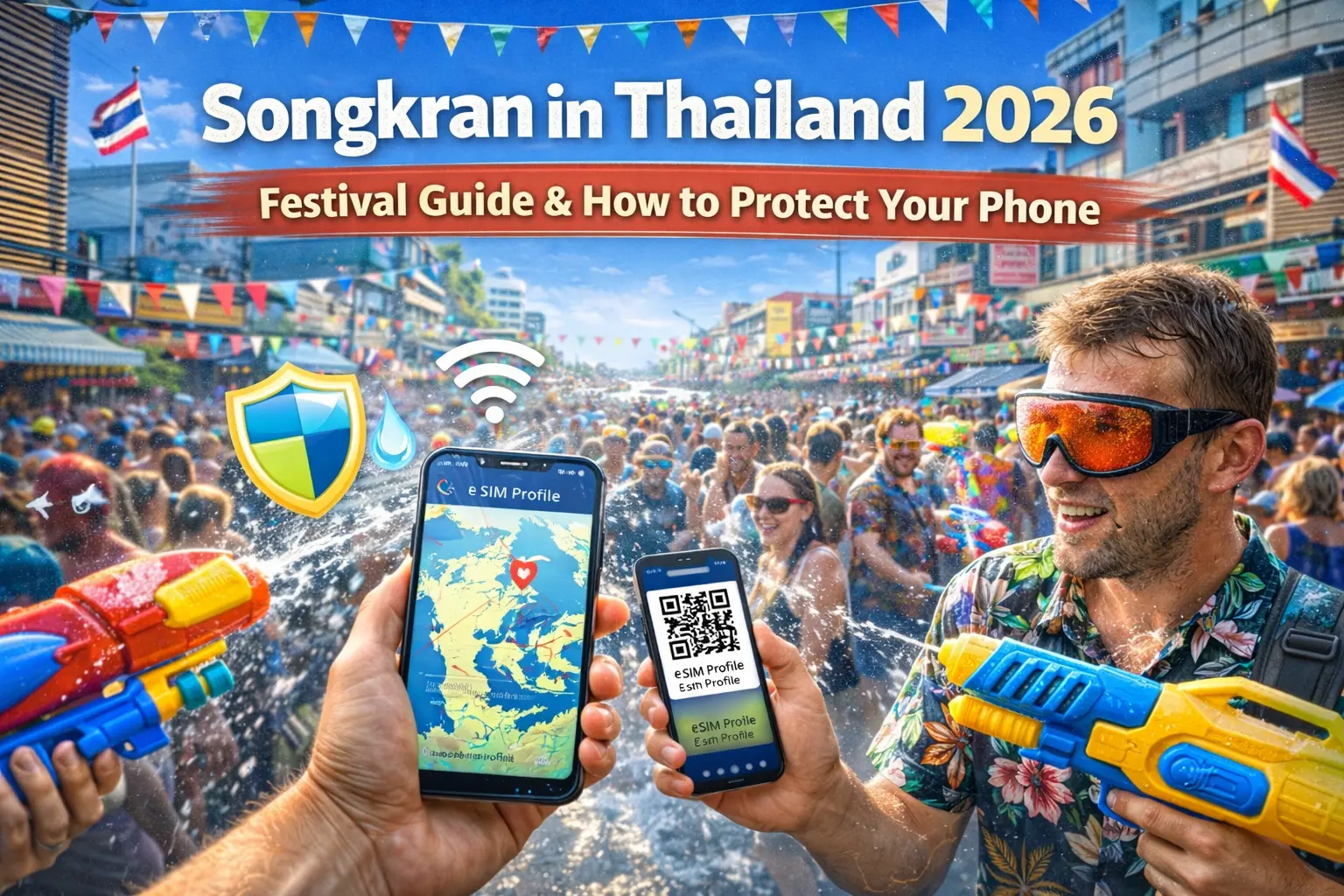
Songkran in Thailand 2026: Festival Guide & How to Protect Your Phone
If you’re planning to experience Songkran Thailand 2026, you’re signing up for one of the most joyful, chaotic, and surprisingly tech-unfriendly festivals on the planet. Imagine walking down a Bangkok side street with water cannons firing from every direction, talc paste smeared on your face, and your phone buzzing with messages from friends trying to find you in the crowd. Now add in the stress of wondering if your smartphone will survive the next bucket of ice water. This guide will walk you through Songkran in Thailand 2026 from both a traveler and connectivity perspective, including how to protect your phone, how to set up a Thailand eSIM for tourists, and how to stay reachable without ruining your device.
Because connectivity is such a big part of travel now, we’ll also look at how an international eSIM can make your Songkran experience smoother—from ordering a Grab car in Chiang Mai to backing up your photos in real time. If you’ve ever landed in a new country, needed Google Maps immediately, and then realized your roaming is off or your SIM doesn’t fit, you already know why planning your mobile setup before Songkran matters. For a deeper primer on how digital SIMs work in general, EasyAlo’s about eSIM overview is a useful background read, but this article will stay focused on Thailand, Songkran, and your phone’s survival.
Songkran Thailand 2026: Dates, Destinations & What Actually Happens
Songkran is Thailand’s traditional New Year, officially celebrated from 13–15 April each year, but in practice the party often stretches to five days or more in major cities. For Songkran Thailand 2026, those core dates still apply, with the main action expected from Monday 13 April through Wednesday 15 April, and spillover events on the surrounding weekend. In my experience, Bangkok usually starts to feel “wet” from the afternoon of the 12th, and in places like Chiang Mai and Pattaya, organized events and stages often run from 12–16 April. This means your travel dates should include at least one buffer day before and after if you want to see both the traditional ceremonies and the full-blown street water battles.
Where you choose to celebrate changes your experience completely. Bangkok’s Silom Road and Khao San Road are the most famous Songkran zones, with thousands of people, loud music, foam machines, and waist-deep puddles. Chiang Mai turns its Old City moat into a giant water battlefield, with pickup trucks circling the square, barrels of water in the back, and locals and tourists drenching each other from sunrise to sunset. In the south, Phuket’s Patong Beach and Koh Samui’s Chaweng area have more of a beach-party vibe, combining water fights with beach bars and sunset views. Each location also differs in how easy it is to retreat to your hotel to dry off, which is worth thinking about if you’re carrying cameras or laptops.
It’s important to understand that Songkran is more than just a water fight. Mornings often start with temple visits, merit-making, and gentle water pouring over Buddha statues and elders’ hands as a sign of respect. In Bangkok, you’ll see this at temples like Wat Pho and Wat Arun, while in Chiang Mai, Wat Phra Singh and Wat Chedi Luang are particularly active. The playful soaking in the streets is the modern, tourist-friendly expression, but Thai families still treat the holiday as a time for cleansing, renewal, and visiting relatives. Knowing this helps you respect dry zones—many temples, markets, and government buildings request no water throwing, and it’s good etiquette to keep your water gun holstered in those spaces.
From a practical standpoint, Songkran changes how cities operate. Traffic in Bangkok often gets lighter during the day because many locals leave town, but the main Songkran streets can be completely gridlocked. Some small shops and family-run restaurants close for several days, while malls and big chains stay open with reduced hours. Public transport like the BTS Skytrain and MRT still runs, but stations near Songkran hotspots can be packed and floors get extremely slippery. This is where having reliable mobile data is crucial: you’ll want to check live traffic, coordinate meeting points with friends, and keep an eye on ride-hailing ETAs, especially in the evening when everyone is wet, tired, and trying to go home at the same time.
Because 2026 falls firmly in Thailand’s hot season, you can expect daytime temperatures around 33–37°C (91–99°F) in Bangkok and Chiang Mai, with humidity making it feel even hotter. The water fights are partly a way to cope with that heat, but they also mean you’ll be constantly moving between soaked and dry, hot and cooled. This has implications for your phone’s battery and performance, as devices tend to overheat faster when sealed in waterproof pouches under direct sun. Planning for shade breaks, indoor cool-downs, and occasional power-bank top-ups will make your Songkran Thailand 2026 experience much more enjoyable.
Why Songkran Is a Phone’s Worst Nightmare (and What to Expect)
On paper, a modern smartphone with IP68 water resistance should handle Songkran without drama. In reality, I’ve watched more than a few iPhones and Samsung Galaxy devices die mid-festival in Bangkok and Chiang Mai. The problem isn’t just water; it’s the combination of high-pressure jets from water guns, talc powder paste, extreme heat, and constant handling with wet, slippery hands. Even if your phone survives the first day, the repeated soaking over several days can push seals and ports beyond what they were designed for, especially on older devices that have seen a few drops or screen replacements.
Another issue is false confidence. Many travelers assume that because their phone is “waterproof up to 1.5 meters for 30 minutes,” it can handle anything. Songkran water isn’t a clean swimming pool; it’s often a mix of tap water, moat water, ice, and powder, which can be more corrosive and leave residue inside speakers and microphones. I’ve seen phones that technically survived but had muffled speakers, distorted microphones, or non-functional charging ports for weeks afterward. When you’re relying on that same device for your Thailand eSIM for tourists, navigation, and two-factor authentication for banking apps, even partial damage becomes a serious travel problem.
There’s also the theft and loss angle, which people talk about less but matters just as much. During Songkran, you’re constantly distracted—aiming your water gun, dodging buckets, laughing with strangers. It’s easy to put your phone down on a bar counter “just for a second” to dry your hands and then forget it when someone splashes you from behind. While Thailand is generally safer than many countries in terms of petty theft, crowded festivals always attract opportunists. I’ve met more than one traveler at Khao San Road who lost both their phone and their hotel details in one go, then had to rely on the hostel’s desktop computer and a sympathetic receptionist to log into email.
Connectivity problems can compound this stress. If your phone gets wet and starts glitching, you may not be able to access your booking apps, translation tools, or ride-hailing services. This is especially tricky if you’re using two phones—one for photos and one as a backup with your eSIM—because you’ll be tempted to pull out the “good camera” phone more often, putting it at risk. Some travelers try to leave their main phone at the hotel and carry only a cheap backup, but then they lose access to all the apps that require verification or can’t install an eSIM on the older device. This is why planning both physical protection and a connectivity strategy in advance is so important.
One more subtle risk is condensation and thermal shock. During Songkran, you’ll move from air-conditioned malls and BTS trains at around 22°C straight into 35°C street heat, then get blasted with ice water. Your phone’s glass and metal expand and contract with each temperature change, and the waterproof seals are constantly stressed. If you’re using a cheap waterproof pouch that traps heat, your device can overheat, throttle performance, and sometimes shut down temporarily. I’ve had my phone show a temperature warning in Chiang Mai’s midday sun even without a pouch; add a sealed plastic bag and continuous 4G use for live streaming, and you’re asking for trouble.
How to Protect Your Phone During Songkran: Practical, Tested Methods
Let’s get into the part you’re probably most worried about: how to protect your phone during Songkran in Thailand. Over several Songkran festivals, I’ve tested different combinations of cases, pouches, and habits, and the most effective approach is layered protection. Think of it like dressing for a storm: one thin layer isn’t enough, but stacking a few smart choices dramatically reduces your risk. You want to protect against water ingress, physical drops, and theft, while still being able to use your phone for photos, maps, and messages when you need it.
First, invest in a proper waterproof pouch with a certified rating, not just a generic street-stall plastic sleeve. Look for pouches rated to at least IPX8 or tested to 10–20 meters, even if you never plan to submerge your phone. In Bangkok and Chiang Mai, you’ll find plenty of stalls selling pouches for 100–200 THB (about 3–6 USD), but quality varies wildly. I recommend buying a reputable brand online before your trip and testing it in a sink or bathtub with tissue paper inside. Make sure the seal is easy to close properly, as you’ll be opening it occasionally to wipe condensation or switch devices. A clear front and back will also let you take photos without removing the phone, which is crucial.
Second, use a robust case underneath the pouch. A slim silicone case might be fine for everyday life, but during Songkran, a drop on wet concrete is much more likely. Consider a shock-absorbing case from brands like Spigen, OtterBox, or UAG, ideally with raised edges around the screen and camera. This helps if you ever need to take the phone out of the pouch in a “safe” area and then get surprised by a stray water gun. Add a tempered glass screen protector as well; talc paste mixed with grit can act like sandpaper, and I’ve seen micro-scratches appear after just a few hours of wiping screens with damp hands.
Third, change how you carry and use your phone. Wearing the pouch on a lanyard around your neck is common, but it also advertises your most valuable item to everyone. I prefer a cross-body strap worn under a light shirt, with the phone pouch hanging near my chest but mostly hidden. When I need to use it, I slide it out, check the map or message, then tuck it back. Avoid walking through the busiest water zones while holding your phone in your hand; that’s exactly when someone will “accidentally” dump a bucket over your head. Designate specific “dry-ish” corners, like under awnings or inside cafes, as your phone-check zones.
Finally, prepare for the worst by backing up and minimizing what’s on the device you carry. Before Songkran Thailand 2026, back up your photos to cloud storage over Wi‑Fi, turn on automatic backups for WhatsApp and other key apps, and remove any sensitive documents or photos from your main gallery. If you’re using EasyAlo or another provider for an international eSIM for Asia travel, keep a copy of your QR code or activation details in a secure cloud folder and maybe printed in your luggage. That way, if your phone does fail and you need to switch to a new device, you’re not starting from zero. This preparation doesn’t take long, but it can turn a potential disaster into a manageable inconvenience.
Staying Connected: eSIM vs Local SIM for Songkran 2026
Once your phone is physically protected, the next question is how to get mobile data in Thailand for Songkran without paying a fortune or spending your first hour in Bangkok queuing at a SIM counter. You essentially have two options: a traditional Thailand travel SIM card vs eSIM. Both can work, but they offer very different experiences, especially when you’re arriving right before a national holiday when airport counters can be understaffed or temporarily closed. In my experience, the less you have to do at the airport after a long-haul flight, the better your first day of Songkran will feel.
With a physical SIM, you’ll typically buy a tourist package from one of the big Thai carriers like AIS, TrueMove H, or DTAC. These packages often include 15–30 GB of data for 8–15 days, plus some local call minutes, for around 299–599 THB. They’re good value, but swapping SIM cards means opening your SIM tray, keeping track of your home SIM, and sometimes dealing with staff who are rushed and might not explain all the settings. During Songkran, I’ve also seen airport counters run low on certain SIM types or have long lines of confused travelers, all trying to get online at once. If you arrive late at night on 12 April, you may find only one counter open with a queue snaking into the arrivals hall.
By contrast, a Thailand eSIM for tourists lets you land with data ready to go. You purchase the plan online before your trip, scan a QR code to install it on your phone, and then activate it either immediately or once you touch down. This is especially handy if you’re connecting through other countries first; for example, if you’re flying via Singapore and already using an EasyAlo Singapore eSIM package, you can switch profiles in your phone settings as you leave Changi and approach Bangkok. There’s no physical card to swap, so there’s no risk of losing your home SIM, and you can keep your regular number active for SMS codes while using local Thai data.
Another advantage of eSIM during a festival like Songkran is flexibility. If you decide to extend your trip from 10 to 14 days, or to add a side trip to another country in the region, you can often top up or buy a new regional plan directly from your phone. Many digital nomads using Thailand as a base choose an international eSIM for Asia travel that covers countries like Thailand, Vietnam, Singapore, and Indonesia under one plan. That way, if you decide mid-Songkran to escape the madness and hop to Bali, you can keep the same data profile active. For reference, EasyAlo’s Indonesia eSIM options pair well with a Thailand plan for travelers doing multi-country Southeast Asia routes.
There are a few cases where a physical SIM might still make sense, such as older phones without eSIM support or travelers who need a Thai phone number for specific services like banking or long-term rentals. However, for most short-term visitors focused on Songkran Thailand 2026, the best eSIM for Thailand 2026 will be one that prioritizes strong coverage in Bangkok, Chiang Mai, and the major islands, offers at least 10–20 GB of high-speed data, and lets you tether to other devices if needed. Always check whether your eSIM plan is data-only or includes a local number; most tourist eSIMs are data-only, which is usually enough if you rely on apps like WhatsApp and Line for calls.
Step-by-Step: Setting Up Your Thailand eSIM Before Songkran
Setting up an eSIM for Songkran isn’t difficult, but doing it in the right order will save you frustration when you land. The ideal time to install your eSIM is one or two days before your flight, while you still have stable Wi‑Fi and time to troubleshoot. If you’ve never used an eSIM before, it’s worth skimming EasyAlo’s guide on activating an eSIM on an iPhone, as the basic steps are similar on most modern devices, including Android phones from Samsung and Google.
Start by confirming that your phone is both eSIM-compatible and unlocked. Most iPhones from the XS onward, Google Pixel models from the Pixel 3, and flagship Samsung Galaxy S and Z series devices from 2019 onward support eSIM. You can usually check under Settings → Mobile/Cellular → Add eSIM or similar. If the option isn’t there, your device may not support eSIM, or your carrier may have restricted it. In that case, contact your home provider or consider using a secondary device that does support eSIM. It’s better to discover this at home than at Suvarnabhumi Airport when you’re jet-lagged and surrounded by water guns on promotional posters.
Once compatibility is confirmed, purchase your Thailand eSIM plan from your chosen provider. You’ll receive a QR code by email or in your account dashboard. On your phone, go to the mobile settings, choose “Add eSIM” or “Use QR code,” and scan it. The phone will create a new cellular profile, which you can label something like “Thailand 2026.” At this stage, you can usually choose whether to activate the plan immediately or later. For Songkran, I recommend installing the eSIM but leaving it inactive until you’re on the plane or have just landed, so you don’t accidentally start the validity period too early.
Next, configure your data and roaming preferences. Set your Thailand eSIM as the default line for mobile data, but keep your home SIM active for calls and SMS if you need to receive verification codes. Turn off data roaming on your home SIM to avoid surprise charges. Many travelers forget this step, then wonder why their bill is huge after a week of streaming and posting festival videos. If you plan to tether a laptop or tablet for work—common among those doing digital nomad Thailand mobile data setups—double-check that your eSIM plan allows hotspot usage and that you know how to enable it in your phone’s settings.
Finally, test everything before Songkran starts. If you arrive in Thailand a day or two early, use that time to verify that maps, translation apps, ride-hailing services, and messaging apps all work smoothly on your eSIM. Do a quick speed test in your hotel and in a busy area like Siam in Bangkok or Tha Phae Gate in Chiang Mai to gauge performance. If anything seems off—like data not connecting, speeds unusually slow, or the eSIM profile showing “No Service”—it’s much easier to troubleshoot calmly then than when you’re already soaked and trying to find your friends in a crowd. EasyAlo’s article on quick eSIM troubleshooting fixes is a good resource to bookmark just in case.
Using Your Phone Safely During the Festival: Navigation, Photos & Backups
Once Songkran is in full swing, you’ll be using your phone differently than on a normal city break. Navigation, coordination, and photography become your main use cases, and each comes with its own risks. For navigation, it’s worth downloading offline maps for Bangkok, Chiang Mai, or wherever you’ll be celebrating. Google Maps and apps like Maps.me let you save regions for offline use, so if your mobile data hiccups in a crowded area or your eSIM briefly loses signal, you’re not stranded. This is especially helpful late at night when some smaller streets near Khao San or the Chiang Mai moat can feel disorienting after hours of water fights and music.
For communication, agree on a backup meeting point with your group in case phones die or get separated. For example, in Bangkok’s Silom area, you might choose the Sala Daeng BTS station entrance as a default regroup spot at a certain time. In Chiang Mai, Tha Phae Gate is a common landmark that’s easy to find. Use messaging apps like WhatsApp, Line, or Telegram to share live locations when possible, but assume that at some point, someone’s battery will hit 1% or their phone will be too wet to respond. A portable power bank of at least 10,000 mAh can be a lifesaver, but remember that charging cables also don’t love being soaked, so keep them in a separate dry pouch inside your bag.
Photography is where most people take the biggest risks with their phones during Songkran. It’s tempting to pull your device out of the waterproof pouch for a “better” shot, especially at golden hour when the light hits the water spray. I’ve done this myself in Chiang Mai, only to get ambushed by a group on a pickup truck who clearly had the same idea as hundreds before me. The safest approach is to accept a slight reduction in image quality and shoot through the pouch. Clean the plastic with a soft cloth beforehand to reduce smudges, and use burst mode or short video clips to capture action rather than fumbling with multiple taps.
Think about backups in real time too. With a solid data plan—whether it’s the best eSIM for Songkran in Thailand or a local SIM—you can enable automatic photo backups to services like Google Photos, iCloud, or Dropbox whenever you’re on Wi‑Fi or mobile data. I usually set mine to back up over mobile data as well during festivals, even if it uses a few extra gigabytes, because losing a phone then also losing all your Songkran memories is a double blow. If you’re worried about data limits, prioritize backing up the best shots each evening from your hotel Wi‑Fi and clearing your camera roll of unnecessary videos that eat storage.
It’s also smart to separate your “festival phone” from your “everything phone” if you have the option. Some travelers carry an older but still eSIM-capable phone, install their Thailand plan there, and use it for all Songkran activities, while keeping a newer flagship device locked in the hotel safe for more serious photography on non-water days. If you go this route, make sure your secondary phone is also set up with essential apps, logged into your email and booking platforms, and able to run your eSIM profile. Multi-country travelers sometimes do the same when hopping from Thailand to Europe later in the year, using a sturdy mid-range device for festivals and a nicer one for destinations like Italy, where they’ll rely on a dedicated Italy eSIM plan for longer-term city exploration.
Songkran Travel Tips Beyond Your Phone: Money, Transport & Respect
While this guide focuses on connectivity and phone protection, a few broader Songkran travel tips will make the whole experience smoother. Money is the first one. ATMs are widely available in Bangkok, Chiang Mai, and the islands, but you don’t want to be fumbling with bank cards and cash in the middle of a water fight. Take out enough cash in the morning—perhaps 1,000–2,000 THB in small bills—and keep it in a waterproof waist pouch or neck wallet separate from your phone. Many bars and some street vendors in tourist areas accept QR payments via Thai apps, but as a visitor you’ll mostly rely on cash and card, so minimizing how often you expose your wallet to the elements is key.
Transport during Songkran requires patience and flexibility. In Bangkok, the BTS and MRT remain the most reliable way to move between areas, but expect stations near Silom and Siam to be crowded and occasionally slippery. Taxis and Grab cars can be harder to book at peak times, especially around sunset when people shift from street soaking to dinner and nightlife. Your mobile data will be essential for checking ETAs and surge pricing. If you’re planning a multi-country trip that includes Songkran and then a hop to Europe, it can be helpful to compare how regional eSIM bundles work; for instance, EasyAlo’s France eSIM solutions are popular with travelers continuing onward to Paris after Southeast Asia.
Respecting local customs is just as important as having fun. Not everyone wants to be soaked all the time, and there are unofficial but widely understood rules: don’t throw water at monks, the elderly, or people in work uniforms; avoid dousing motorbike riders, as it can cause accidents; and don’t use ice-cold water on small children. Many Thais participate enthusiastically in the water fights, but they also appreciate when visitors understand that Songkran has religious and cultural roots. If you visit temples during the holiday, dress modestly, keep your water gear outside, and follow the lead of locals in how they pour water gently over Buddha images.
Clothing choices matter more than you might think. Quick-dry fabrics, secure sandals or water shoes, and a lightweight, long-sleeved shirt can protect you from both the sun and the constant water exposure. Avoid white tops unless you’re comfortable with them becoming see-through, and leave heavy denim at the hotel; it gets waterlogged and uncomfortable fast. A hat and sunglasses with a secure strap can also help, but remember that anything on your body is at risk of getting soaked or knocked off. Treat your outfit as semi-disposable and prioritize comfort and practicality over style.
Finally, build in downtime. Songkran is intense, especially if you go all-in for multiple days in a row. Plan a quieter morning at a cafe or a mall, catch up on backing up photos over Wi‑Fi, recharge your power banks, and let your phone dry out fully before heading back into the fray. If you’re working remotely from Thailand, you might schedule your heavier workdays just before or after the main Songkran dates, then keep the festival days lighter with only essential check-ins. This balance is what keeps many digital nomads coming back year after year, using reliable mobile data to blend work and play without burning out.
Bringing It All Together: Enjoy Songkran 2026 Without Sacrificing Your Phone
Songkran in Thailand 2026 is going to be loud, wet, and unforgettable. It can also be stressful if you’re constantly worrying about your phone, your data, or how you’ll find your friends after dark. By thinking through both the physical risks to your device and the connectivity side—choosing between a Thailand travel SIM card vs eSIM, setting up your plan in advance, and using smart habits during the festival—you can dramatically reduce those worries. The goal isn’t to baby your phone so much that you don’t enjoy the water fights; it’s to protect it enough that it quietly does its job in the background while you focus on the experience.
Layered protection, from a solid waterproof pouch and case to smart carrying habits and regular backups, will handle most of the “how to protect your phone during Songkran” question. On the connectivity front, a well-chosen eSIM with generous data, good coverage in key Songkran cities, and hotspot support gives you the freedom to navigate, share, and work as needed. If you’re already planning other trips in 2026—maybe skiing in the Alps or exploring the UK later in the year—it’s worth getting comfortable with eSIM now; many travelers who start with Thailand soon find themselves using regional options like a dedicated United Kingdom eSIM package for their next adventure.
Ultimately, the best eSIM for Thailand Songkran 2026 is the one that fits your travel style: enough data for all your photos and navigation, straightforward activation, and the flexibility to handle last-minute plan changes. Combine that with a bit of prep—backups, offline maps, and a clear plan for how and when you’ll use your phone—and you’ll be free to lean into the chaos. When you’re standing in the middle of Silom Road at sunset, drenched, laughing, and watching water spray catch the light, you’ll be glad your phone is safe, your connection is solid, and the only thing you have to worry about is who you’re going to splash next.