





 France
 Italy
Italy Mexico
 Singapore
 Spain
Spain




























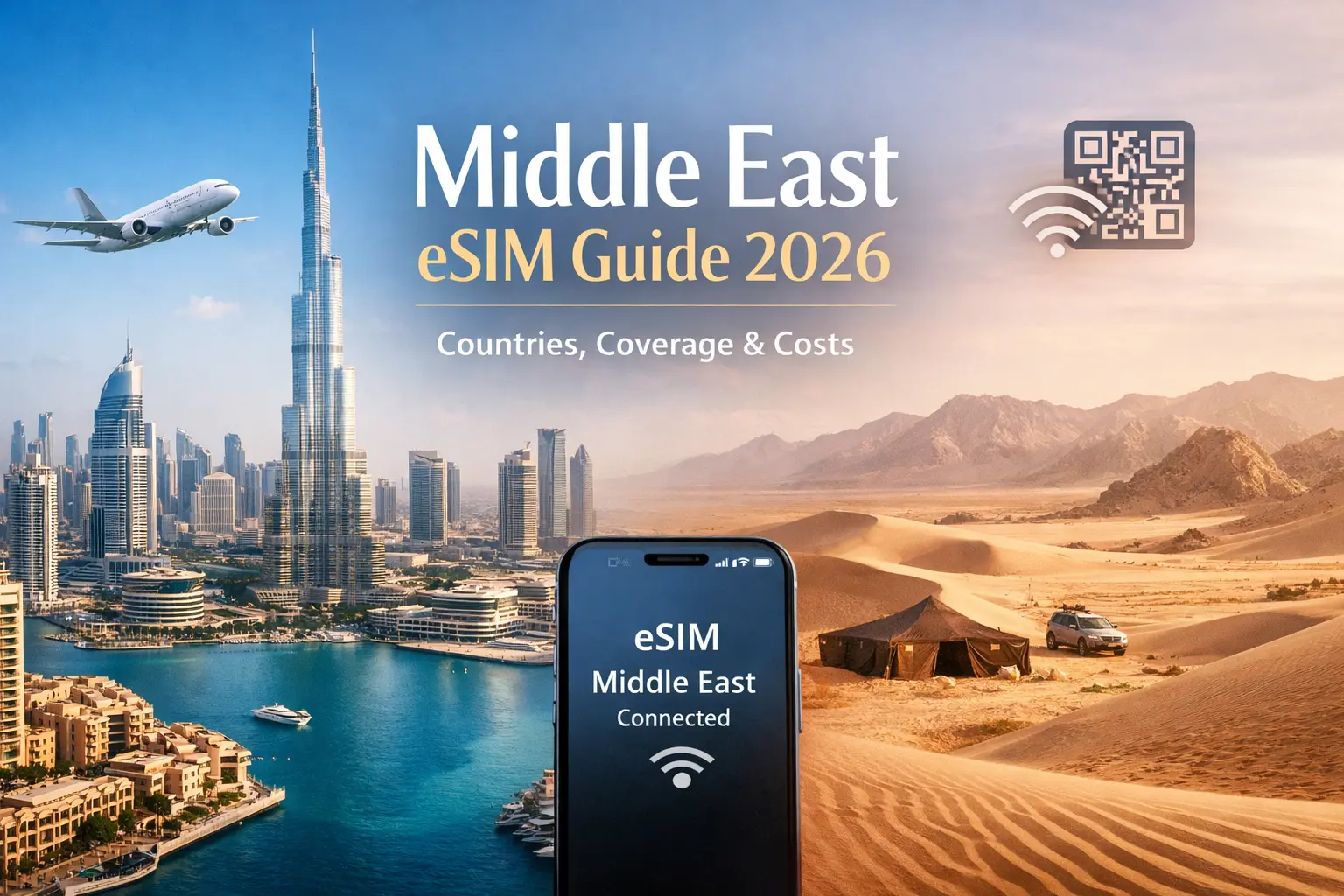
Middle East eSIM Guide 2026: Countries, Coverage and Costs
Picture this: you land in Dubai at midnight after a long connection through Istanbul. Your hotel driver is waiting somewhere outside, the airport Wi‑Fi keeps dropping, and your banking app wants to send a security code before you can book an Uber. This is exactly the moment when having a Middle East eSIM already installed and ready to go feels like a superpower. In this Middle East eSIM guide for 2026, we’ll walk through where eSIM works in the region, how coverage and costs compare, and what you can realistically expect when you rely on digital connectivity in places like the UAE, Saudi Arabia, Jordan and beyond. If you’ve used regional eSIMs in Europe or Asia before, this will feel familiar, but the Middle East has a few quirks worth understanding before you fly.
Before we dive into specific countries and prices, it helps to understand how eSIM works and why so many travelers are switching away from physical SIM cards. If you’ve ever juggled tiny bits of plastic at a café table in Rome or compared data plans for Turkey eSIM options at the airport, you already know that traditional roaming can be clunky and expensive. A travel eSIM for the Middle East lets you scan a QR code, download a profile, and be online the moment your plane touches down. In this guide, I’ll share what has actually worked for me across the region, from getting maps in Amman at 3 a.m. to uploading desert photos from Wadi Rum, so you can avoid surprises and stay connected on your own trip.
1. Quick primer: how eSIM works in the Middle East
At its core, an eSIM is just a SIM card that lives inside your phone as a tiny programmable chip instead of a removable piece of plastic. In 2026, almost all flagship phones and many mid‑range models support eSIM, including iPhone XR and later, Google Pixel 4 and up, and Samsung Galaxy S20 series and newer. When you buy a Middle East data eSIM from a provider like EasyAlo, you’re essentially buying a digital profile that can be downloaded onto that chip. The profile tells your phone which local networks to connect to in each country and what data allowance you have. This means you can switch between your home SIM and your travel eSIM in your settings, without ever opening your SIM tray.
In the Middle East, eSIM support is now widespread in major hubs. The UAE, Saudi Arabia, Qatar, Bahrain, Kuwait, Oman, Israel and Jordan all have operators that support eSIM at the network level, which is why regional providers can offer strong Middle East eSIM coverage there. For example, a regional eSIM might connect you to Etisalat or du in Dubai, STC or Mobily in Riyadh, and Zain in Amman, all under a single QR code. In my experience, this multi‑network approach is what makes regional eSIMs so practical: you don’t have to research each operator individually or stand in multiple airport lines if you’re crossing borders.
Technically, nothing changes for you as the user once the profile is installed. Your phone still shows a signal bar, 4G or 5G icons, and data usage just like it would with a regular SIM. Behind the scenes, the eSIM profile handles authentication with the local carrier, just as a plastic SIM would. The biggest difference is flexibility. You can store multiple eSIM profiles for different trips and toggle them on and off in your settings, which is especially handy if you’re combining a Middle East trip with, say, a week in Europe using a dedicated Europe eSIM setup. This digital layer also makes it easier to troubleshoot: deleting and re‑adding a profile often fixes connectivity issues faster than anything a physical SIM can offer.
One important nuance in the region is that some countries still have stricter telecom regulations or patchy rural coverage, even if cities are well served. That means your Middle East eSIM might deliver blazing 5G speeds in Doha but fall back to 3G or 4G in remote desert areas of Oman or the Saudi Empty Quarter. This is not a limitation of eSIM technology itself but of the underlying networks. Experienced travelers know that downloading offline maps in Google Maps or Maps.me before a long desert drive is still smart, even if you expect strong coverage most of the time. In short, eSIM gives you the best of what local networks can offer, but it can’t create coverage where none exists.
2. Countries covered: where a Middle East eSIM works in 2026
When travelers ask, “Which Middle East countries support eSIM in 2026?”, they’re really asking two different questions: which countries have networks that technically support eSIM, and which countries are actually included in a regional eSIM for the Middle East. Those lists overlap heavily but aren’t always identical. By 2026, most regional Middle East eSIM plans from providers like EasyAlo typically cover at least 10–14 destinations, focusing on where travelers most commonly go and where roaming agreements are stable.
As of early 2026, you can expect a typical regional eSIM for Middle East travel to include the United Arab Emirates (Dubai, Abu Dhabi, Sharjah), Saudi Arabia (Riyadh, Jeddah, Dammam), Qatar (Doha), Bahrain (Manama), Kuwait, Oman (Muscat, Salalah), Jordan, Israel, and often Lebanon. Some plans also extend to nearby countries often bundled in wider regional offerings, such as Egypt or Türkiye, though those are sometimes categorized under North Africa or a separate Turkey product. If your route includes Istanbul plus Dubai, it can be worth comparing a dedicated Middle East eSIM with specific single-country options in Europe and other regions to avoid paying for coverage you do not need.
Coverage within each country is where the real differences show up. In the UAE, for example, Middle East eSIM coverage is usually excellent along the Dubai–Abu Dhabi corridor, at major malls like Dubai Mall and Yas Mall, and in tourist hotspots like Palm Jumeirah and the Louvre Abu Dhabi. In my own trips, I’ve had consistent 5G in these areas, with speeds often exceeding 150 Mbps, which is more than enough for HD video calls and rapid uploads. In contrast, when I drove the coastal road in Oman from Muscat to Sur, I noticed that my eSIM connection dipped to 3G in a few stretches between small towns, though it remained usable for maps and messaging.
Jordan is a great example of how a well‑designed eSIM plan can lean on the strongest local networks. EasyAlo’s Jordan eSIMs, for instance, connect to Umniah and Zain, which means you get excellent 4G and 5G in Amman, Aqaba, Petra, Wadi Rum and around the Dead Sea. That same principle applies across the region: regional eSIMs are usually configured to prefer the top‑tier operators in each country. When you see a plan that lists multiple partner networks, that’s a good sign. It means if one network has a temporary issue in, say, central Doha, your phone can often latch onto a different one without you doing anything. This multi‑network redundancy is one of the quiet advantages of using a travel eSIM Middle East solution rather than relying on a single local SIM.
3. Coverage expectations: cities, deserts and border zones
Middle East eSIM coverage is generally excellent in major cities and tourist corridors, but it’s not uniform once you step off the beaten path. In cities like Dubai, Riyadh, Doha, Tel Aviv and Amman, you can expect strong 4G and increasingly 5G coverage not just downtown but also in residential neighborhoods and at airports. I’ve streamed live video from Dubai Marina, uploaded 4K clips from the Doha Corniche, and used ride‑hailing apps late at night in Amman without a hitch. In these urban environments, an eSIM will perform just as well as a local SIM because both are using the same underlying networks.
Once you move into rural or desert areas, the story changes slightly. On a trip through Wadi Rum in Jordan, for example, my eSIM maintained a solid 4G connection near the main camp clusters but dropped to intermittent service when we went deeper into the protected area for a sunset jeep tour. This wasn’t specific to eSIM; my guide’s local SIM on the same network behaved the same way. In Oman’s Wahiba Sands and parts of Saudi Arabia’s vast interior, coverage can be spotty between towns. This is where having downloaded offline maps and key booking confirmations becomes essential, because no Middle East eSIM, no matter how good, can compensate for a complete lack of cell towers.
Border zones and cross‑country highways are another interesting edge case. When you’re traveling by land between, say, Jordan and Israel or UAE and Oman, your phone may briefly latch onto multiple networks as it negotiates the handover. With a regional eSIM for Middle East travel, this usually looks like a short period of “No Service” followed by a new carrier name appearing at the top of your screen. In my experience driving between Dubai and the Omani exclave of Musandam, the handover took less than five minutes, and data resumed automatically without any manual setting changes. Still, it’s wise to avoid banking transactions or critical uploads right during these transitions.
One more nuance that travelers sometimes overlook is indoor coverage. In ultra‑modern malls in Doha or Dubai, indoor coverage is generally excellent thanks to distributed antenna systems. But in older stone buildings in Jerusalem’s Old City or thick‑walled riads in some historic districts, signal can weaken inside. A Middle East eSIM cannot change physics, but you can plan around it. I’ve learned to quickly check signal strength near hotel windows and, if needed, step into a courtyard or balcony when making important calls over WhatsApp or FaceTime. If you’re planning a winter escape to North Africa as well, it’s worth reading a detailed guide like the one for Morocco winter travel and connectivity, because the same building‑related coverage quirks often apply.
4. Middle East eSIM costs in 2026: what you’ll actually pay
Let’s talk numbers, because “Is eSIM cheaper than roaming in the Middle East?” is one of the first questions people ask. In 2026, international roaming from many North American and European carriers still runs anywhere from US$8 to US$15 per day for a small data allowance, often around 500 MB to 1 GB. If you’re spending 10 days between Dubai and Amman, that can easily add up to US$80–150 per line. By contrast, regional Middle East eSIM cost structures are usually based on total data over a set number of days, and the savings can be significant—often 40–60% compared with roaming, depending on how data‑hungry you are.
As a ballpark, you’ll commonly see Middle East data eSIM plans starting around US$15–20 for 3–5 GB valid for 7–10 days, US$25–35 for 10–15 GB valid for 15 days, and US$40–60 for 20–30 GB valid for 30 days. Heavy‑use travelers who stream a lot or work remotely might look for unlimited or high‑cap plans, which can run US$60–90 for a month of multi‑country coverage. When I spent three weeks between the UAE, Oman and Jordan, I used roughly 18 GB of data for maps, ride‑hailing, social media, and a few video calls. A 20 GB regional plan around US$45 easily covered this, and I never had to think about roaming charges.
Cheapest eSIM plans for Middle East data roaming are not always the best value if they come with very low speeds or limited network partners. A rock‑bottom plan that only connects to one budget network in each country might leave you frustrated in crowded areas, where premium networks prioritize their own customers and higher‑tier roaming partners. This is why I always recommend checking not just the headline price, but also which operators the plan uses and whether 5G is supported. It’s the same logic I apply when comparing regional bundles with single‑country products like Mexico eSIM data plans or Southeast Asia packages: sometimes paying a few dollars more for better networks saves you a lot of stress on the ground.
One counterintuitive tip: if you’re traveling as a couple or family, it can be cheaper to buy one larger data plan and hotspot from that device than to buy multiple small plans. For example, a solo 30 GB plan at US$50 plus hotspotting to a partner’s phone might be more economical than two separate 10 GB plans at US$30 each. The trade‑off is that the hotspot phone needs decent battery life and should stay with the group most of the time. I’ve done this on road trips in Oman and Saudi Arabia, where one phone sat on the dashboard running maps and sharing data, while the others stayed in battery‑saving mode for photos and messaging. Just remember to check your plan’s terms; most travel eSIMs allow personal hotspot use, but it’s always good to confirm.
5. eSIM vs physical SIM in the Middle East: which should you choose?
Comparing Middle East eSIM vs physical SIM for travelers comes down to three main factors: convenience, cost, and control. Physical SIMs bought on arrival can sometimes be a bit cheaper on a per‑gigabyte basis, especially if you’re staying in just one country for several weeks. For instance, in the UAE you might find a tourist SIM from Etisalat or du with 10–20 GB and local calls for around US$25–35. In Jordan, local prepaid SIMs from Umniah or Zain often offer generous data bundles at competitive prices. If you’re comfortable navigating local shops, showing your passport, and dealing with paperwork in busy arrivals halls, this can be a solid option.
However, that “airport SIM” experience is exactly what many travelers are trying to avoid. After a red‑eye flight into Riyadh or Kuwait City, the last thing you may want is to queue at a kiosk, hand over your passport, and hope the staff set up your APN correctly while you’re half asleep. With a Middle East eSIM, you can install the profile at home, test that it appears in your phone settings, and then simply toggle it on when the cabin crew says you can use your phone again after landing. Your data starts working as soon as you connect to a supported network, and you can head straight to immigration while already online. This difference in first‑hour stress is hard to quantify in dollars, but every frequent traveler I know values it highly.
Control is another subtle advantage. With an eSIM, you keep your physical SIM slot free for emergencies or special cases. If you’re traveling from Europe, you might want to keep a local SIM active for banking SMS while also running a regional travel eSIM Middle East profile for data. On dual‑SIM phones, you can choose which line handles calls and which handles data, and you can switch off data roaming on your home line entirely to avoid surprise bills. I’ve done this combo approach on trips that combined the Middle East with Europe, using a regional Middle East plan and then switching back to an existing European profile for a few days in Paris, similar to how you might juggle between a Middle East eSIM and a dedicated France data eSIM.
There are still a few edge cases where a physical SIM makes sense. If you’re moving to a Middle Eastern country for several months or more, a local postpaid plan with a resident ID can be cheaper over the long term and offer full local call and SMS bundles. Also, if your phone is older and doesn’t support eSIM, a physical SIM is your only option. But for most short‑term travelers—those doing 5 days in Dubai, a week in Jordan, or a two‑week multi‑country itinerary—eSIM offers a cleaner, more flexible, and often cheaper alternative to both roaming and traditional SIM cards.
6. How to set up and activate a Middle East eSIM step by step
Installing and activating a Middle East eSIM is less technical than it sounds, but doing it in the right order can save you a lot of stress. I always recommend starting the process at home on a stable Wi‑Fi connection, ideally at least a day before your flight. After you purchase your plan, you’ll receive a QR code and sometimes a manual activation code by email. On an iPhone, you go to Settings → Mobile Service (or Cellular) → Add eSIM, then choose “Use QR Code” and point your camera at the code. On Android devices like recent Samsung Galaxy or Google Pixel models, the path is similar: Settings → Connections → SIM Manager or Network & Internet → + Add eSIM → Scan QR code.
Once scanned, your phone will download the eSIM profile and ask you to label it, for example “Middle East Trip.” This label is just for your reference and is especially handy if you also use other regional profiles, such as one for Southeast Asia or a dedicated Indonesia travel eSIM. At this stage, you can choose whether to use the new eSIM for mobile data, calls, or both. For most travelers, the best setup is to keep your home SIM active for calls and SMS (if you expect verification codes) but disable data roaming on it, and then set the Middle East eSIM as your default line for mobile data. This way, all your apps use the affordable local data while your regular number remains reachable over Wi‑Fi or when needed.
Activation timing is another common question. With most travel eSIMs, the validity period only starts when the eSIM first connects to a supported network in the destination region, not when you install the profile. That means you can safely install it at home without “wasting” days. I usually toggle the eSIM off after installation, then, as the plane lands and I switch off airplane mode, I enable the eSIM line and watch for the local network name to appear. Within a minute or two, I usually see 4G or 5G icons and can load a web page. If you don’t see data working, checking APN settings, restarting the phone, or briefly toggling airplane mode on and off often resolves it. In stubborn cases, deleting and re‑adding the profile using the original QR code is a reliable fix.
One more practical tip: take a screenshot or printout of your QR code and any manual activation details. Airport Wi‑Fi in the region can be hit or miss, and if you’re relying on email access to retrieve the QR code at the last minute, you might find yourself stuck. Having the code saved in your photos or printed in your carry‑on means you can always reinstall the eSIM if you switch phones or accidentally delete the profile mid‑trip. I’ve had to do this once after a factory reset on a Pixel phone in Doha, and that screenshot is what saved me from a very offline evening.
7. Device compatibility and practical tips for 2026
By 2026, most mid‑range and high‑end smartphones support eSIM, but compatibility is still the number one cause of last‑minute panic emails. The basic rule is: your phone must be both eSIM‑capable and carrier‑unlocked. iPhones from the XR/XS series onward, Google Pixel 4 and newer, and Samsung Galaxy S20 and newer generally support eSIM. Some budget Android models sold by carriers, however, still ship without eSIM hardware, or they have eSIM disabled in software. Before you buy a Middle East eSIM, it’s worth checking your device settings for an “Add eSIM” or “Add mobile plan” option. If you can see that option, you’re almost certainly good to go.
Another nuance is regional locking. Some phones bought in specific markets may be locked to a single carrier for the first few months, or their firmware may restrict eSIM use to local profiles. This is less common in 2026 than it was a few years ago, but I still occasionally hear from travelers whose dual‑SIM phones from certain Asian markets won’t accept foreign eSIMs. If you’re unsure, contact your carrier and ask whether your device is unlocked and whether it supports international eSIMs. EasyAlo also maintains a comprehensive list of compatible devices, similar to what you’d check if you were confirming whether your phone works with a dedicated product like a UK eSIM for London travel.
Tablets and wearables add another layer. Many iPads with cellular capability and some LTE‑enabled smartwatches support eSIM, but travel eSIMs are generally designed for phones first. If you’re planning to work on an iPad while in Dubai or Riyadh, the easiest approach is often to install the Middle East eSIM on your phone and use it as a hotspot. This avoids any compatibility surprises and keeps all your data usage in one place. On a multi‑city work trip between Doha, Abu Dhabi and Muscat, I ran my laptop and tablet entirely off my phone hotspot for two weeks without issue, using around 12 GB of data for calls, cloud docs and light streaming.
Finally, remember that eSIM does not change your phone’s need for power. High‑speed 5G in particular can drain batteries faster, especially if you’re using GPS and hotspotting. Carrying a 10,000–20,000 mAh power bank is almost as important as choosing the best eSIM for Middle East travel. I’ve lost count of how many times a dead phone would have meant getting lost in a new city or missing a pickup, from Amman’s bus station to Muscat’s corniche. Good connectivity plus a dead battery still equals zero help.
8. Real‑world scenarios and smart usage strategies
To make all of this more concrete, it helps to imagine how a Middle East eSIM fits into actual travel days. Say you’re flying into Dubai for three days, then heading to Jordan for a week. With a regional plan, you install your eSIM at home, label it “Middle East Trip,” and set it as your data line. You land at DXB, turn off airplane mode, and your phone connects to Etisalat or du within a minute. You message your hotel on WhatsApp to confirm late check‑in, order a Careem or Uber, and load Google Maps to find the right exit. The next morning, you use the same eSIM to get directions to the Burj Khalifa, check dress codes for a mosque visit, and upload photos to Instagram without worrying about roaming fees.
A few days later, you fly to Amman. As the plane descends, you’re still using the same eSIM; there’s no need to swap anything. After landing, your phone detects a Jordanian network like Umniah or Zain, and data resumes automatically. You use your saved QR code from your hotel booking, call your driver via a data‑based app, and check the latest entry rules. On the way to Petra the next day, you download offline maps in case coverage drops in the mountains, but your eSIM keeps you connected in most towns along the way. The same profile that served you in Dubai now covers you in Wadi Musa and later in Wadi Rum, where you send a quick message to family back home from a Bedouin camp under the stars.
Another scenario: you’re doing a multi‑country winter escape that includes Istanbul, Dubai and a side trip to Oman. You might decide to pair a regional Middle East eSIM with single‑country options in other regions, just as you might use a dedicated Greece island‑hopping eSIM for a separate summer trip. On this itinerary, you could use a Turkey‑specific product while in Istanbul, then switch your data line to the Middle East eSIM as you fly to Dubai. Later, when you land in Muscat, the same Middle East profile remains active, and you never once have to open your SIM tray or hunt for a kiosk.
Smart usage also means being intentional about what you do on mobile data. Backing up thousands of photos to the cloud or downloading massive system updates on a cellular connection can chew through even generous plans quickly. I usually set my phone to only update apps on Wi‑Fi and disable automatic photo backups until I’m on a strong hotel network. For heavy streaming—say you’re catching up on a series during a long layover in Doha or Riyadh—it’s often better to download episodes in advance over Wi‑Fi. This way, a 10–20 GB plan comfortably covers maps, social media, messaging, ride‑hailing, and a reasonable amount of video calls for a one‑ or two‑week trip.
If you’re planning more complex itineraries that span multiple regions over several months, it can be helpful to read destination‑specific connectivity guides, like those for choosing connected destinations by month or seasonal deep dives such as Japan winter travel and eSIM tips. The same planning mindset—checking coverage expectations, estimating data needs, and confirming device compatibility—applies just as much to the Middle East as it does to Europe or Asia. Once you’ve done it for one trip, the process becomes second nature.
9. Key takeaways: choosing the best Middle East eSIM for your trip
By now, you’ve seen that a Middle East eSIM is more than just a way to “have internet.” It’s a tool that shapes how confidently you move through airports, cities and remote landscapes across the region. When you land in Dubai or Doha already connected, you skip the SIM card scramble and go straight to what matters—finding your hotel, meeting your driver, or grabbing that first shawarma. When your eSIM seamlessly switches networks as you cross borders into Jordan, Oman or Saudi Arabia, you can focus on the journey instead of your signal bars.
To choose the best eSIM for travel to the Middle East in 2026, start with your itinerary. List the countries you’ll visit and how many days you’ll spend in each. Then, compare regional plans that cover all of them against single‑country options, similar to how you’d weigh a regional bundle against a focused product like a Georgia eSIM for the Caucasus. Look for clear information about partner networks, 4G/5G support, hotspot allowance, and total data. If a plan is dramatically cheaper than others, ask yourself what you might be sacrificing—often it’s network quality or customer support.
Finally, give yourself a small test run before you leave. Install the eSIM, check that it appears in your settings, and familiarize yourself with switching data lines and turning roaming on and off. Save your QR code offline, pack a power bank, and download key maps and documents just in case you pass through low‑coverage areas. With these simple steps, a Middle East eSIM becomes a quiet, reliable ally in the background of your trip. You’ll still have the occasional hiccup—no technology is perfect—but you’ll avoid the worst‑case scenarios of being offline when you most need to be connected. And that peace of mind is worth far more than the cost of the plan itself.