






 Australia
 Greece
 Portugal
 Turkey




























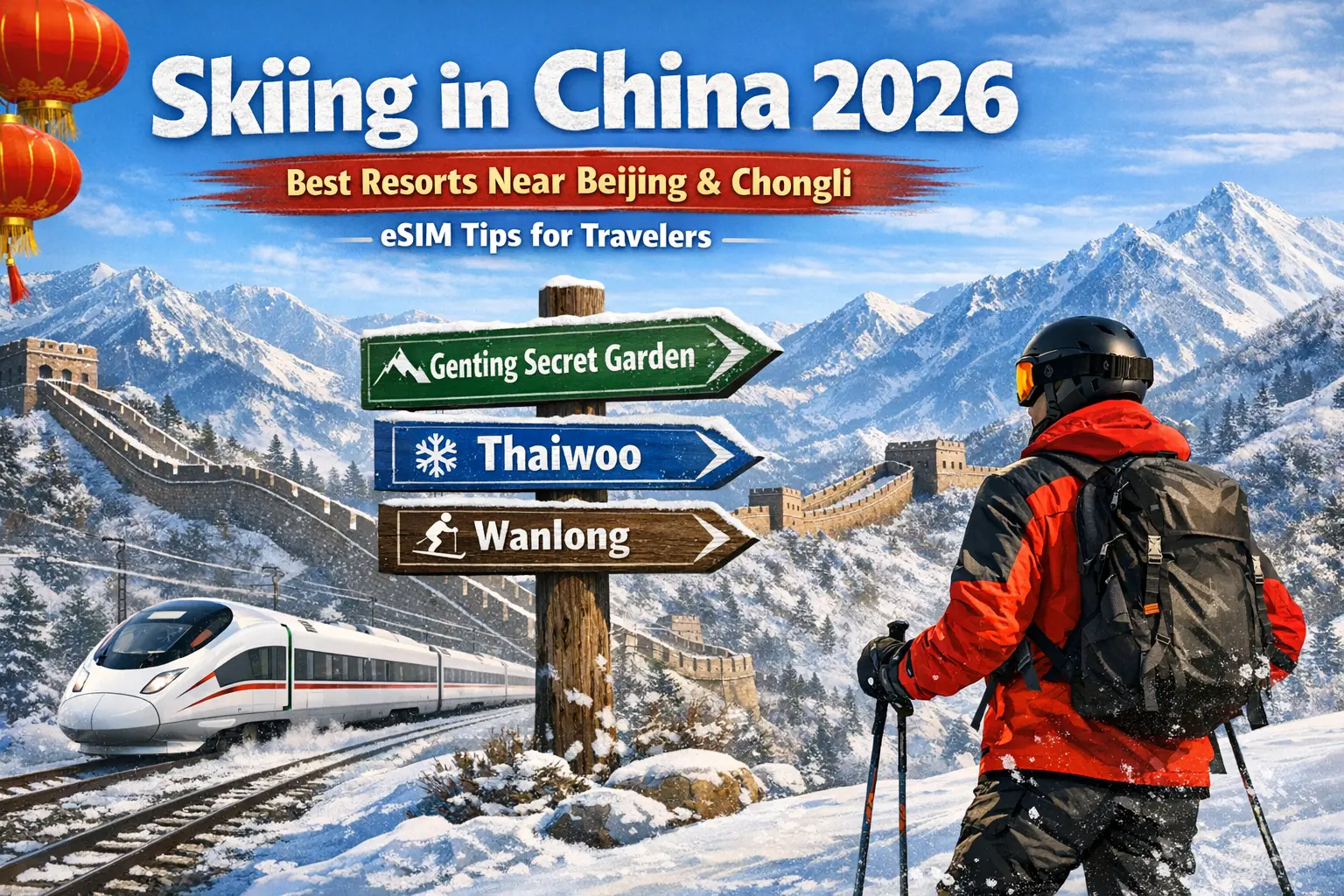
Skiing in China 2026: Best Resorts Near Beijing & Chongli with Smart eSIM Tips
If you’re thinking about skiing in China 2026, you’re not alone. Since the Beijing 2022 Winter Olympics, the mountains around Beijing, Chongli, and Zhangjiakou have gone from under-the-radar to seriously impressive, with modern lifts, fast trains from the capital, and resorts that can easily fill a week-long trip. The part most people underestimate isn’t the snow, though—it’s the logistics and staying connected in a country with the Great Firewall and very different mobile rules. That’s where planning your China eSIM for tourists in advance makes a huge difference, especially if you rely on maps, translation apps, and messaging to coordinate your ski days.
In this guide, we’ll walk through the best ski resorts near Beijing and Chongli for 2026, how to get there without stress, what to expect on and off the mountain, and exactly how to keep your phone online using an eSIM. I’ll share the kind of details you only notice once you’re standing in a crowded Beijing train station with your skis and no Wi‑Fi, plus a few counterintuitive tips that can save you both money and hassle. By the end, you’ll know which resort fits your style, how to navigate the journey, and how to set up connectivity that just works the moment your plane lands.
Why Skiing in China 2026 Is Worth Your Radar
China’s ski scene has changed more in the last decade than some European countries have in thirty years. The Beijing 2022 Winter Olympics poured billions of yuan into lift infrastructure, snowmaking, highways, and the high-speed rail line between Beijing and Zhangjiakou. Resorts like Genting Secret Garden and Thaiwoo went from local hills to full-scale destinations with gondolas, modern chairlifts, and terrain parks that can actually challenge advanced riders. For travelers planning their Beijing 2026 winter travel guide, that means you’re not just taking a curiosity trip—you’re heading to a legitimately competitive ski region.
One big surprise for many visitors is how close the mountains are to the capital. You can land at Beijing Capital International Airport (PEK) in the morning, jump on the Jingzhang high-speed train from Qinghe or Beijing North station, and be checking into your Chongli hotel in about two and a half hours door to door. In my experience, that’s often quicker than getting from Geneva to some of the big French resorts, especially on a Saturday. This proximity makes China a realistic option even for a five- or six-day ski break rather than a long expedition.
Another reason 2026 is a smart year to go is that the post-Olympic rush has calmed down. The infrastructure is still new, but the initial crowds and teething problems have eased. Lift queues at major Zhangjiakou ski resorts from Beijing can still be busy on Chinese public holidays, but midweek in January or early March you’ll often find short lines and plenty of space. Add to that a growing ecosystem of English-speaking ski schools and rental shops, and it’s much less intimidating than it was even five years ago.
From a connectivity point of view, China is also more manageable than many first-time visitors expect—as long as you plan. Resorts, hotels, and trains tend to have Wi‑Fi, but it’s often crowded, sometimes filtered, and occasionally requires a Chinese phone number to log in. That’s why experienced travelers now lean heavily on a China travel eSIM for skiing instead of gambling on public networks. You’ll feel that difference the first time you’re trying to translate a rental form at Genting Secret Garden or route a Didi ride back to your hotel in Chongli after après-ski hotpot.
Getting to Beijing, Chongli & the Olympic Ski Cluster
Most international skiers will fly into either Beijing Capital (PEK) or Beijing Daxing (PKX). PEK is closer to the high-speed rail stations that serve the ski areas, but Daxing has a stunning, efficient terminal that’s often less crowded. When I last connected through PEK for a winter trip, it took me around 40–60 minutes to clear immigration and baggage in early January, which is pretty typical. If you’re planning tight connections to the train, give yourself at least three hours from scheduled landing to departure time, especially if you’re carrying ski bags that might come out on an oversize belt.
From central Beijing to the mountains, the game-changer is the Jingzhang high-speed railway. Trains run from Beijing North and Qinghe stations to Chongli’s Taizicheng and Chongli stations, which serve the Olympic ski cluster. The ride takes roughly 60–70 minutes at speeds up to 350 km/h and costs in the range of 90–150 RMB (about USD 13–21) for second class. Tickets during peak winter weekends can sell out, so it’s worth booking a few days in advance through Chinese rail apps or via your hotel. This is one of those moments where having mobile data already active on your phone is invaluable; trying to navigate Chinese-language booking screens on patchy station Wi‑Fi is not fun after a long-haul flight.
Once you arrive in Chongli, resorts like Genting Secret Garden, Thaiwoo, and Wanlong are a short shuttle or taxi ride from the station. Many hotels offer pre-booked transfers if you share your arrival time. In 2022 I found that resort shuttles were reasonably punctual but not always clearly signed in English, so I kept my translation app open and sometimes showed drivers the Chinese characters for my hotel. With a local data connection from an eSIM, you can also use Didi (China’s Uber equivalent) around Chongli, which is often more straightforward than negotiating prices on the spot.
If you prefer more flexibility, you can also hire a private driver from Beijing to the resorts. Door-to-door transfers from downtown Beijing to Chongli usually take around 3–3.5 hours in winter conditions and cost roughly 1,200–1,800 RMB (USD 170–260) one way for a standard car or van. This can make sense for groups with a lot of gear or families traveling with kids. Just keep an eye on weather forecasts; heavy snowfall can slow road traffic significantly, and it’s wise to have your driver’s contact details saved in a messaging app before you leave the city.
If China is just one stop on a broader Asia trip, you might be comparing connectivity options across multiple countries. In that case, it’s worth looking at regional guides like this Korea eSIM data overview to understand how your China plans fit into a bigger itinerary. Different countries in the region have very different rules, so planning your mobile setup alongside your transport can save you a lot of stress.
Staying Connected: eSIM vs Local SIM for a China Ski Trip
Connectivity is where ski trips to China can either feel effortless or incredibly frustrating. On paper, you have three main options: roaming with your home carrier, buying a local physical SIM after arrival, or using a China eSIM for tourists that you activate before your flight. Roaming is usually the easiest but also the most expensive; I’ve seen travelers come home from a one-week Beijing and Chongli ski trip with USD 300+ roaming bills after a few days of maps, social media, and video calls. If your carrier has a reasonably priced day-pass, do the math: seven days at USD 10–15 per day adds up quickly.
Buying a local SIM can be cheaper, but it’s less straightforward than in many countries. Chinese carriers like China Mobile, China Unicom, and China Telecom typically require passport registration and sometimes a local address, and staff at airport kiosks may not speak much English. On top of that, if your phone is eSIM-only (like recent iPhone models sold in the US), you might not even have a physical SIM slot. That’s why more skiers are turning to digital options and activating a China travel eSIM for skiing before takeoff, so they land with data already working.
With an EasyAlo-style eSIM, the process is usually: you purchase a plan online, scan a QR code to install the eSIM profile, and then activate it once you land in China. Plans are often sold in data tiers, for example 5 GB, 10 GB, or 20 GB for 7–30 days. For a week of skiing with regular map use, translation apps, social media, and a few video calls, many travelers find 5–10 GB is sufficient. If you’re the type who uploads 4K ski clips to Instagram or TikTok every day, you’ll want to bump that up. The key advantage is that you can keep your home number active on your physical SIM for SMS codes and calls, while using the eSIM for affordable data.
There are a few China-specific quirks to keep in mind. First, some Western apps and websites are restricted behind the Great Firewall. If you rely heavily on Google Maps, Gmail, or certain social networks, you may want to research legal, compliant ways to access the services you need, or be ready to use local alternatives like Baidu Maps and WeChat. Second, resort Wi‑Fi can be hit or miss. I’ve had days at Thaiwoo where lodge Wi‑Fi was perfectly fine for messaging, and other days where it crawled because hundreds of people were streaming videos during lunch. An eSIM gives you a consistent backup so you’re not stuck when the public network slows down.
If you’re completely new to eSIMs, it can help to read a general explainer like the EasyAlo about eSIM technology guide before you choose a plan. Understanding how profiles, QR codes, and dual-SIM settings work will make it much easier to switch between your home number and your China data plan. And if you’re an iPhone user, you can even go step by step with an activation walkthrough such as the iPhone eSIM setup guide so you’re not guessing at airport arrivals.
Best Ski Resorts Near Beijing & Chongli for 2026
The heart of any China ski resort guide with eSIM tips is the actual mountains. Around Beijing and Chongli, three names come up repeatedly: Genting Secret Garden, Thaiwoo, and Wanlong. Each has its own flavor, and the best choice depends on whether you’re chasing Olympic runs, family-friendly slopes, or something that feels a bit more local. The good news is that all of them are reachable from Beijing in under four hours, and all have enough terrain to keep intermediate skiers and snowboarders happy for several days.
Genting Secret Garden: Olympic Star with Modern Facilities
Genting Secret Garden is arguably the flagship of the cluster and a centerpiece of many Chongli skiing guide itineraries. It hosted several freestyle skiing and snowboarding events during the Beijing Winter Olympics, and it shows in the quality of the terrain parks and halfpipes. The resort sits between roughly 1,600 and 2,100 meters, with a vertical drop of around 500 meters and more than 30 marked runs. For intermediates, there are plenty of long, groomed blue and red pistes that feel surprisingly European in length and width.
What sets Genting apart is the overall resort infrastructure. You’ll find multiple high-speed chairlifts, gondolas, and modern lift ticket systems, plus a compact resort village with hotels, restaurants, and rental shops. English signage is better here than at many Chinese resorts, and staff are relatively used to international guests thanks to the Olympics. That said, don’t expect everyone to speak English; having translation apps ready on your phone is still essential, especially when you’re renting gear or signing up for lessons.
From a connectivity angle, Genting Secret Garden has decent Wi‑Fi in its main hotels and some public areas, but coverage gets patchy in outlying lodges and apartments. When I tested mobile data there, I found that China Unicom and China Mobile both provided 4G coverage across most of the resort, with speeds typically in the 20–50 Mbps range on a good day. This is more than enough for navigation, messaging, and uploading photos. If your eSIM connects to one of these networks, you should be able to check trail maps, call friends, and share your day without hunting for Wi‑Fi hotspots.
Thaiwoo: Balanced Terrain and Village Atmosphere
Thaiwoo, also in the Zhangjiakou cluster, offers a slightly more relaxed vibe with a well-planned resort village that feels purpose-built for weeklong stays. The ski area spans multiple faces, with a mix of beginner-friendly greens near the base, long blues and reds for intermediates, and a handful of steeper blacks up high. Elevation ranges from about 1,600 to 2,100 meters, similar to Genting, and snowmaking covers a large percentage of the pistes, which is critical given northern China’s generally dry winter climate.
One thing I appreciate about Thaiwoo is the walkability of the base area. You can step out of most hotels and be at the gondola in five minutes, which is a big plus if you’re traveling with kids or don’t want to deal with shuttle buses in ski boots. The resort has several rental shops, ski schools, and restaurants clustered around the main plaza, including a few Western-style cafes and bars. Prices for lift passes are generally in the region of 400–600 RMB per day (USD 55–85), with discounts for multi-day passes and midweek stays.
On the tech side, Thaiwoo’s Wi‑Fi is similar to Genting’s: decent in hotels, less reliable on the mountain. When I last checked coverage maps, China Unicom’s 4G network was especially strong in the Thaiwoo area, which is worth noting if your eSIM partner primarily uses that carrier. With a stable data connection, you can easily coordinate rendezvous points, check weather forecasts, and even book dinner reservations while you’re riding the gondola back down. It’s also handy for keeping an eye on train schedules if you’re heading back to Beijing after a shorter stay.
Wanlong: A Local Favorite with Strong Terrain
Wanlong Ski Resort tends to attract more serious local skiers and riders, partly because of its terrain and partly because it developed earlier than some of the newer, more polished villages. The mountain has a reputation for good grooming and relatively steep pistes, with a vertical drop of around 500 meters and a decent selection of red and black runs. If you’re a confident intermediate or advanced skier who enjoys carving at speed, Wanlong can be a lot of fun, especially midweek when it’s quieter.
The base area is more functional than glamorous. You’ll find hotels, rental shops, and restaurants, but the overall feel is less “international resort village” and more “Chinese ski hub.” English signage and staff language skills can be more limited here compared to Genting or Thaiwoo, which is another reason why having a reliable translation app and data connection is so important. I’ve watched more than one foreign guest struggle to explain boot sizes or binding preferences using hand gestures alone; a quick photo and translation on your phone can smooth that process significantly.
Mobile coverage at Wanlong is generally solid, with 4G from major carriers across the base and most on-piste areas. Because the resort is popular with domestic guests, network congestion can spike on peak weekends and public holidays, leading to slower speeds at lunchtime or in the evenings. This is a good reminder not to rely solely on Wi‑Fi or a single app. Download offline trail maps where possible, and keep essential information like hotel addresses saved in both English and Chinese in case you need to show them to staff or taxi drivers.
If you’re curious how China’s ski scene compares to other emerging destinations, it can be useful to look at other winter guides such as the Andorra ski trip 2026 overview. You’ll notice similar themes: fast-growing infrastructure, improving connectivity, and the importance of planning your mobile setup before you arrive.
On-Mountain Life: What to Expect Day to Day
Daily life at the Beijing Winter Olympics ski resorts is a mix of familiar and distinctly Chinese. Lift operations start early—often around 8:30–9:00 a.m.—and run until mid to late afternoon, depending on conditions. Night skiing is less common than in some Japanese resorts, though there are occasional illuminated runs on weekends or holidays. Temperatures in Chongli can be brutally cold, with daytime highs in January often between -10°C and -5°C and windchill making it feel colder. Good layering, face protection, and hand warmers are not optional; they’re essential.
Food on the mountain ranges from simple noodle bowls and dumplings in self-service cafeterias to more international options like burgers and pasta in hotel restaurants. Expect to pay 40–80 RMB (USD 6–12) for a basic lunch at a cafeteria and more like 100–200 RMB (USD 15–30) for a sit-down meal in a resort hotel. One insider tip: many Chinese skiers take a late lunch around 1:30–2:00 p.m., so if you can eat slightly earlier or later, you’ll avoid the worst cafeteria queues and have an easier time finding a seat with an outlet for charging your phone.
Rental gear quality has improved significantly in the major resorts, but it can still be hit or miss. If you’re particular about boots or skis, consider bringing at least your own boots and helmet and renting skis or boards locally. Rental prices vary, but you can expect something in the range of 150–300 RMB per day (USD 20–40) for mid-range gear. Ski schools typically offer both group and private lessons, with some English-speaking instructors available at Genting and Thaiwoo. Booking ahead is wise, especially if you need instruction in English during peak season.
On the connectivity front, this is where your China eSIM for tourists really earns its keep. A typical ski day involves checking weather and wind forecasts in the morning, using maps to navigate from your hotel to the lifts, coordinating meeting points with friends, and maybe making restaurant reservations or ordering ride-hailing at day’s end. When resort Wi‑Fi sputters or requires repeated logins with SMS codes sent to Chinese numbers, you’ll be glad your data just works. If you ever run into issues with your eSIM, having a troubleshooting resource like the eSIM troubleshooting quick fixes guide bookmarked can save you from wasting slope time on tech problems.
Another underrated use of reliable data is safety. If you get separated from your group in low visibility, or if lifts close unexpectedly due to wind and you need to find an alternate way back to your accommodation, being able to share your live location or message your hotel is a big comfort. I’ve had days in China where sudden wind closures reshuffled lift operations, and the skiers with working phones had a much easier time adjusting plans on the fly.
Practical Tips: Money, Language, Apps & Etiquette
China is increasingly cashless, and that’s especially true in ski resorts. Many places default to QR-code payments via Alipay or WeChat Pay, which historically have been easier for residents than for tourists. The good news is that in recent years, both platforms have made it possible for foreigners to link international credit cards. The catch is that you need a stable internet connection to set up these apps and to complete payments. This is another reason why having a China travel eSIM for skiing is more than a convenience; it directly affects how easily you can pay for lift passes, meals, and taxis.
Language-wise, you’ll encounter more English in Beijing than in Chongli, and more at Genting and Thaiwoo than at smaller local hills. Still, it helps a lot to learn a few key phrases in Mandarin, especially numbers, “thank you” (xièxie), and “where is…?” (…zài nǎlǐ?). Translation apps like Google Translate or Pleco are lifesavers, but remember that some services may be restricted or work differently in China. Download offline language packs in advance, and consider having screenshots of important phrases—like your hotel name and address in Chinese characters—saved on your phone.
For navigation and daily logistics, I’ve found a combination of apps works best. Baidu Maps or Amap (Gaode) are more accurate than some Western apps for local addresses and transit in China, while international apps can still be useful for general orientation. Didi is the go-to for ride-hailing, and it’s increasingly foreigner-friendly, with English interfaces in many areas. All of these depend heavily on having mobile data. If your phone is eSIM-capable and unlocked, you’re in a perfect position to take advantage of that with a dedicated travel plan.
Etiquette on the slopes is broadly similar to other countries: respect lift queues, don’t cut lines, and be aware that beginner areas can be crowded, especially on weekends. One difference you might notice is that some skiers stop in the middle of pistes more often than you’re used to; keep your head on a swivel and give others plenty of space. Off the slopes, it’s customary to pour drinks for others at dinner rather than topping up your own glass, and sharing dishes family-style is the norm. A bit of cultural curiosity goes a long way to making your trip more enjoyable.
If you’re also considering other winter destinations and want to compare connectivity strategies, it’s worth skimming resources like the France ski roaming charges guide. You’ll see how different regions handle mobile data and what that means for your budget and planning.
Best Time to Visit for Skiing in China 2026
Timing your trip is crucial for good snow and manageable crowds. The core ski season in the Beijing–Chongli region typically runs from late November to late March, with the most reliable conditions from mid-December through late February. January is often the coldest month, with the driest snow, but also the harshest temperatures. If you’re sensitive to cold, early March can be a sweet spot, with slightly warmer days and still-solid coverage, especially at higher elevations where snowmaking is extensive.
The single biggest factor to watch out for is Chinese New Year (Spring Festival), which usually falls between late January and mid-February, depending on the lunar calendar. During this period, resorts can become extremely crowded, train tickets sell out quickly, and prices for hotels and transport spike. If your schedule is flexible, avoiding the main holiday week will make your experience much more relaxed. Check the 2026 Chinese New Year dates as you plan; even a shift of one week earlier or later can make a big difference in crowd levels.
Weekdays are generally quieter than weekends, which is true almost everywhere but especially noticeable in China’s rapidly growing ski market. If you can structure your trip to ski Monday–Thursday and travel on the shoulders, you’ll spend less time in lift queues and have an easier time booking trains and hotels. This also matters for connectivity: on peak days, both resort Wi‑Fi and mobile networks can slow down under heavy load, so having a generous data plan and some offline backups (like downloaded maps) is smart.
Weather-wise, northern China is dry in winter, so much of the snow you’ll ski is man-made, with occasional natural top-ups. Don’t expect the waist-deep powder of Hokkaido, but do expect consistent groomers and cold, chalky conditions that are great for carving. Wind can be a factor, especially at higher lifts; it’s not unusual for certain chairs or gondolas to close temporarily on very windy days. This is another time when having a working phone matters: resorts often post updates on closures and re-openings through their apps or websites, and your hotel can message you if there are major changes.
If you’re combining your China ski adventure with a stop in another country—say, a cultural detour in Europe before or after—it can be helpful to understand how your eSIM strategy will shift. For example, a dedicated Italy eSIM data plan will work very differently from a China-specific one, both in terms of coverage and app access. Planning your connectivity around your calendar, not just your flights, will make the whole multi-country trip feel smoother.
How to Use an eSIM for Skiing in China: Step-by-Step
Putting all of this together, let’s walk through exactly how to use eSIM for skiing in China so you’re not guessing at the last minute. Start at home, at least a few days before your trip, by confirming that your phone is both unlocked and eSIM-compatible. Most flagship devices from Apple, Samsung, and Google released since 2018 support eSIM, but it’s worth double-checking in your settings or on your manufacturer’s website. If your phone is locked to a carrier, contact them well in advance to request an unlock; this process can take a few days.
Next, choose the best eSIM for Beijing and Chongli ski trip based on your dates and data needs. For a 7–10 day trip with moderate use, a 5–10 GB plan is usually sufficient. If you’re staying longer or know you’ll be streaming video or tethering a laptop, consider 15–20 GB. Once you purchase the plan, you’ll receive a QR code or activation code by email. Install the eSIM profile while you still have reliable Wi‑Fi at home. On most phones, this is as simple as going to your mobile settings, selecting “Add eSIM” or “Add mobile plan,” and scanning the QR code.
When you land in Beijing, turn off data roaming on your home SIM to avoid accidental charges, and enable data on your China eSIM. Your phone should automatically connect to a partner network like China Unicom or China Mobile within a minute or two. If it doesn’t, go into your network settings and try selecting a carrier manually, or toggle airplane mode off and on. It’s a good idea to test basic functions—like loading a map or sending a message—before you leave the airport. That way, if anything’s not working, you can troubleshoot while you still have access to airport Wi‑Fi and maybe even your home carrier’s SMS support.
During your trip, monitor your data usage in your phone’s settings. Many devices let you set a data warning or cap, which is useful if you bought a fixed GB plan. You can save a surprising amount of data by downloading offline maps for Beijing and the Chongli region, caching playlists and podcasts before you leave, and limiting high-resolution video uploads to Wi‑Fi. If you do hit your data limit, most eSIM providers let you top up or purchase an additional plan online in a few taps, as long as you still have some connectivity.
One more tip: keep your eSIM QR code or activation details stored somewhere safe but accessible, like a password manager or secure cloud note. In the unlikely event you need to reset your phone or switch devices mid-trip, having that information handy can make the difference between a quick fix and a connectivity blackout. And if you’re planning to ski in other connected destinations later in the season—maybe chasing sun in Latin America with something like a Mexico eSIM data package—getting comfortable with eSIM setup now will pay off again and again.
Conclusion: Make Your China 2026 Ski Trip Smooth, Not Stressful
Skiing in China 2026 around Beijing and Chongli is one of those trips that feels slightly adventurous on paper but surprisingly straightforward once you understand the pieces. The resorts are modern, the trains are fast, and the terrain is more than enough for a week of solid riding. The real friction points tend to be small but important: navigating Chinese-language booking systems, paying with QR apps, staying in touch with your group on crowded slopes, and avoiding bill-shock roaming fees when you get home. That’s exactly where a well-chosen China eSIM for tourists quietly removes a lot of stress.
If you plan your dates around the main holidays, pick a resort that matches your style—Genting for Olympic flair, Thaiwoo for balance and village life, Wanlong for more local flavor—and set up your eSIM before you fly, you’ll be in a great position to enjoy the best of China’s winter mountains. Think of connectivity as part of your gear, like a good pair of gloves or goggles: you barely notice it when it works, but you really notice when it doesn’t. Take a little time now to line up your transport, accommodations, and mobile data, and your focus on the trip can stay where it belongs—on carving those cold, crisp groomers under a blue northern China sky.
When you’re ready to lock in your plans, explore dedicated options like a tailored China eSIM for travelers so your phone is as ready for the slopes as you are. Set it up before you leave, test it on arrival, and then forget about it while you enjoy your run from the top of Genting or Thaiwoo. The snow, the views, and the hotpot will be memorable; your connectivity should be the one thing you don’t have to think about.