





 Australia
 Greece
 South Korea
 United Arab Emirates























Where to Stay in Saint Martin: French vs Dutch Side Explained
If you’re trying to figure out where to stay in Saint Martin, French or Dutch side, you’re not alone. Almost every traveler I’ve met who’s booked flights to this tiny Caribbean island has had the same question: “Which side is better?” You’ll see glossy photos of Orient Bay and Grand Case, then someone tells you you’ll miss out if you don’t stay near Maho Beach and Simpson Bay. Add in the fact that you’re technically crossing from France to the Kingdom of the Netherlands without a border, and it can get confusing fast. Before you even land at Princess Juliana Airport and switch on your Caribbean-ready eSIM setup, it helps to have a clear plan.
This guide breaks down the island in a way that’s actually useful when you’re booking accommodation. We’ll compare the Saint Martin French side travel guide style experience with the more built-up St Maarten Dutch side vibe, look at the best neighborhoods for couples, families, and nightlife, and talk through safety, transport, and budget. I’ll also share what I’ve learned from multiple trips, including how to stay connected seamlessly as you bounce between the two sides. By the end, you’ll know exactly which area fits your style – and how to avoid the common mistakes that leave travelers stuck in the wrong spot without a car or reliable data.
French vs Dutch Side: What’s the Real Difference?
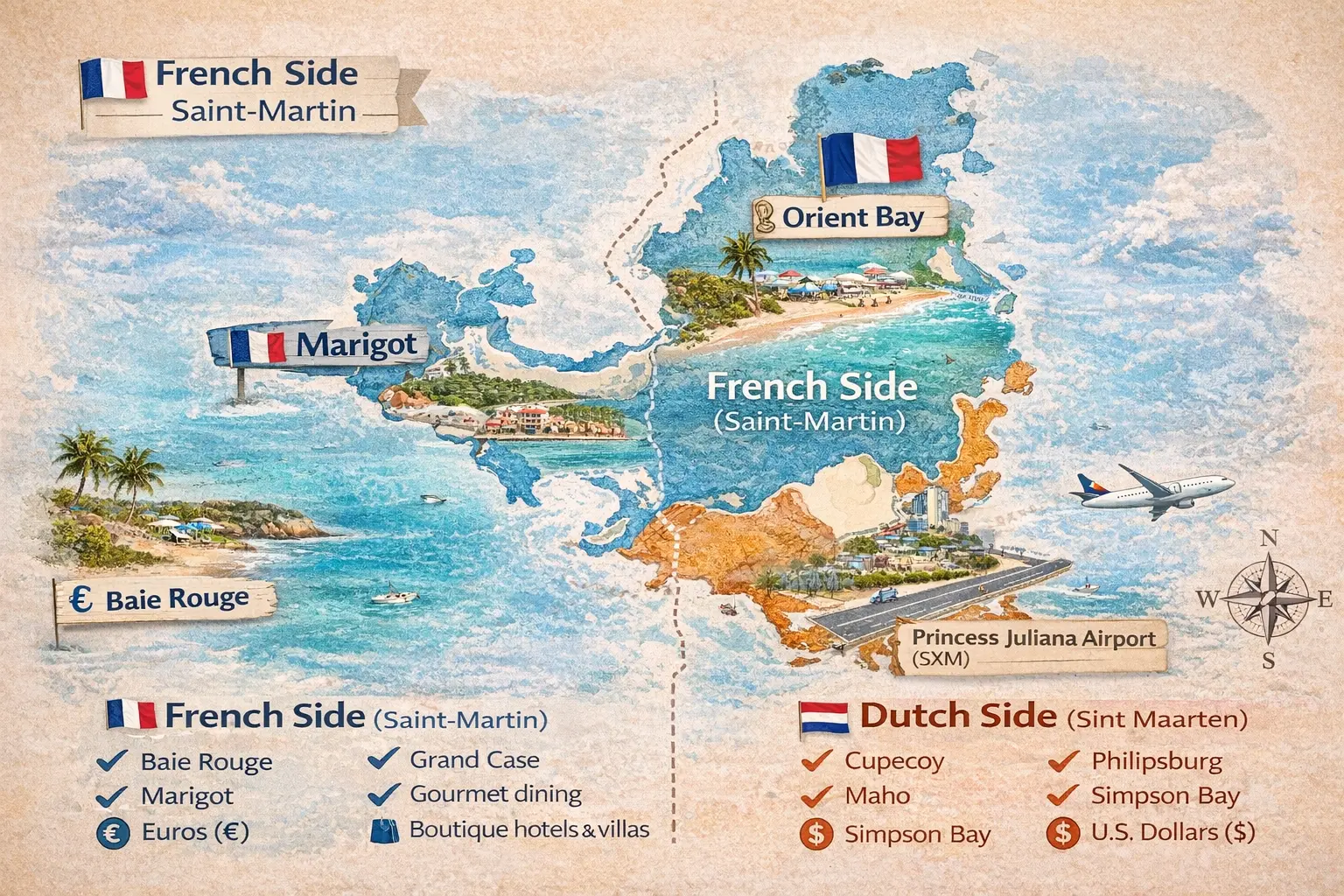
On the map, Saint Martin and Sint Maarten look like one small island, but on the ground they feel like two different destinations. The French side (Saint-Martin) in the north is technically part of France and uses the euro, though US dollars are widely accepted. It has a slower, more relaxed rhythm, with long lunches in Grand Case, quieter residential areas, and a more European-style café culture. The Dutch side (Sint Maarten) in the south is part of the Kingdom of the Netherlands, uses the Netherlands Antillean guilder (ANG) and US dollars, and feels more like a classic Caribbean resort hub, especially around Simpson Bay and Philipsburg where the cruise ships dock.
In my experience, the biggest difference isn’t just language or currency; it’s the overall energy. On the Dutch side, you’ll find larger resorts, casinos, duty-free shopping, and the famous plane-spotting at Maho Beach. It’s louder, busier, and geared toward people who like activity and nightlife. On the French side, days tend to revolve around beach time and food. Think beach clubs on Orient Bay, sunset dinners in Grand Case, and small boutique hotels or guesthouses rather than big high-rises. This means that if you are the kind of traveler who wants to walk to bars and late-night spots, the Dutch side will feel more convenient, while those craving long, quiet mornings and good bakeries may feel more at home in the north.
Another key distinction is how each side handles tourism infrastructure. The Dutch side is more “plug and play” for first-timers: more ATMs, more car rental desks near Princess Juliana Airport, and more large supermarkets. The French side is absolutely tourist-friendly, but it still feels like a place where locals live first and visitors second. For example, some restaurants in the French villages close one or two days a week, and opening hours can be more relaxed. This isn’t a problem if you plan for it, but it can surprise people arriving from a big all-inclusive in Simpson Bay. Having good data on your phone with a regional or flexible eSIM solution helps you adjust on the fly when you find a favorite spot closed.
Legally, there’s no passport control between the two sides, and you can drive or taxi back and forth freely. That makes it tempting to think, “I’ll just stay anywhere and explore both.” You can, but the reality is traffic can slow to a crawl in high season, especially around Cole Bay and Marigot. A 20-minute drive on the map can easily turn into 45 minutes. This is why your choice of where to stay matters more than it seems on a small island. If you know you’ll want to go out late in Simpson Bay most nights, staying way up in Orient Bay on the French side will mean a lot of night driving or expensive taxis. Conversely, if you dream of quiet mornings on a near-empty beach, staying right by Maho may feel like you never really escape the crowds.
How to Choose: A Simple Guide to French vs Dutch Side
To make a clear guide to choosing between Saint Martin French and Dutch side, it helps to start with your priorities: nightlife, food, beaches, budget, and whether you’ll rent a car. For travelers who want late nights, bars that stay open past midnight, and easy access to casinos, the best place to stay in St Maarten Dutch side for nightlife is around Simpson Bay, Maho, or possibly Philipsburg if you like being near the cruise port. These areas have a dense cluster of bars, live music, and restaurants, so you can walk or take short taxis home without worrying about long drives after a few cocktails. Many first-time visitors who skip the car choose a Dutch-side base for exactly this reason.
On the other hand, if you are more interested in food and quieter beaches, the best neighborhood to stay in Saint Martin on the French side is often Grand Case or nearby Orient Bay. Grand Case has been called the “gourmet capital of the Caribbean,” and while that’s a big claim, the concentration of bistros and beachside grills is impressive. You can walk from a small guesthouse or boutique hotel to multiple excellent dinner options without ever getting in a car. Orient Bay offers a long, lively beach with multiple beach clubs, watersports, and a mix of self-catering apartments and small hotels, making it ideal for families and couples who want a mix of comfort and independence.
Budget is another factor. Broadly speaking, you can find both budget and luxury on each side, but the Dutch side leans more toward mid-range resorts and timeshares, while the French side has more self-catering apartments and boutique-style places. If you’re comparing Saint Martin all inclusive vs boutique hotels, you’ll notice that the Dutch side has more of the classic all-inclusive or resort-style properties, especially around Maho and Cupecoy. The French side’s charm is more in individually run hotels and villas with character. In practice, this means you might get more space for your money in a French-side apartment, but fewer on-site services like 24/7 reception or multiple pools.
Connectivity and logistics also play a role in your decision. If you plan to work remotely or are anxious about staying in touch with home, you’ll want strong mobile data on both sides of the island. EasyAlo’s Saint Martin eSIMs are designed to work across the border seamlessly, similar to how their France eSIM plans handle roaming across mainland regions. This matters because some local SIMs or hotel Wi‑Fi setups are stronger on one side than the other, and you don’t want your connection to drop the moment you cross the invisible line. I’ve had video calls from a café in Marigot and then driven to Simpson Bay without losing connectivity, which makes it much easier to treat the whole island as your playground, even if your hotel is on just one side.
Best Areas on the French Side: Quiet, Food, and Classic Caribbean Vibes
When people ask about the best place to stay in Saint Martin French side for couples, I almost always start with Grand Case. This small waterfront town on the northwest coast has a lovely mix of romantic restaurants, small hotels, and a low-key beach. In the evening, you can walk along the main strip and choose between French bistros, beach bars, and “lolos” – casual grill shacks serving ribs, fish, and lobster. There are no high-rise hotels here, which keeps the skyline low and the atmosphere intimate. For couples who care more about long dinners and sunset strolls than late-night clubs, Grand Case is hard to beat.
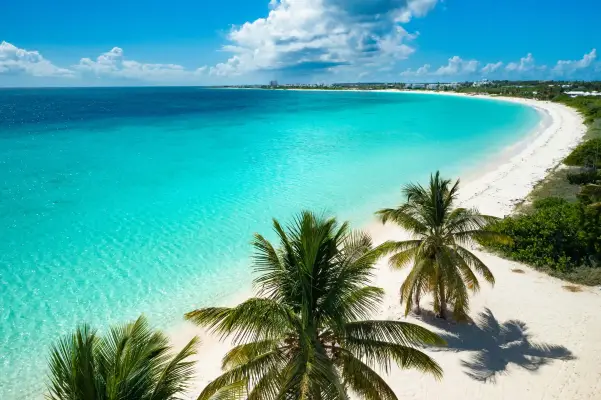
Just a short drive east, Orient Bay is the French side’s main beach hub. It’s a long crescent of sand lined with beach clubs like Kakao and Kontiki, plus a small village-style area with restaurants and shops just behind the beach. Families like Orient Bay because you can rent chairs, book watersports, and still have easy access to apartments or villas with kitchens. The sea can be a bit choppier here than on some other beaches, but it’s usually fine for swimming, and on windy days you’ll see kitesurfers out in force. In my experience, this is one of the best spots if you want a “park yourself on a beach all day” kind of vacation without feeling isolated.
If you’re looking for something more secluded, consider Terres Basses and the surrounding areas on the western French side. This region is known for upscale villas, quiet coves like Baie Rouge, and a distinctly residential feel. It’s not the place for walking to restaurants, but if you’re renting a car and want privacy, it’s an excellent choice. You’ll find some high-end villas that work well for groups or extended families, often with private pools and direct beach access. The trade-off is that you’ll be driving for groceries, dining, and any nightlife, so a reliable data connection for maps and ride-hailing is essential. Having an eSIM already installed, just as you might for a road trip with a Turkey eSIM package, means you’re never guessing at directions on unfamiliar roads.
Marigot, the main town on the French side, is another option some travelers overlook. It’s not as polished as Grand Case, but it has a local market, a marina, and a few small hotels and guesthouses. If you like the idea of staying somewhere that feels more like a lived-in town than a resort, Marigot can be interesting. You’ll have easy access to the ferry to Anguilla, bus routes, and French bakeries for your morning croissant. Just be aware that it’s quieter at night, and some streets can feel deserted after dark, so it’s better suited to travelers who are comfortable with that slower pace and have done a bit of research on Saint Martin safe areas to stay.
Best Areas on the Dutch Side: Nightlife, Convenience, and Resorts
The Dutch side is where you’ll find the island’s busiest nightlife and many of its larger hotels. For travelers who want energy and convenience, the best place to stay in St Maarten Dutch side for nightlife is usually Simpson Bay. This long lagoon-side area is packed with bars, restaurants, and marinas, plus a good mix of hotels, timeshares, and apartments. You can walk between multiple dinner options, grab live music at places like Buccaneer Beach Bar, and still be within a short taxi ride of Maho and the airport. It’s also practical for people arriving on late flights, because you can be checked into your room within 15–20 minutes of landing.
Maho Village, right next to Princess Juliana Airport, is the island’s most famous spot for plane-watching. Hotels like Sonesta Maho Beach Resort sit almost directly under the flight path, and the tiny Maho Beach is packed when big jets come in. This area has casinos, bars, and a very compact, resorty feel. If you love the idea of watching 747s roar overhead at sunset and then walking to dinner and a casino, Maho is fun. If you’re sensitive to noise or prefer a more natural setting, it may feel overwhelming after a couple of days. In my experience, it’s an area that works best for short stays or for travelers who really prioritize convenience and nightlife over tranquility.
Philipsburg, the capital on the Dutch side, is where the cruise ships dock. The town has a long boardwalk, duty-free shops on Front Street, and a beach right in front. Some travelers like staying here for a night or two to be close to the action when ships are in port, but it can feel very different when the cruise crowds leave and shops close early. For longer stays, I usually recommend Simpson Bay or Maho instead, unless you specifically want to be close to the port. That said, Philipsburg can be a solid base if you find a good deal and plan to explore the rest of the island by day.
For something a bit quieter but still on the Dutch side, look at Cupecoy and the surrounding area near the French border. This area has cliffs, small beaches, and a mix of condos and upscale resorts. It’s popular with longer-stay visitors and those who want easier access to both sides of the island. From Cupecoy, you can drive to Maho in under 10 minutes and cross into the French side toward Terres Basses and Marigot. Connectivity tends to be solid here, and many digital nomads appreciate having a stable base with decent Wi‑Fi plus an EasyAlo eSIM as backup, just like they might rely on a Indonesia eSIM when working remotely from Bali or Lombok.
Families, Couples, and Digital Nomads: Matching the Side to Your Style
When comparing the Saint Martin French side vs Dutch side for families, it really comes down to how independent you want to be. Families who like self-catering, quieter evenings, and long days on the beach often do well on the French side, especially in Orient Bay or the residential areas near it. You can rent an apartment with a kitchen, walk to a bakery in the morning, and spend the day at a beach club where you can rent chairs and order food without feeling like you’re in a party zone. The sea can occasionally be wavy, so for younger kids, you may want to mix in calmer beaches like Friar’s Bay or Anse Marcel, which are also on the French side.
On the Dutch side, families who want more structured resort facilities may prefer the larger hotels in Maho, Simpson Bay, or Cupecoy. These often have pools, kids’ areas, and on-site restaurants, which can be a lifesaver with younger children. You’ll also find more organized excursions departing from Simpson Bay marinas, such as snorkeling trips or day sails. The trade-off is that these areas can be busier and noisier, especially in high season. I’ve met parents who loved being able to walk to dinner with a stroller in Simpson Bay, and others who felt their kids slept better in a quieter French-side villa. If you’re unsure, think honestly about your family’s tolerance for noise and how much time you’ll spend out at night.
For couples, the French side tends to win for romance, while the Dutch side wins for “fun.” The best place to stay in Saint Martin French side for couples is usually Grand Case or a quiet villa in Terres Basses. You get candlelit dinners, quieter beaches, and a more intimate feel. Couples who enjoy nightlife and social energy may prefer Simpson Bay or Maho on the Dutch side, where you can bar-hop and listen to live music. A nice hybrid is to stay on the French side and plan one or two evenings out on the Dutch side, using taxis or a rental car and relying on your eSIM data to coordinate rides and check opening hours.
Digital nomads and remote workers often ask where to stay in Saint Martin for digital nomads, and my honest answer is: pick somewhere with reliable Wi‑Fi first, then think about side. Both sides have pockets with good connectivity, but you should always treat hotel Wi‑Fi as “best effort” rather than guaranteed. That’s where a robust eSIM plan comes in. EasyAlo’s Saint Martin plans, which partner with local providers like CHIPPIE and Digicel, deliver 4G LTE speeds across most of the island, similar to what their United Kingdom data eSIM offers across England and Scotland. In practice, that means you can tether from your phone if the hotel Wi‑Fi hiccups during a video call. Areas like Simpson Bay, Cupecoy, and Orient Bay are popular with longer-stay visitors because they offer a good balance of amenities, beach access, and connectivity.
Getting Around, Safety, and Staying Without a Car
One of the most important but least glamorous questions is where to stay in Saint Martin without a car. The island does have taxis and some local buses, but it’s not like a big city with constant public transport. If you don’t plan to rent a car, you’ll want to stay in an area where you can walk to most of what you need. On the Dutch side, Simpson Bay and Maho are the most walkable, with plenty of restaurants, small supermarkets, and beaches within a short distance. On the French side, Orient Bay and Grand Case are your best bets, as both have clusters of dining and beach options you can reach on foot.
That said, taxis can add up quickly. A ride from the airport to Orient Bay can easily cost US$35–40, and late-night taxis between the sides may be more. There are informal minibuses that locals use, especially between Marigot and Philipsburg, but they’re not always intuitive for visitors and don’t run late at night. This is where having maps and translation apps ready on your phone really helps. I always download offline maps and keep my eSIM data active so I can check routes in real time, much like I would when navigating a new city with a Mexico travel eSIM. It’s also useful for confirming taxi prices and ensuring you’re being dropped at the right address, especially in villa areas where house numbers can be confusing.
On the topic of safety, both sides of the island are generally safe for tourists, but you still need to use common sense. The main risks are petty theft, especially from parked cars and on busy beaches. Whichever side you choose, avoid leaving valuables in your vehicle and don’t flash expensive jewelry or large amounts of cash. At night, stick to well-lit areas and use official taxis rather than accepting unsolicited rides. When researching Saint Martin safe areas to stay, you’ll see the same names come up repeatedly: Orient Bay, Grand Case beachfront, Terres Basses, Simpson Bay, Maho, Cupecoy, and most of the main resort zones. These are well-traveled, tourist-oriented areas where you’ll rarely feel isolated.
Driving between the French and Dutch sides is straightforward, with multiple crossing points and no border checks. The main challenge is traffic, especially at peak times and when cruise ships are in port. If you plan to explore multiple beaches in a day, start early and use your phone’s navigation to check congestion. This is another situation where a reliable eSIM makes a real difference: you can reroute around bottlenecks, check live traffic, and even look up parking options near popular beaches. If something goes wrong with your connection, EasyAlo’s eSIM troubleshooting tips can usually get you back online in a few minutes without needing to hunt down a local store.
Connectivity Tips: eSIMs, Coverage, and Staying Online on Both Sides
Because Saint Martin is split between two jurisdictions, one of the most common questions is: can you stay on the French side and visit the Dutch side of Saint Martin easily without losing service or paying crazy roaming fees? With the right eSIM, yes. EasyAlo’s Saint Martin products are designed to connect to local networks that cover both the French and Dutch sides seamlessly, as confirmed in their FAQ: “Our eSIMs connect to local networks that provide coverage across the entire island, so you can enjoy seamless connectivity whether you are on the French or Dutch side without any service interruption.” In practice, that means you don’t have to think about roaming when you cross the invisible border near Cole Bay or Oyster Pond.
Technically, most EasyAlo Saint Martin eSIMs are data-only, leveraging partnerships with local carriers like CHIPPIE and Digicel to deliver 4G LTE speeds. The FAQ notes that “you can expect reliable 4G LTE speeds throughout most of the island,” which lines up with my experience streaming maps, uploading photos, and even doing a few Zoom calls from beach cafés. Because the plans are data-only, you keep your regular phone number active on your primary SIM for calls and SMS, while using data-based apps like WhatsApp, FaceTime, or Skype to communicate. This setup is similar to their regional offerings for other destinations, such as the Georgia eSIM that covers Tbilisi and the Caucasus region with strong LTE.
To avoid that stressful moment when you land at Princess Juliana Airport and realize you can’t pull up your hotel confirmation, I strongly recommend installing your eSIM before departure. EasyAlo supports pre-installation, and the plan only activates when you first connect to a supported network on the island. That means you can scan the QR code at home, follow the prompts, and then simply toggle the eSIM on when your plane lands. If you’ve ever tried to buy a local SIM while jetlagged, juggling luggage, and trying to find your transfer, you’ll appreciate how much smoother this feels. I like to keep my primary SIM set to “calls and SMS only” and route all data through the EasyAlo eSIM, which also protects me from surprise roaming charges.
One more connectivity tip: don’t rely solely on hotel Wi‑Fi, especially if you need to work or make video calls. Power cuts and router issues happen, and some older properties on both sides still have weak coverage in certain rooms. With an eSIM, you can tether your laptop to your phone and keep going, which is exactly what I’ve done from a balcony in Grand Case when the hotel network went down. If you’re planning a longer Caribbean trip that includes other islands like Saint Kitts, Saint Lucia, or Saint Barthélemy, it’s worth looking at EasyAlo’s regional Caribbean solutions and their Caribbean winter sun guide so you’re not juggling a different SIM for every stop.
Money-Saving and Booking Tips for Each Side
Accommodation prices in Saint Martin can swing a lot depending on season, side, and how far in advance you book. High season is roughly December to April, with peak rates around Christmas, New Year, and school holidays. During these times, the Dutch side’s large resorts and the French side’s most popular beaches (like Orient Bay and Grand Case) can be pricey. If you’re flexible, consider shoulder seasons like late April to early June or October to early December, when you can often save 20–30% on nightly rates. I’ve found particularly good deals on French-side apartments in May and November, when the weather is still warm but demand is lower.
On the Dutch side, one of the best ways to save is to book self-catering studios or condos in Simpson Bay or Cupecoy rather than full-service hotels. You’ll still be close to beaches and restaurants, but you can cook some meals at home and avoid resort markups. On the French side, look for weekly rates on apartments or small hotels, which can be significantly cheaper than nightly pricing. When comparing Saint Martin all inclusive vs boutique hotels, remember that all-inclusive might look more expensive upfront but can make sense if you plan to stay mostly on-site and eat many meals at the hotel. Boutique or self-catering options give you more freedom to explore the island’s food scene, which is a big part of the French side’s appeal.
Transport is another area where planning ahead saves money. Renting a car for at least part of your stay is often cheaper than relying exclusively on taxis, especially if you’re staying somewhere like Terres Basses or Anse Marcel. Daily rental rates can start around US$40–50 in low season if you book early. Just remember to factor in insurance and fuel. If you’re nervous about driving in a new place, use your eSIM data to keep navigation apps running and avoid getting flustered by missed turns. I always drop a pin for my accommodation and favorite beaches so I can find my way back even if signage is poor.
Finally, think about currency and payments. On the French side, prices are often listed in euros, but many places accept US dollars at a fixed rate. On the Dutch side, US dollars are widely used alongside guilders. Credit cards are accepted in most tourist-facing businesses, but it’s smart to carry some cash for small purchases, beach chair rentals, and local snacks. Using mobile banking and secure connections over your eSIM rather than unsecured public Wi‑Fi reduces the risk of card issues. If you’ve ever had your card blocked abroad after a suspicious transaction, you know how disruptive that can be. Having reliable data lets you quickly contact your bank’s app or support chat and resolve problems without hunting for a phone.
Conclusion: So, Is the French or Dutch Side Better?
So, is it better to stay on the French side or Dutch side of Saint Martin? The honest answer is that it depends on the kind of trip you want. If you picture long, lazy beach days, great food, and quieter evenings, the French side – especially Grand Case, Orient Bay, and Terres Basses – is probably your best match. If you want nightlife, casinos, and walkable access to bars and restaurants, the Dutch side – with hubs like Simpson Bay, Maho, and parts of Philipsburg – will feel more natural. The good news is that with a smart accommodation choice and solid connectivity, you don’t actually have to choose just one experience.
What matters most is aligning your base with your daily rhythm. Families and couples craving calm usually gravitate to the French side, while groups of friends and nightlife lovers often prefer the Dutch side. Digital nomads and long-stay travelers tend to pick practical, amenity-rich neighborhoods on either side and then use their EasyAlo eSIM to treat the whole island as one big, borderless workspace. Remember that where to stay in Saint Martin, French or Dutch side, is only half the equation; the other half is how easily you can move around and stay connected.
If you take one thing away from this guide, let it be this: decide what you want your average day to look like, then pick the side and neighborhood that make that day effortless. Once that’s set, sort your connectivity before you fly. Installing an EasyAlo Saint Martin eSIM in advance means that the moment you land, you can message your host, pull up directions, and start exploring without worrying about roaming charges or hunting for a SIM shop. From there, it’s just you, the beaches, and the freedom to cross that invisible border as often as you like, knowing your connection – and your plans – will keep running smoothly.