






 Brazil
 Georgia
 United Kingdom














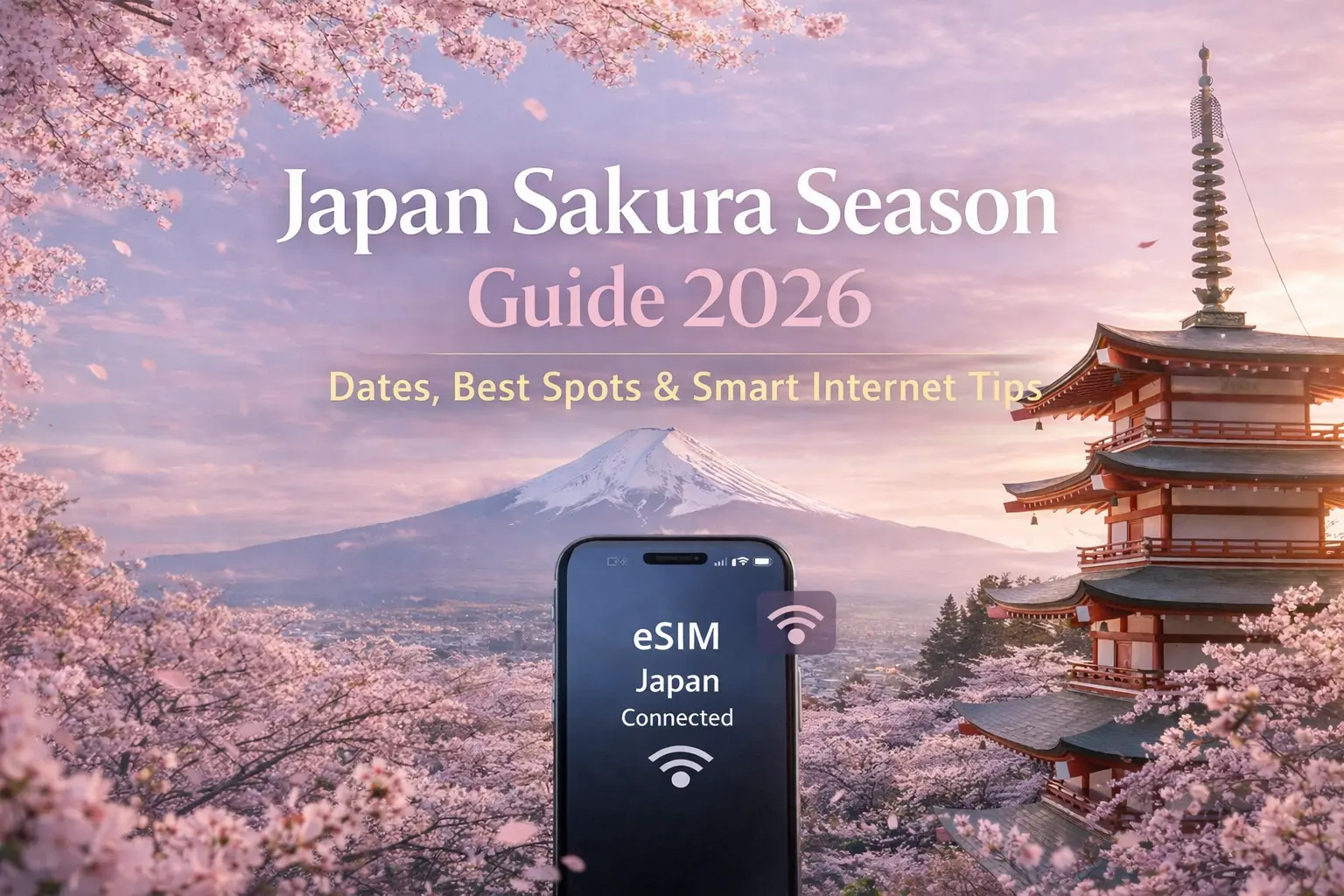
Japan Sakura Season Guide 2026: Dates, Best Spots & Smart Internet Tips
If you’re dreaming about japan sakura season 2026, you’re not alone. Those few weeks when the whole country turns pastel pink are magical, but they’re also chaotic, expensive, and surprisingly easy to mistime. I’ve had one trip where I hit peak bloom in Tokyo by accident, and another where I arrived a week late and spent more time looking at green leaves than cherry blossoms. In this guide, I’ll walk you through realistic bloom dates, how long blossoms usually last, the Tokyo vs Kyoto vs Osaka forecast, and exactly how to stay online with a Japan travel eSIM so you’re not stuck hunting for Wi‑Fi when you should be enjoying hanami under the trees. If you like planning trips by season, it’s also worth checking EasyAlo’s 12‑month destination guide for smart, connected travelers to line up sakura with the rest of your year.
Overview of Japan Sakura Season 2026: What to Expect
Cherry blossom season isn’t a single week when the whole of Japan turns pink; it’s a rolling wave that starts in the south and moves north over nearly two months. For japan sakura season 2026, you can expect the first buds to open in late March around Kyushu and Shikoku, with Tokyo usually following a few days later and northern regions like Tohoku and Hokkaido blooming through April and even into early May. In my experience, travelers often underestimate just how different the timing can be between, say, Fukuoka and Sapporo, and end up chasing blossoms on expensive last‑minute trains. Planning around regional dates rather than “Japan” as a whole makes your itinerary far more reliable.
Based on historical data from the Japan Meteorological Agency and private forecasters like Weathernews, Tokyo’s average first bloom (kaika) date is around March 22–24, with full bloom (mankai) about a week later. Kyoto and Osaka tend to lag Tokyo by one to three days, though some years they’re almost perfectly in sync. In 2023, for example, Tokyo hit full bloom on March 22, one of the earliest on record, while in later years cooler temperatures pushed things into early April. For 2026, long‑range climate models suggest another relatively warm spring, so it’s wise to assume slightly earlier than historical averages rather than later.
Another key thing to understand is that “sakura season” in travel marketing often stretches from mid‑March to mid‑April, but peak bloom in any given city is usually just 3–7 days. This is why you’ll see photos of Tokyo’s Meguro River packed with blossoms at the end of March while Kyoto’s Philosopher’s Path is still mostly buds. When I plan a sakura trip now, I give myself at least 10–12 days in Japan and build in flexibility to move between cities by shinkansen if the forecast shifts by a few days. With reliable mobile data from an eSIM, it’s easy to monitor Japanese blossom trackers and adjust your route on the fly without worrying about roaming charges.
Weather volatility is the wildcard. A sudden warm spell can accelerate blooming by up to a week, while a cold snap can pause development. Heavy rain and strong wind can strip petals in a single night. I’ve watched Ueno Park in Tokyo go from perfect pink to patchy green after one windy afternoon in early April. Because of that, aim to arrive just before the forecasted full bloom date for your main city, not during or after. That way, even if blossoms open early, you’ll still catch them, and if they’re a bit late, you can enjoy the early stages of hanami when crowds are slightly thinner.
Japan Sakura Season 2026 Dates by Region
To make sense of japan sakura season dates by region 2026, it helps to think of Japan as a vertical strip: warm south, temperate center, cooler north. Cherry blossoms generally start in Kyushu and Shikoku, sweep through Honshu (Tokyo, Kyoto, Osaka), and finish in Tohoku and Hokkaido. While official 2026 forecasts will only be released around January–February 2026, we can make educated estimates using 10‑year averages and recent early‑bloom trends. Treat these as planning windows, not guarantees, and keep an eye on updated forecasts about four to six weeks before your trip.
Kyushu & Shikoku (Fukuoka, Nagasaki, Kagoshima, Matsuyama)
Historically, Kyushu cities like Fukuoka see first bloom around March 20–23 and full bloom around March 28–31. For 2026, a reasonable estimate is first bloom March 18–22 and full bloom March 25–30. Kagoshima, further south, can be a couple of days earlier, while Nagasaki tracks closely with Fukuoka. Shikoku cities such as Matsuyama tend to follow a similar pattern, with full bloom likely in the last week of March. If you’re landing in Fukuoka and heading north, you can actually “ride the wave” of blossoms up through Hiroshima and on to Kansai over 7–10 days.
Chugoku & Kansai (Hiroshima, Okayama, Kyoto, Osaka, Nara, Kobe)
Hiroshima and Okayama usually bloom just after Kyushu, with full bloom often around March 29–April 2. For Kyoto and Osaka, recent averages put first bloom around March 24–27 and full bloom around March 31–April 4. Given the tendency toward earlier springs, the safe planning window for full bloom in 2026 is March 29–April 3 for both Kyoto and Osaka. Nara and Kobe are usually within one to two days of this timing. When I traveled in early April a few years ago, I caught Kyoto’s Maruyama Park at absolute peak on April 2 while Osaka Castle Park was already starting to shed petals, which shows how microclimates and tree varieties can create subtle differences even within the same region.
Kanto & Chubu (Tokyo, Yokohama, Nagoya, Kanazawa)
Tokyo is the reference point everyone watches. Historically, first bloom is around March 22–24 and full bloom around March 29–31. For 2026, I’d plan for full bloom between March 27 and April 1 in Tokyo, with Yokohama following by a day or so. Nagoya is usually very similar to Tokyo, sometimes one day later. On the Sea of Japan side, Kanazawa runs later due to cooler weather, with full bloom often around April 6–10. If you’re building a route like Tokyo → Nagoya → Kyoto → Kanazawa, you can potentially enjoy three different peaks over roughly two weeks, especially if you’re flexible with your dates and check forecasts daily using your phone.
Tohoku & Hokkaido (Sendai, Aomori, Hakodate, Sapporo)
Northern Japan is where latecomers to sakura season still have a chance. Sendai usually hits full bloom around April 12–18, with Aomori closer to April 20–25. Hokkaido cities like Hakodate and Sapporo are even later: Hakodate often peaks around April 25–30, while Sapporo can be as late as May 2–7. For japan sakura season 2026, that means you could feasibly arrive in Tokyo around March 29 for early blossoms, then fly or take a shinkansen up to Tohoku two weeks later and still enjoy stunning hanami. If you’re interested in seeing how Japan looks in winter before the blossoms, EasyAlo’s detailed Japan winter travel guide for snow and cities gives a good contrast to the spring experience.
Tokyo vs Kyoto vs Osaka: 2026 Cherry Blossom Forecast
Most first‑time visitors focus on the “Golden Triangle” of Tokyo, Kyoto, and Osaka, so let’s zoom in on what the tokyo cherry blossom 2026 forecast, kyoto cherry blossom 2026 forecast, and osaka cherry blossom 2026 forecast realistically look like. While these cities are relatively close in latitude, local climate, urban heat islands, and tree varieties create small but important timing differences. If you only have 7–10 days, understanding those nuances can mean the difference between postcard‑perfect photos and bare branches.
Tokyo Cherry Blossom 2026 Forecast
For Tokyo, a reasonable working forecast is first bloom around March 21–24 and full bloom around March 28–31 in 2026. Central districts like Chiyoda (home to Chidorigafuchi) and Sumida (near Tokyo Skytree) tend to align closely with the official city forecast. Slightly cooler spots such as Shinjuku Gyoen sometimes lag by a day or two, which can be useful if you arrive just after peak in other areas. In my experience, Tokyo’s sheer number of trees and varieties means there’s almost always something in bloom from about March 20 to April 5, but that tight 4–5 day peak is when the city really feels transformed.
Kyoto Cherry Blossom 2026 Forecast
Kyoto’s microclimates are more pronounced than Tokyo’s because of its basin geography and mix of riverside, hillside, and temple gardens. For the kyoto cherry blossom 2026 forecast, expect first bloom around March 23–26 and full bloom around March 30–April 3. Famous spots like Maruyama Park, the Philosopher’s Path, and the Kamo River usually track close to these dates, while higher‑elevation temples like Kiyomizu‑dera or Daigo‑ji can be a touch later. One year, I caught Maruyama’s iconic weeping cherry tree at full bloom on April 1, then hiked up to Kiyomizu on April 4 and still found blossoms just opening, which was perfect for avoiding the densest crowds in the lower city.
Osaka Cherry Blossom 2026 Forecast
Osaka generally blooms in step with Kyoto, sometimes a day earlier due to its slightly warmer, more urban environment. For the osaka cherry blossom 2026 forecast, pencil in first bloom around March 23–26 and full bloom March 30–April 3, similar to Kyoto. Osaka Castle Park and Kema Sakuranomiya Park along the Okawa River are the two big headline spots, and both become extremely busy during peak days, especially on weekends. If you’re staying in Osaka and doing day trips to Kyoto and Nara, this overlapping bloom window works in your favor, since you can choose the least crowded city each day based on live crowd reports and train conditions you check on your phone.
When comparing Tokyo vs Kyoto vs Osaka for japan sakura season 2026, the main decision isn’t just timing; it’s atmosphere. Tokyo offers big‑city energy with cherry trees framing skyscrapers and rivers lit up at night. Kyoto gives you classic temple and shrine backdrops, but also the heaviest crowds and narrow streets that can feel clogged by mid‑morning. Osaka sits in between: plenty of blossoms, great food, and easier last‑minute accommodation than Kyoto. A smart strategy is to base yourself in Osaka or Kobe, day‑trip into Kyoto early in the morning for specific spots, and then retreat to less crowded areas in the afternoon. With a stable data connection from an eSIM, you can check real‑time Google Maps congestion and local Twitter updates about crowd levels at places like Arashiyama before committing to a 40‑minute train ride.
How Long Do Cherry Blossoms Last in Japan?
The question “how long do cherry blossoms last in japan?” sounds simple, but the honest answer is: it depends on the tree, the location, and the weather that particular week. On an individual Somei Yoshino tree—the most common variety used for forecasts—you typically get about one week from first bloom to full bloom, and then another three to five days before petals have mostly fallen. That means a single tree might look “perfect” for only three or four days. When you multiply that across a whole city, though, different microclimates and varieties extend the overall viewing period to roughly 10–14 days in most urban areas.
Weather is the biggest factor that shortens or extends that window. If temperatures stay cool and calm, blossoms can linger for over a week at full or near‑full bloom. I remember one year in Osaka when a stretch of mild, windless days kept Kema Sakuranomiya Park looking stunning for nearly ten days, with petals slowly drifting into the river like snow. On the other hand, a single day of heavy rain and strong wind can strip 50–70% of the petals in a vulnerable area. In Tokyo’s Ueno Park, I once watched the ground turn white with petals overnight after a storm, even though the trees had been at peak just 24 hours before.
For Tokyo, Kyoto, and Osaka specifically, you can think of it this way: once full bloom is declared, you usually have three to six days of very good viewing in central parks if the weather cooperates. Outlying or higher‑elevation spots might still be coming into bloom as inner‑city trees start to fade, which is why guidebooks often recommend visiting places like Kyoto’s Ninnaji Temple or the hills around Arashiyama a few days after the main city peak. When planning your japan sakura season 2026 trip, aim to be in your primary city from two days before forecasted full bloom to three days after. That seven‑day bracket gives you the best chance of hitting the sweet spot.
It’s also worth remembering that not all “sakura” are the same. Early‑blooming varieties like Kawazu‑zakura in Shizuoka or Kanhi‑zakura in Okinawa can flower as early as February, while late‑blooming yaezakura (double‑flowered cherries) in places like Tokyo’s Shinjuku Gyoen can still be going strong after the main Somei Yoshino have finished. If you miss peak by a few days, don’t panic. Use your phone to search Japanese‑language blogs or Twitter for “八重桜 見頃” (yaezakura in full bloom) and you’ll often find pockets of late blossoms you’d never discover offline. This is where having constant data access from a Japan eSIM is genuinely useful rather than just a nice‑to‑have.
Best Places to See Cherry Blossoms in Tokyo, Kyoto & Osaka
If you’re focusing on the best places to see cherry blossoms in tokyo kyoto osaka, you’ll quickly find the same names repeated everywhere—Ueno Park, Maruyama Park, Osaka Castle. They’re famous for a reason, but they’re also where you’ll find shoulder‑to‑shoulder crowds and tripods blocking every bridge. Here’s a mix of headline spots and slightly less obvious alternatives I’ve actually enjoyed in peak season, plus how to make each one more pleasant.
Tokyo: Classic & Alternative Sakura Spots
In Tokyo, Ueno Park and Shinjuku Gyoen are the poster children. Ueno’s central path becomes a tunnel of blossoms, but it also becomes packed by 10 a.m. If you go, aim for sunrise; I’ve had entire stretches almost to myself at 6:00 a.m. Shinjuku Gyoen is more spacious and landscaped, with a small entrance fee (around ¥500) that helps thin the crowds slightly. For riverside views, the Meguro River illuminations are stunning at night, but can feel like a moving queue on weekends.
For something a bit calmer, I like Chidorigafuchi near the Imperial Palace, where you can rent rowboats and float under the blossoms, and Sumida Park near Tokyo Skytree for long riverside walks with great skyline views. Another underrated option is the residential area around Nakameguro early in the morning, before the food stalls open. If you’re connecting through other Asian hubs like Singapore on your way to Japan, a dedicated Singapore eSIM for stopovers plus a Japan eSIM means you can stay online for navigation and reservations all the way from airport to hanami spot without swapping physical SIMs.
Kyoto: Temples, Rivers & Quiet Corners
Kyoto’s sakura spots are about atmosphere as much as quantity. Maruyama Park, especially its giant weeping cherry tree lit up at night, is iconic but extremely busy. The Philosopher’s Path along the canal between Ginkaku‑ji and Nanzen‑ji is another favorite; go at dawn or just after sunset to avoid the slow‑moving daytime crowds. Along the Kamo River, locals gather on the grassy banks with convenience‑store snacks and canned chu‑hai, which is one of the most relaxed hanami experiences you can have in the city.
For slightly less crowded options, I like the area around Hirano Shrine, which has dozens of different cherry varieties in a compact space, and the grounds of Heian Shrine, where late‑blooming weeping cherries can still be spectacular even after central Kyoto has peaked. Daigo‑ji, a bit southeast of the city, is worth the subway and bus ride if you want temple architecture framed by blossoms without the crush of the Higashiyama district. When I visited Daigo‑ji during peak season, I was surprised how easy it was to find quiet corners, especially if you wander away from the main pagoda area.
Osaka: Parks, Rivers & Urban Vibes
Osaka Castle Park is the big star, with thousands of cherry trees surrounding the castle keep and stone walls. The combination of white petals, blue sky, and the green copper roof is hard to beat, but be prepared for crowds and lots of blue tarps on the grass for hanami parties. Kema Sakuranomiya Park, stretching along the Okawa River, might actually be my favorite Osaka spot; it’s long enough that you can always walk a bit further to find a quieter patch of grass, and the reflections of blossoms in the water are beautiful at sunset.
For a more local feel, check out the banks of the Yamato River on the border of Osaka and Sakai, or the smaller neighborhood parks around Tennoji. If you’re combining Osaka with other destinations like Italy or France in a longer multi‑country trip, EasyAlo’s Europe eSIM setup guide is handy for understanding how to juggle multiple regional eSIMs on the same device without losing your Japanese data profiles.
Practical Hanami Planning: Crowds, Weather & Etiquette
Once you’ve nailed down your dates, the next challenge is making hanami actually enjoyable rather than a stressful box‑ticking exercise. In japan cherry blossom season guide discussions, people often gloss over the unglamorous parts: packed trains, no free benches, and sudden temperature swings that can leave you shivering under a tree in what was supposed to be “spring weather.” Thinking through crowds, weather, and etiquette in advance makes a huge difference.
Crowds are unavoidable at the biggest spots, but you can work around them. Aim for early morning visits to headline parks and temples; being at the gate when Shinjuku Gyoen opens can feel like having a private garden for the first 30–45 minutes. Try scheduling your most popular location for a weekday rather than a Saturday or Sunday, especially in Tokyo and Kyoto. Use real‑time transit apps like Japan Transit Planner or Google Maps (which work well with Japanese train schedules) to avoid the busiest train lines right at rush hour. I’ve stood on a Yamanote Line platform at Shibuya during peak season and watched three packed trains go by before squeezing on the fourth; a ten‑minute timing shift would have completely changed that experience.
Weather is another factor many people underestimate. Late March and early April can swing from 5°C and windy to 20°C and sunny within 48 hours. Bring layers: a light down jacket or fleece, a packable rain jacket, and something you’re comfortable sitting on if the ground is damp. I like to check three sources the night before a big hanami day: the Japan Meteorological Agency forecast, a local app like Yahoo! Weather, and the radar map on my phone to see if showers are likely during my planned picnic time. With a reliable data connection, you can adjust your hanami window by a couple of hours to dodge a passing rain band and save your picnic from becoming a soggy memory.
Etiquette is straightforward but important. In most major parks, you’re allowed to picnic under the trees, but you’re expected to take all your trash with you; bins are limited or nonexistent during busy periods. Avoid shaking branches or climbing trees for photos, and don’t block entire pathways with tripods. If you lay down a picnic sheet, keep it within marked areas and don’t encroach on walking paths. Alcohol is generally tolerated in hanami areas, but some parks (especially family‑focused ones) may restrict it, so check the official website or on‑site signs. When you leave, do a quick sweep for small items like bottle caps or food wrappers; locals notice when visitors leave spaces cleaner than they found them, and it helps keep hanami areas open to everyone.
Finally, build some flexibility into your schedule. Instead of planning three different sakura spots in one day, choose one main location and a backup nearby. If the main site is unbearably crowded, you can pivot quickly using navigation apps on your phone. I’ve had days where I abandoned a packed Philosopher’s Path and hopped a bus to a quieter riverside area within 20 minutes because I could see route options and bus ETAs in real time. That kind of nimbleness is almost impossible if you’re relying on paper maps and station posters alone.
Smart Internet Tips: eSIM vs Roaming for Sakura Season Travel
During japan sakura season 2026, having stable mobile data isn’t just about posting photos; it’s about adjusting to moving bloom forecasts, checking live train times, and even finding toilets in giant parks when you’ve been drinking convenience‑store beer for two hours. You essentially have three connectivity options: your home carrier’s roaming, local physical SIMs, or a japan travel eSIM data plan from a provider like EasyAlo. I’ve tried all three over multiple trips, and for most travelers eSIM wins on a mix of cost, convenience, and flexibility.
Roaming with your home carrier is the simplest on paper—no setup, your number stays the same—but it’s usually the most expensive and restrictive. I’ve seen daily roaming packages in the US and Europe that charge US$10–15 per day for 500 MB to 1 GB of data, which adds up quickly on a 10‑day sakura trip. Some carriers throttle your speeds after a small allowance, which is painful when you’re trying to load high‑resolution maps around Shinjuku Station or stream live blossom forecasts. You also have less control over which Japanese network you connect to, and in crowded areas, that can mean slower speeds.
Buying a local physical SIM at the airport is cheaper, but comes with its own headaches. At Narita or Haneda, you’ll find dozens of SIM vending machines and counters, but not all plans are clearly explained in English, and some require passport registration or APN configuration. If your phone uses eSIM only (as many recent iPhone and high‑end Android models do), you might not even have a physical SIM slot. Plus, standing in line for 20–30 minutes for a SIM after a long‑haul flight is the last thing most people want, especially when they still need to navigate to their hotel or Airbnb in an unfamiliar city.
A japan eSIM vs roaming for sakura season travel comparison usually comes out in favor of eSIM. With EasyAlo, for example, you can purchase and install your Japan eSIM profile before you fly, then activate it as soon as your plane lands and your phone detects a local network. That means you have data immediately for things like contacting your accommodation, checking the train from Haneda to Shinjuku, or confirming the latest tokyo cherry blossom 2026 forecast on a Japanese weather site. If you’re curious how eSIM technology works more generally, the EasyAlo About eSIM explainer breaks down activation, compatibility, and common troubleshooting in plain language.
In terms of how much data you need, think about your habits. For a 7–10 day sakura trip using Google Maps, train apps, translation tools, social media, and some light video, 5–10 GB is a realistic range. If you plan to upload a lot of 4K video or tether a laptop, consider 15–20 GB. The nice thing about most Japan eSIM plans is that validity starts when you first connect in Japan, not on purchase date, and top‑ups are usually possible online without visiting a store. Just make sure your phone is unlocked and eSIM‑compatible; EasyAlo maintains a compatibility list, and their FAQ on common Japan connectivity mistakes is surprisingly useful even for spring travelers.
One more practical tip: before you leave home, download offline maps for your main cities in Google Maps and set up your translation app (Google Translate or DeepL) with Japanese offline language packs. Even with an eSIM, there may be brief dead zones in tunnels or remote temple areas. Having offline backups means you’re never stuck if you lose signal for a few minutes on a mountain bus or in a basement train station. Combine that with a good power bank and you’ll be able to check blossom forecasts, reroute around crowds, and coordinate with travel companions without worrying about your phone dying halfway through a hanami picnic.
Putting It All Together: Sample 2026 Sakura Itinerary
To make all of this more concrete, here’s how you might structure a 10‑day japan sakura season 2026 trip that balances Tokyo, Kyoto, and Osaka, plus a bit of flexibility. Let’s assume you’re aiming for the end of March and early April, when those three cities are most likely to overlap in bloom. This isn’t a rigid checklist, but rather a framework you can tweak based on your flight prices and personal interests.
Days 1–4: Tokyo Base (Around March 27–30)
Arrive in Tokyo just before the expected full bloom window. Use your first day to recover from jet lag and explore a non‑sakura‑heavy area like Asakusa or Akihabara. On days 2 and 3, hit one major sakura spot each day—maybe Ueno Park at sunrise with a museum visit afterward, and Chidorigafuchi plus the Imperial Palace area the next. Keep an eye on live forecasts using your eSIM data; if Meguro River or Shinjuku Gyoen are reported to be at their best, slot them into an afternoon or evening.
Days 5–7: Kyoto & Nara (Around March 31–April 2)
Take a morning shinkansen to Kyoto (about 2.5 hours from Tokyo). If Kyoto is at or near peak, prioritize a sunrise or early‑morning walk along the Philosopher’s Path, then visit Maruyama Park and Yasaka Shrine. On another day, consider a half‑day trip to Nara, where the park and temple areas are dotted with cherry trees and semi‑tame deer wander through the petals. Use your phone to check crowd levels and train times; if Kyoto feels overwhelmingly busy, you can retreat to quieter neighborhoods like the northwestern temples or head back to your hotel in Osaka if you’ve chosen to base there instead.
Days 8–10: Osaka & Departure (Around April 3–5)
Shift to Osaka for your final days. Spend one day at Osaka Castle Park and Kema Sakuranomiya Park, timing your visit for late afternoon into sunset for the best light. Another day can be more food‑focused in areas like Dotonbori and Shinsekai, with a quick visit to a smaller local park if blossoms are still holding on. If you discover that Kyoto or Osaka are already past peak by the time you arrive, consider a day trip to a slightly later‑blooming area like Hikone on Lake Biwa or even Kanazawa if the timing works. With high‑speed rail and reliable mobile data, these last‑minute adjustments are much less stressful than they sound.
If you’re combining sakura with winter sports in Hokkaido or planning to return for snow festivals another year, EasyAlo’s Hokkaido powder snow and Sapporo Snow Festival guide is a good companion read. It shows how the same connectivity strategies—pre‑installed eSIMs, offline maps, flexible data plans—work just as well in January blizzards as they do under April cherry blossoms.
Conclusion: Enjoying Sakura Season 2026 Without the Stress
Planning for japan sakura season 2026 is a balancing act between fixed dates and moving targets. Blossoms don’t follow airline schedules, and no forecast is perfect, but understanding typical regional bloom windows and how long cherry blossoms last in Tokyo, Kyoto, and Osaka gives you a real edge. If you aim for late March to early April in the Golden Triangle, build in a few days of flexibility, and keep an eye on updated forecasts once you’re on the ground, you’ll almost certainly catch something beautiful in bloom—whether it’s a headline park or a quiet neighborhood canal you stumble upon while wandering.
The other piece of the puzzle is staying connected in a way that doesn’t create more stress. Relying on hotel Wi‑Fi and spotty café networks makes it harder to adapt when the weather shifts or a particular park is too crowded to enjoy. A well‑chosen japan travel eSIM data plan means that from the moment you land, you can check blossom trackers, navigate complex train systems, translate signs and menus, and coordinate with friends without worrying about roaming bills or SIM card kiosks. In my own trips, that constant, reliable connection has been the difference between rigid itineraries that fall apart in bad weather and flexible days that flow around whatever Japan’s spring decides to throw at me.
If you start with clear expectations about timing, pick a handful of key spots in Tokyo, Kyoto, and Osaka, and give yourself permission to pivot using real‑time information on your phone, you’ll be in a great position to enjoy sakura season the way locals do: sitting under the trees with good company, good snacks, and nowhere urgent to be. From there, all that’s left is to choose the right eSIM, pack a light jacket, and let Japan’s most celebrated season unfold around you.